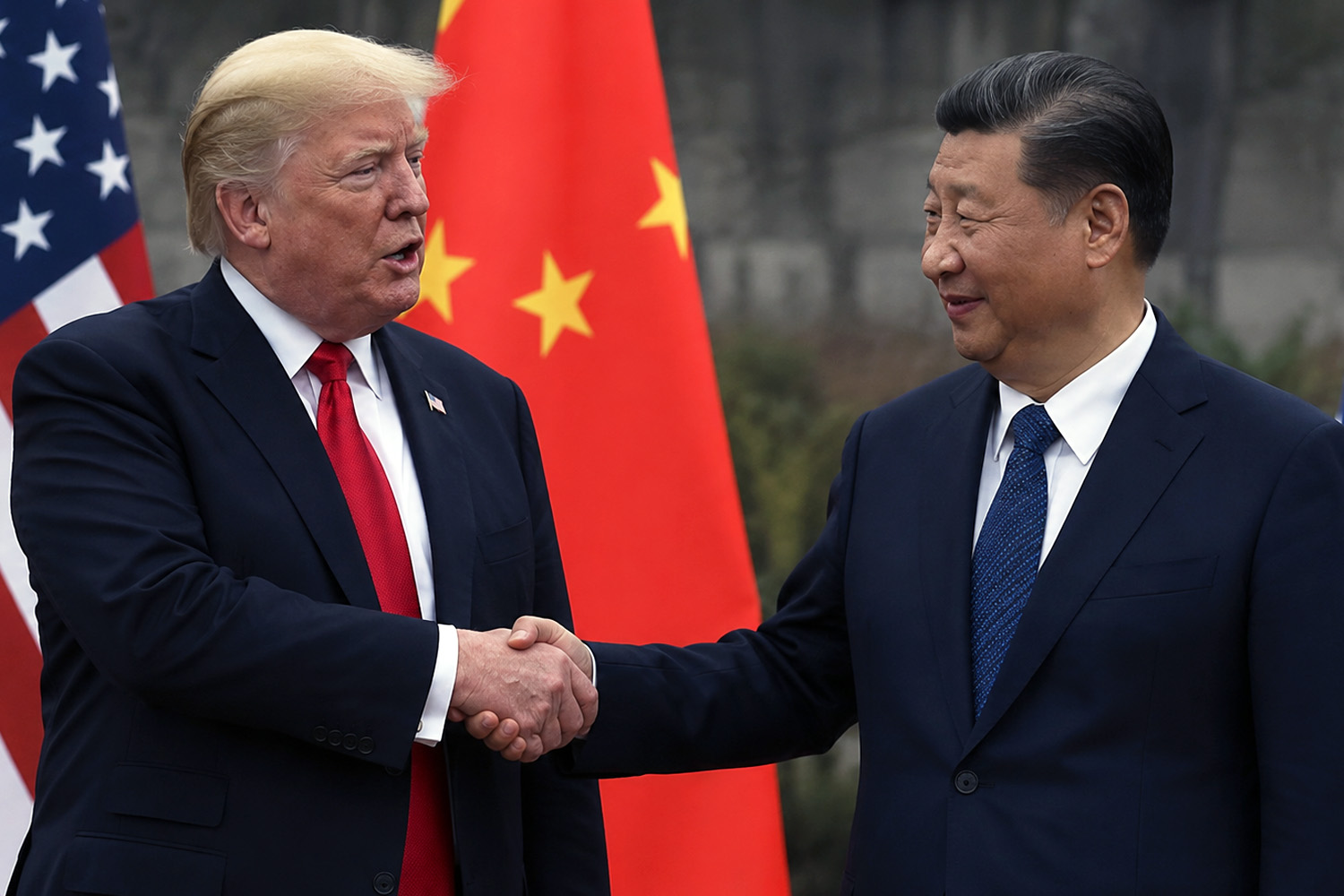
Trump’s China Visit and the Search for Controlled Competition
The latest meeting between U.S. President Donald Trump and Chinese President Xi Jinping reflects a broader transformation in global politics: the transition from economic globalization toward strategic competition managed through selective cooperation. While both governments publicly emphasized stability, investment, and dialogue, the summit revealed that the United States and China are no longer attempting to restore the deeply integrated relationship that defined the early 2000s. Instead, both powers appear to be building a framework for coexistence under conditions of persistent rivalry.
The significance of the visit lies less in symbolic diplomacy and more in what it reveals about the changing structure of the international system. The world’s two largest economies remain economically interdependent, yet increasingly distrustful in matters of technology, security, industrial policy, and geopolitical influence. The summit therefore represented an effort to prevent uncontrolled escalation rather than to achieve genuine strategic reconciliation.
This distinction matters for the global economy. Markets often respond positively to signs of diplomatic engagement between Washington and Beijing, particularly after years of tariffs, export restrictions, supply-chain disruptions, and political tensions. However, beneath the optics of cooperation, the structural drivers of rivalry remain largely unchanged.
Economic Stabilization Without Strategic Alignment
One of the most closely watched aspects of the summit was the renewed emphasis on economic cooperation. Chinese officials presented the meeting as evidence that Beijing remains open to international investment and engagement with American companies. During a reception with U.S. business leaders traveling alongside Trump, Xi Jinping stated that China’s doors would “open even wider” for American business.
This messaging reflects a broader challenge facing the Chinese economy. China continues to confront slowing growth, declining foreign investment inflows, pressure in the property sector, and concerns from international corporations about regulatory unpredictability and geopolitical risk. Re-engagement with American business therefore serves both economic and political purposes. Beijing wants to signal that despite strategic competition, China remains indispensable to global commerce.
From the American perspective, the summit also demonstrated a recognition that complete economic decoupling from China is neither realistic nor economically painless. Over the past several years, Washington has pursued selective de-risking rather than total separation. U.S. policy increasingly aims to reduce dependence in strategic sectors such as semiconductors, advanced manufacturing, artificial intelligence, and critical minerals, while preserving broader commercial ties where possible.
This context helps explain reports that U.S. Treasury Secretary Scott Bessent proposed creating an investment council designed to deepen economic engagement and improve communication between the two countries. The idea suggests that parts of the U.S. administration increasingly view institutional economic dialogue as necessary for managing competition and avoiding systemic shocks.
Importantly, such initiatives do not indicate a return to the era of unrestricted globalization. Instead, they reflect the emergence of what analysts increasingly describe as “guardrail diplomacy” – mechanisms intended to reduce the risk of crisis while accepting that strategic rivalry will continue.
Why the Global Economy Still Depends on U.S.–China Stability
The global economic implications of the summit are substantial because the United States and China remain central pillars of international trade, manufacturing, finance, and consumption. Even after years of tariffs and geopolitical tension, economic interdependence between the two countries remains deeply embedded in global supply chains.
A prolonged deterioration in relations would affect not only bilateral trade but also inflation, industrial production, energy markets, technological development, and financial stability worldwide. Multinational corporations continue to rely on Chinese manufacturing capacity while simultaneously depending on access to American financial systems and consumer markets.
For this reason, international markets often interpret diplomatic engagement between Washington and Beijing as a stabilizing signal. The summit may reduce immediate fears of sudden escalation, particularly in areas such as tariff expansion or large-scale financial restrictions. However, businesses and governments are increasingly adapting to a world in which geopolitical fragmentation is becoming structural rather than temporary.
This adaptation is already visible through supply-chain diversification strategies. Many corporations are expanding manufacturing operations into countries such as Vietnam, India, Mexico, and Indonesia in order to reduce exposure to geopolitical disruption. Governments are also pursuing industrial policies aimed at strengthening domestic production in strategic sectors.
As a result, the global economy is entering a more regionalized and politically managed phase. Trump’s visit may slow the pace of confrontation temporarily, but it is unlikely to reverse the broader trend toward strategic economic fragmentation.
Taiwan Remains the Central Strategic Fault Line
Despite the summit’s emphasis on economic engagement, security tensions continue to define the limits of U.S.–China stabilization efforts. The clearest example is Taiwan.
During discussions with Trump, Xi reportedly warned that conflict between the United States and China could emerge if the Taiwan issue is not properly managed. The statement underscored how central Taiwan has become to Beijing’s strategic thinking and national identity. For the Chinese leadership, Taiwan is not simply a regional dispute but a core sovereignty issue closely tied to domestic legitimacy and long-term geopolitical status.
For Washington, however, Taiwan occupies a different strategic role. The island is viewed as a key democratic partner, a critical node in the global semiconductor industry, and an important component of the U.S. security architecture in the Indo-Pacific region. As a result, the United States continues to deepen military and economic ties with Taipei while officially maintaining the long-standing “One China” policy framework.
The structural problem is that both governments increasingly perceive Taiwan through the lens of credibility and deterrence. Beijing fears permanent political separation backed by American power, while Washington fears that a successful coercive move against Taiwan would fundamentally reshape regional power balances in Asia.
This dynamic creates a paradox in U.S.–China relations. Economic cooperation may continue in selected areas, but strategic mistrust intensifies simultaneously. The result is a relationship characterized by coexistence without genuine confidence.
For global markets, Taiwan also represents an economic risk of extraordinary magnitude. The island plays a central role in advanced semiconductor manufacturing, meaning any military crisis would likely disrupt industries ranging from consumer electronics to automotive production and artificial intelligence infrastructure.
Consequently, the Taiwan issue acts as both a geopolitical and economic pressure point capable of overriding diplomatic stabilization efforts.
Institutional Competition and the Rise of Managed Rivalry
Another important implication of the summit concerns the changing behavior of state institutions. Both Washington and Beijing are increasingly constructing long-term policy frameworks based on the assumption of enduring competition.
In the United States, bipartisan political consensus around strategic rivalry with China has hardened significantly over the past decade. While tactics may vary between administrations, concerns over technology transfer, industrial dependence, cybersecurity, and military competition now shape policy across multiple institutions, including Congress, the Pentagon, and federal economic agencies.
China has undergone a parallel transformation. Beijing increasingly emphasizes economic self-sufficiency, technological independence, and national security integration across industrial policy. Under Xi Jinping, the Chinese political system has moved toward tighter state control over strategic sectors and greater centralization of decision-making.
This institutional evolution matters because it reduces the likelihood that short-term diplomatic improvements will fundamentally alter the trajectory of competition. Even when leaders seek temporary stabilization, bureaucratic systems, national security priorities, and domestic political incentives continue pushing both countries toward strategic caution.
The summit therefore illustrates a broader global transition: major powers are increasingly balancing economic openness with national security considerations. This shift is reshaping international trade rules, investment screening mechanisms, technology partnerships, and global governance institutions.
Xi’s Planned U.S. Visit and the Politics of Symbolic Engagement
Reports that Xi Jinping plans to visit the United States in the fall further reinforce the importance both governments place on maintaining communication channels. High-level diplomacy now serves a dual purpose: reducing immediate tensions while signaling to domestic and international audiences that competition remains manageable.
For Beijing, engagement with Washington helps reassure investors and trading partners concerned about instability. For the United States, continued dialogue demonstrates an effort to manage geopolitical risk without abandoning strategic objectives.
However, symbolism should not be confused with strategic convergence. Diplomatic summits can lower tensions temporarily, but they cannot easily resolve the deeper structural issues driving rivalry. Trade imbalances, technological competition, military positioning in Asia, and ideological differences regarding governance models remain unresolved.
As a result, future engagement between Trump and Xi is likely to focus less on partnership and more on crisis management.
Conclusion
Trump’s visit to China does not signal the beginning of a new era of U.S.–China partnership. Instead, it reflects a growing recognition on both sides that unmanaged confrontation between the world’s two largest economies would carry enormous political and economic costs.
The summit demonstrated that Washington and Beijing still possess strong incentives to preserve economic communication, encourage investment, and avoid destabilizing escalation. Proposals such as an investment council and Xi’s outreach to American business leaders suggest both governments are searching for mechanisms capable of stabilizing relations under increasingly difficult conditions.
At the same time, the meeting also exposed the limits of that stabilization. Taiwan remains a profound strategic fault line, institutional distrust continues to deepen, and economic competition increasingly overlaps with national security priorities.
The most likely outcome is neither a renewed Cold War-style separation nor a return to the globalization model of previous decades. Instead, the international system appears to be moving toward a prolonged period of managed rivalry – a condition in which cooperation and confrontation coexist simultaneously.
For the global economy, this means uncertainty will remain structural rather than temporary. Businesses, governments, and international institutions are no longer preparing for a brief diplomatic dispute between Washington and Beijing. They are adapting to a world in which strategic competition between the United States and China has become a defining feature of the international order itself.