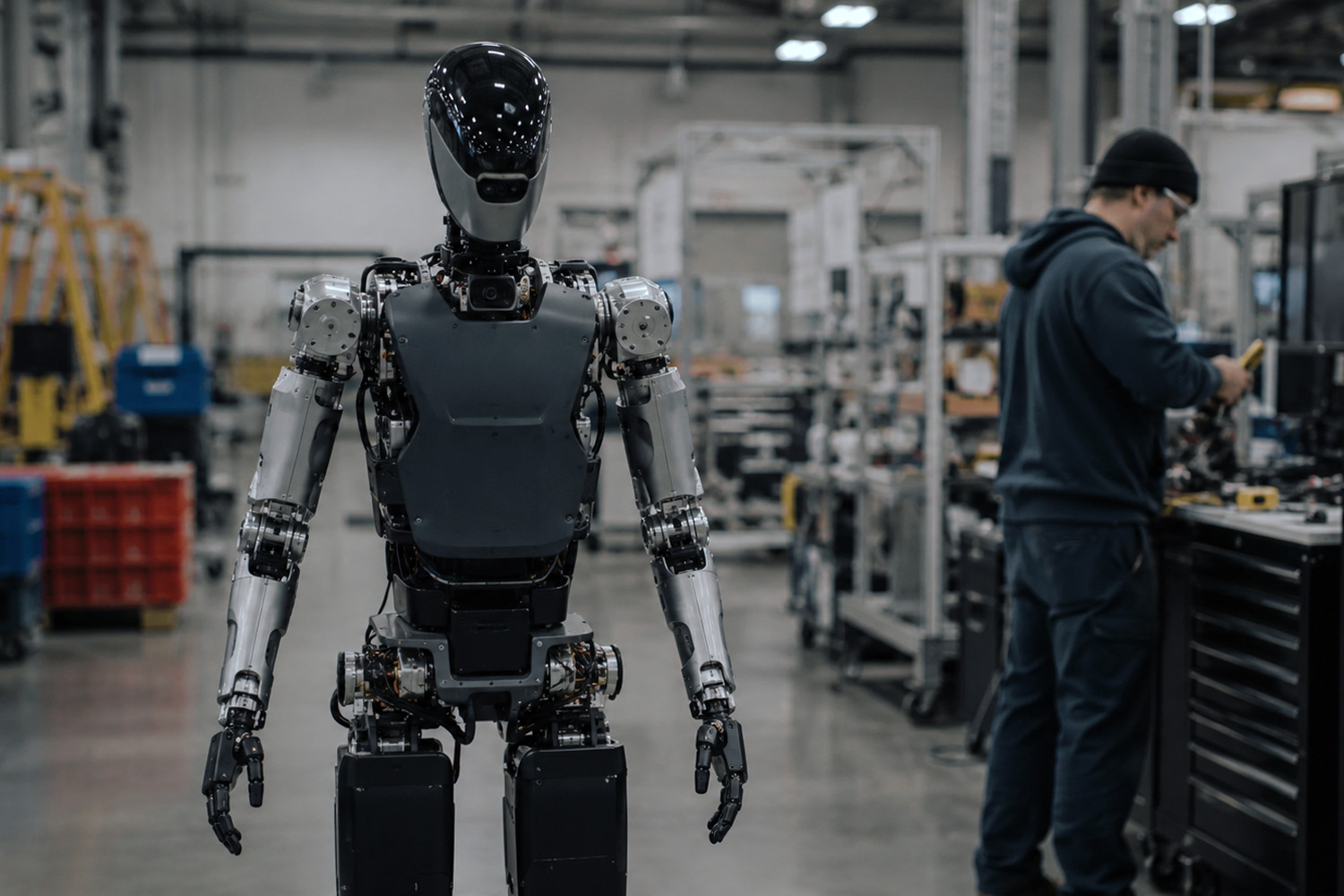
Introduction: Why Humanoid Robots Matter Now
For decades, humanoid robots occupied an uncertain space between engineering ambition and science fiction. Technological demonstrations periodically generated excitement, yet most systems remained expensive, fragile, energy inefficient, and poorly suited for practical work.
That situation is beginning to change-not because robots suddenly became intelligent enough to replace humans, but because several structural conditions have shifted simultaneously.
Artificial intelligence systems have become better at perception and navigation. Industrial labor shortages are intensifying across major economies. Military institutions increasingly seek technologies capable of operating in dangerous environments. Meanwhile, advances in batteries, sensors, electric motors, and machine learning have reduced some of the technical barriers that previously made humanoid systems commercially impractical.
As a result, humanoid robots are moving from experimental prototypes into pilot deployment.
Yet the central political and societal question is not whether humanoid robots will exist. They already do.
The more important question is this:
Why are governments, corporations, and military institutions investing in humanoid robots now despite major technical limitations-and what does that reveal about the future of labor, governance, and geopolitical power?
The answer lies not in futuristic predictions, but in observable economic and institutional realities.
The Economics Behind the Humanoid Push
Humanoid robotics is accelerating because of economics before technology.
For decades, automation succeeded primarily in structured environments: factory assembly lines, warehouses, semiconductor plants, and logistics hubs. Industrial robots excelled at repetitive tasks performed under predictable conditions.
Humans remained dominant in environments requiring mobility, adaptation, or flexible movement.
Warehouses, construction sites, military logistics chains, hospitals, transportation hubs, and industrial inspection environments still depend heavily on human labor because the physical world is chaotic.
This creates an expensive problem.
Across the United States, Europe, China, Japan, and South Korea, demographic aging is tightening labor markets. Manufacturing, logistics, warehousing, and industrial maintenance increasingly face labor shortages, especially in physically demanding occupations.
Humanoid robots are attracting investment because they could theoretically operate inside environments already designed for human bodies.
This matters.
Traditional automation often requires redesigning infrastructure around machines. Humanoid systems instead attempt to adapt machines to existing infrastructure: stairs, ladders, doors, tools, vehicles, warehouses, and factories.
Economically, this could dramatically reduce transition costs.
The key word, however, is could.
The economics remain uncertain because current humanoid systems are still expensive, power constrained, and operationally limited.
A useful comparison is industrial robotics.
Factories adopted robotic arms not because they resembled humans but because they achieved measurable productivity gains.
Humanoid robots will face the same requirement.
Mass deployment will depend less on technological spectacle and more on a simple calculation:
Can a robot perform useful labor more cheaply, safely, and reliably than a human worker?
At present, that answer remains highly conditional.
Why Defense Institutions Are Investing
Military interest in humanoid robotics reflects a broader transformation in modern warfare and defense logistics.
Contrary to popular assumptions, defense agencies are not primarily funding humanoid systems for autonomous combat.
Instead, current investments focus on predictable operational areas:
- logistics,
- transportation,
- inspection,
- hazardous environment operations,
- maintenance,
- material handling,
- disaster response.
This distinction matters.
Modern militaries increasingly face recruitment pressures, rising operational costs, and growing exposure to hazardous environments. Robots capable of transporting supplies, inspecting damaged infrastructure, operating in contaminated areas, or reducing soldier exposure offer strategic value even if they remain far from autonomous battlefield decision-making.
The case of startups such as Foundation Future Industries reflects this institutional trend.
Pilot demonstrations and defense contracts indicate growing military willingness to experiment with humanoid systems for logistics and operational support. However, publicly available evidence also shows clear limitations: current prototypes remain constrained by energy efficiency, carrying capacity, mobility reliability, and operational endurance.
This reveals an important reality often lost in public discussion.
Military institutions are investing not because humanoid robots are fully ready, but because defense procurement operates according to long timelines.
Governments fund technologies years before large-scale deployment becomes feasible.
The logic resembles earlier investments in drones, satellite systems, and cyber capabilities.
Experimental technologies often begin with narrow operational functions before gradually expanding into broader strategic roles.
China’s Manufacturing Advantage Could Decide the Industry
Much public discussion focuses on companies such as Tesla, Figure, or American robotics startups.
Yet the structural center of humanoid robotics may increasingly lie elsewhere.
China currently possesses significant advantages in industrial manufacturing, supply chains, and production scaling.
This matters more than prototypes.
Humanoid robots require complex ecosystems of:
- batteries,
- electric motors,
- precision actuators,
- sensors,
- semiconductors,
- machine vision systems,
- rare earth materials,
- manufacturing integration.
China dominates or strongly influences many of these supply chains.
Companies such as Unitree have demonstrated rapid iteration cycles and increasingly competitive pricing models, benefiting from broader industrial ecosystems already optimized for large-scale manufacturing.
Tesla remains influential because of its expertise in batteries, AI systems, electric motors, and vertically integrated production. Elon Musk’s public ambition to deploy large numbers of Optimus robots signals how seriously major firms view embodied AI.
However, corporate targets should not be mistaken for proven outcomes.
Manufacturing millions of reliable humanoid systems remains an immense engineering challenge.
History repeatedly shows that robotics progress is often slower than executive forecasts suggest.
Still, the broader geopolitical implication remains significant:
the future of humanoid robotics may depend less on who invents the best prototype and more on who can manufacture at industrial scale.
This resembles earlier competition in solar panels, electric vehicles, and batteries.
Innovation matters.
Production capacity matters more.
Amazon and the Platform Logic of Automation
Amazon’s acquisition of humanoid robotics startups reflects another important structural force: platform economics.
Large corporations increasingly view robotics not as standalone products but as extensions of logistics systems.
Amazon’s business model depends heavily on warehousing efficiency, labor optimization, delivery speed, and operational continuity.
Humanoid robots potentially address persistent bottlenecks:
- repetitive warehouse movement,
- material transport,
- inventory handling,
- physical inspection tasks.
But Amazon’s strategy also reveals something broader.
The future of robotics may increasingly be controlled by companies already dominant in cloud computing, AI infrastructure, logistics, and data systems.
This creates concentration risks.
Building advanced robotics requires enormous capital expenditure, access to computing infrastructure, proprietary training data, and large operational environments for testing.
Smaller competitors may struggle to compete.
As robotics converges with AI, platform concentration could intensify rather than weaken.
The companies controlling data, infrastructure, and industrial ecosystems may also control automation itself.
This raises future governance questions regarding labor markets, competition policy, and economic inequality.
What Humanoid Robots Still Cannot Do
Public discourse around humanoid robots often swings between hype and fear.
Reality remains more constrained.
Despite visible progress, current systems still struggle with several difficult technical problems.
Energy efficiency
Battery limitations remain severe.
Many humanoid systems cannot operate continuously for long durations without recharging. Industrial usefulness depends heavily on endurance.
Dexterity
Human hands remain extraordinarily difficult to replicate.
Fine motor skills, manipulation of irregular objects, and adaptive movement remain major engineering bottlenecks.
Reliability
Factories demand predictable performance.
A robot that fails unpredictably creates operational risk.
Maintenance costs remain substantial.
Unstructured environments
Humans navigate uncertainty exceptionally well.
Construction sites, disaster zones, warehouses, and military environments constantly change.
Robots still struggle with unpredictable conditions.
For this reason, many near-term deployments will likely involve supervised autonomy rather than full independence.
Human oversight will remain essential.
This distinction matters politically because fears of rapid labor replacement often overestimate actual technological readiness.
Labor, Society, and Public Trust
The social consequences of humanoid robotics are likely to be uneven.
History suggests automation rarely eliminates labor altogether.
Instead, it reorganizes labor.
The occupations most exposed are not necessarily those requiring intelligence but those involving repetitive physical tasks under standardized conditions.
Warehouse operations, industrial transport, inspection work, and some logistics functions may experience gradual automation pressure.
At the same time, new technical roles emerge:
- robot maintenance,
- systems supervision,
- software integration,
- safety compliance,
- robotics operations management.
Public acceptance will depend heavily on trust.
Societies tend to accept automation when framed around dangerous, repetitive, or physically harmful tasks.
Resistance increases when automation appears economically extractive or socially destabilizing.
Governments may therefore face increasing pressure to regulate workplace transitions, worker retraining, liability standards, and labor protections.
The political debate surrounding automation is unlikely to center on robots themselves.
It will center on whether institutions manage economic disruption fairly.
Conclusion: Humanoid Robots Are Becoming a Power Question
The future of humanoid robots is not primarily a technological story.
It is a story about institutions.
Corporations pursue robots because labor costs and productivity pressures create incentives.
Governments invest because geopolitical competition increasingly rewards automation and industrial resilience.
Militaries experiment because reducing human exposure carries operational value.
The deeper societal issue is therefore not whether robots will eventually become capable.
The evidence suggests gradual deployment is already underway.
The more important question is who controls the infrastructure of automation, who benefits economically, and how governments respond to the redistribution of labor and power.
Humanoid robots may ultimately reshape industry and defense less through dramatic breakthroughs than through steady integration into systems already under strain.
Their future will likely be decided not by science fiction ambitions, but by economics, governance, and geopolitical competition.