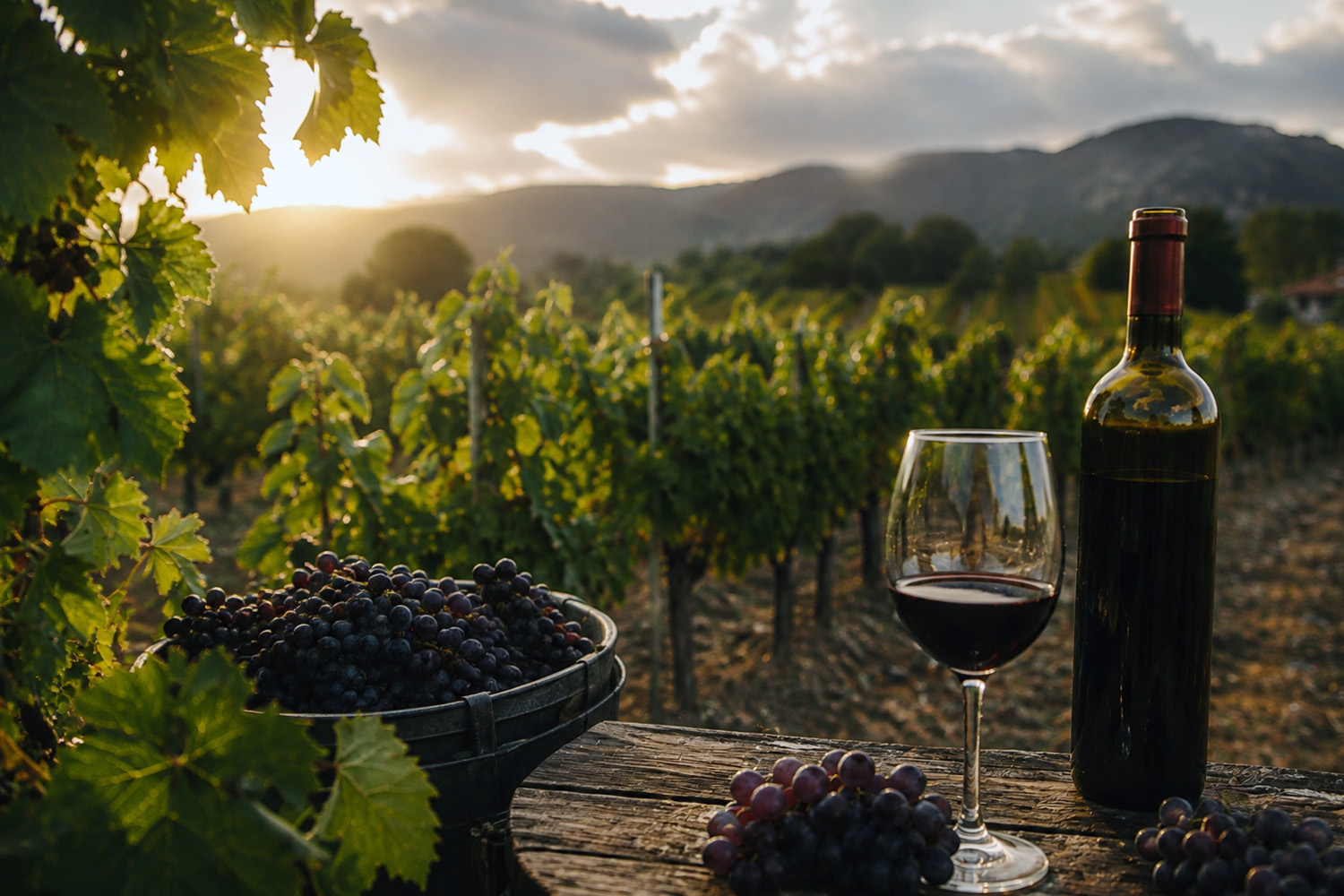
The global wine industry is entering a period of structural adjustment. While wine production has historically been defined by geography, tradition, and vineyard heritage, the industry is increasingly being shaped by measurable economic forces: declining consumption in mature markets, climate-driven supply volatility, rising production costs, and a shift from volume competition toward higher-value segments.
According to the International Organisation of Vine and Wine (OIV), global wine production in 2025 is estimated at 227 million hectoliters, representing a slight recovery from the historically low level recorded in 2024. However, output remains among the weakest levels of recent decades, highlighting a fundamental change in the economics of wine production.
The decline is not caused by a single factor. Instead, it reflects a combination of lower vineyard yields, extreme weather events, changing consumer behavior, and strategic decisions by producers to reduce supply in markets facing weaker demand.
The result is a more competitive industry where production volume alone no longer determines success.
The World’s Largest Wine Producers in 2025
Global wine production remains concentrated among a relatively small number of countries. The top producers account for the majority of global output, but their competitive positions are changing as climate conditions and market demand reshape the industry.
| Rank | Country | 2025 Production (million hectoliters) | Approximate Global Share |
|---|---|---|---|
| 1 | Italy | 47.4 | 21% |
| 2 | France | 35.9 | 16% |
| 3 | Spain | 29.4 | 13% |
| 4 | United States | 21.7 | 10% |
| 5 | Australia | 11.6 | 5% |
| 6 | Argentina | 10.7 | 5% |
| 7 | Chile | 10.0 | 4% |
| 8 | South Africa | 9.2 | 4% |
| 9 | Germany | 7.3 | 3% |
| 10 | Portugal | 6.2 | 3% |
Italy, France, and Spain remain the dominant producers, collectively accounting for more than half of global wine output. However, production leadership increasingly reflects different business strategies.
Italy’s advantage comes from scale and regional diversity. France’s strength comes from brand value and premium positioning. Spain benefits from large vineyard capacity and export competitiveness.
These differences are becoming increasingly important because the future of the wine industry will depend less on producing the largest quantity and more on producing profitably.
Europe Still Dominates Production, but Its Competitive Advantage Is Under Pressure
The European Union remains the center of global wine production, accounting for approximately 136 million hectoliters in 2025, or around 60% of worldwide output.
However, this dominance hides significant challenges.
European production in 2025 is estimated to be 1.3% lower than in 2024, continuing a broader downward trend caused by climate instability and market adjustments.
The three largest European producers illustrate the changing landscape.
Italy: The Scale Leader
Italy remains the world’s largest wine producer with approximately 47.4 million hectoliters of output in 2025.
Its production model is supported by geographic diversity, with vineyards spread across multiple climate zones. This reduces dependence on a single growing region and provides some protection against localized weather problems.
However, Italy’s challenge is not simply maintaining production volume. The larger issue is profitability.
The global wine market has become more competitive, and producers must balance output with demand. Excess production can reduce prices and increase inventory costs, forcing companies to focus more on supply management.
Some Italian wine regions have already adjusted production levels to avoid market oversupply, demonstrating a broader industry shift from maximizing volume toward protecting margins.
France: Lower Volume, Higher Value Strategy
France remains the second-largest wine producer, with estimated production of 35.9 million hectoliters in 2025.
Unlike many producers, France competes heavily through brand strength and premium pricing. French wine exports benefit from strong international recognition, particularly in luxury and high-end categories.
However, production has fallen significantly below historical levels.
The decline is linked to several factors:
- unfavorable weather conditions;
- vineyard restructuring programs;
- reduced production in some regions;
- changing consumption patterns.
France demonstrates an important industry trend: lower production does not automatically mean weaker competitiveness.
A producer with strong pricing power can sometimes benefit from controlled supply, especially when scarcity supports higher-value products.
Spain: Large Production Base Facing Climate Pressure
Spain ranks third globally with approximately 29.4 million hectoliters of production.
The country has one of the world’s largest vineyard areas, giving it significant production potential. However, climate conditions have become a major limiting factor.
Spain’s 2025 production remains around 17% below its five-year average, largely due to drought and heat-related effects.
The impact has been especially significant in Castilla-La Mancha, one of Spain’s largest wine-producing regions.
Spain’s challenge is balancing its historical advantage in production capacity with the need to adapt vineyards to changing environmental conditions.
Climate Risk Is Becoming a Business Cost
Climate change is no longer only an agricultural issue for wine producers. It is becoming a direct factor affecting costs, investment decisions, and competitive positioning.
Wine production depends heavily on predictable seasonal conditions. Temperature changes, drought, heavy rainfall, and disease outbreaks can influence both quantity and quality.
The financial impact appears in several areas:
- lower vineyard yields;
- higher irrigation costs;
- increased investment in technology;
- changing grape varieties;
- relocation decisions.
For large producers, this means climate adaptation is becoming part of capital strategy.
Companies must decide whether to invest in existing vineyards, change production methods, or reduce exposure to vulnerable regions.
The winners will likely be producers that can combine agricultural expertise with financial flexibility.
The Industry Is Moving From Volume Competition to Value Competition
For much of the twentieth century, wine producers competed primarily through production capacity. Larger vineyards and higher output created economies of scale.
That model is becoming less effective.
Global wine consumption has weakened in many traditional markets, creating pressure on producers dependent on large volumes.
Consumers are increasingly shifting toward:
- premium wines;
- regional identity;
- quality-focused products;
- differentiated experiences.
This creates an advantage for companies with strong brands and pricing power.
A producer selling a premium bottle has more ability to absorb rising costs than a producer competing mainly on volume.
The economic divide between premium and commodity producers is therefore becoming wider.
New World Producers Expand Their Strategic Role
Outside Europe, several producers have developed highly competitive export-focused business models.
United States
The United States produces approximately 21.7 million hectoliters, making it the largest non-European wine producer.
The country’s industry combines large-scale production with strong premium brands, particularly from California.
However, US producers also face challenges from climate risks, especially drought and wildfire exposure in major wine regions.
Australia
Australia produces around 11.6 million hectoliters and has built a strong international export presence.
Its industry has historically relied heavily on global markets, making exchange rates and trade conditions important competitive factors.
Argentina and Chile
Argentina and Chile produce approximately 10.7 million and 10 million hectoliters respectively.
Both countries benefit from export-oriented production models and strong positioning in international markets.
Chile, in particular, has developed competitiveness through production efficiency and global distribution networks.
However, Southern Hemisphere producers remain exposed to global demand cycles because exports represent a critical part of their business models.
Who Wins and Who Loses in the New Wine Economy?
The changing structure of the wine industry creates clear competitive advantages.
Likely winners:
Premium producers
Companies with recognized brands and strong consumer loyalty can maintain higher prices.
Climate-adaptive producers
Businesses investing in technology, vineyard management, and resilient production methods will have advantages.
Efficient exporters
Countries with modern production systems and strong international distribution networks can gain market share.
Under pressure:
Commodity wine producers
Companies competing mainly on low prices face declining margins.
High-cost producers without differentiation
Without strong brands, rising costs become difficult to absorb.
Regions dependent on traditional conditions
Areas unable to adapt to changing climate conditions may face declining competitiveness.
Long-Term Outlook: A Smaller but More Strategic Industry
The global wine industry is unlikely to return to previous production levels without significant structural changes.
The combination of weaker consumption growth, climate volatility, and changing consumer preferences suggests that future competition will focus on efficiency and value creation rather than simply increasing output.
Production rankings will remain important, but they will not fully determine economic success.
Italy, France, Spain, the United States, and other major producers will increasingly compete through different strategies:
- controlling supply;
- protecting margins;
- strengthening brands;
- investing in climate resilience;
- targeting higher-value consumers.
The wine industry is becoming a more disciplined business sector. Production remains essential, but the ability to manage risk and capture value will determine which producers succeed.
Conclusion: The Future Belongs to Adaptable Producers
The 2025 global wine production figures reveal a market undergoing structural change.
Italy remains the world’s largest producer, France retains its premium position, and Spain maintains its enormous production base. But behind the rankings, a deeper transformation is taking place.
Climate pressure, weaker consumption trends, and rising costs are forcing producers to rethink traditional strategies.
The next phase of the wine industry will not be defined only by who produces the most wine. It will be defined by who can produce efficiently, adapt quickly, and maintain economic value in a changing global market.