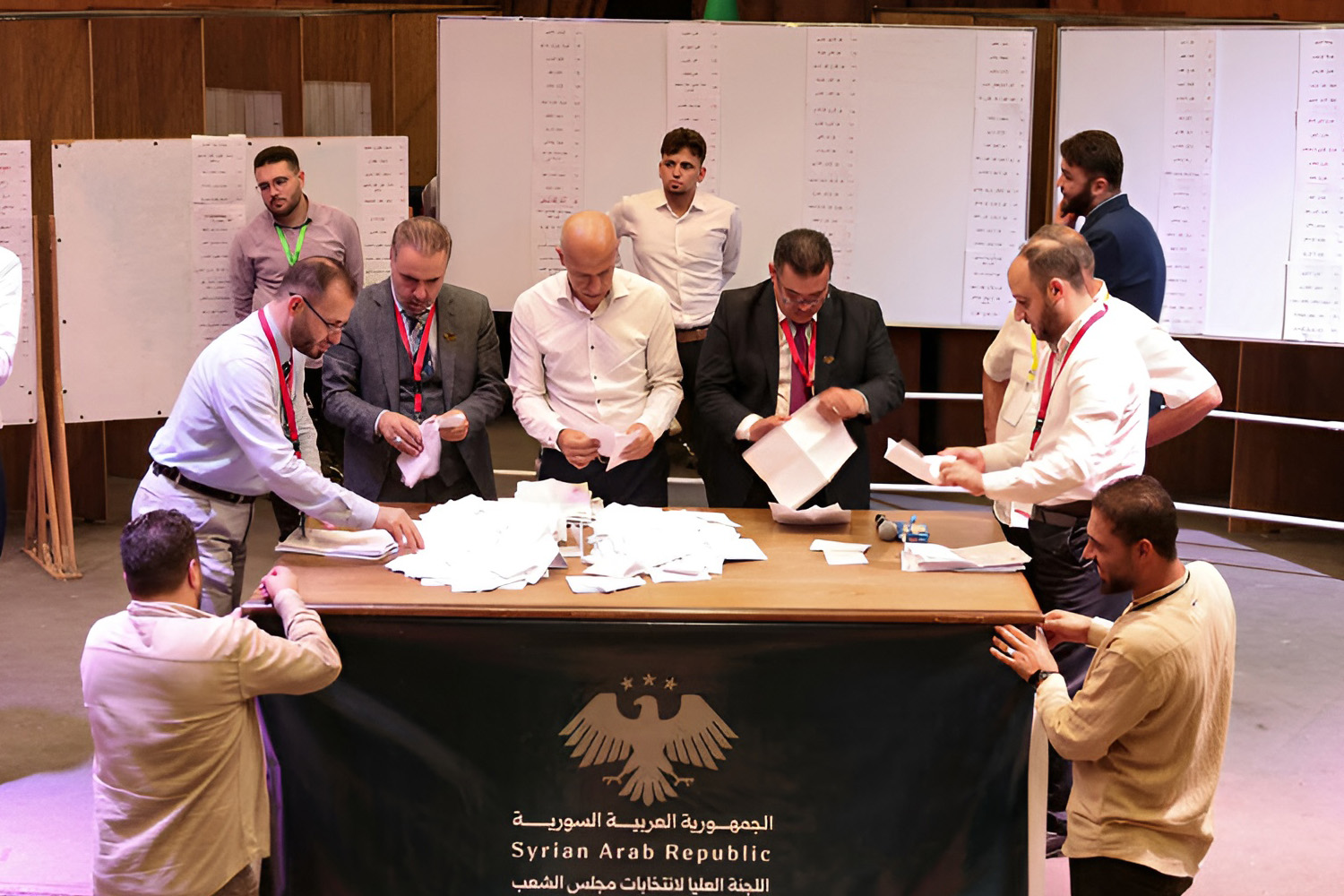
On 5 October 2025, Syria held its first parliamentary elections since longtime leader Bashar al-Assad was ousted in December 2024. These elections mark a major step in the country’s fragile political transition under interim President Ahmed al-Sharaa, whose interim government is faced with rebuilding state institutions after years of civil war and widespread displacement.
Election Structure & Process
- The newly formed People’s Assembly is composed of 210 seats. Two-thirds of these (140 seats) were to be chosen via provincial electoral colleges; the remaining one-third (70 seats) will be directly appointed by President Ahmed al-Sharaa.
- Due to ongoing displacement, incomplete population data, and control issues in certain areas, the vote was not a fully direct popular election. Millions of Syrians were displaced both internally and across borders, complicating registration and access.
- In some governorates and regions-such as Sweida province and areas controlled by the Kurdish-led Syrian Democratic Forces-elections were postponed, leaving certain seats vacant. Official reasons given included security concerns, displacement, and absence of reliable population data.
Representation, Inclusivity & Criticisms
- Preliminary results show low representation for women and minority groups. Only a small number of seats were won by women and by members of religious or ethnic minorities-including Christians, Kurds, Alawites, Turkmen, and others. Critics argue that the system and candidate criteria did not sufficiently enable broad participation.
- The absence of political parties: After the fall of Assad’s regime, existing parties connected to that regime were dissolved. Under the current electoral framework, no legal mechanism exists yet for registering new parties; all candidates run as independents.
- President al-Sharaa’s appointments of one-third of the assembly raise concerns about centralization of power and the ability of the interim government to influence legislative outcomes.
Political Situation & Implications
- Transition and Legal Framework: The new parliament has been tasked with passing a new electoral law and a new constitution during its roughly 30-month term, as part of Syria’s post-Assad restructuring.
- President al-Sharaa has stated that full presidential elections are expected in roughly 4-5 years, contingent upon restoring infrastructure, rebuilding civil registration systems and addressing displacement.
- Regions outside government control and those with heavy displacement remain a major part of the political challenge. The postponed elections in those areas highlight fractures in national governance and raise questions about the legitimacy and inclusivity of the transition.
What to Watch Going Forward
- How many of the vacant seats (postponed due to territorial control or displacement) will be filled, and under what conditions.
- Whether the upcoming constitution and new electoral law uphold protections for minorities, extend voting rights, and enable direct popular votes in future elections.
- The balance between appointed and elected representatives, and how much influence the President will retain via appointments or control over electoral bodies.
- Real progress on security, reconciliation, and transitional justice, especially in areas that suffered sectarian conflict or mass displacement.
- How the international community responds: recognition of the new assembly’s legitimacy, support for rebuilding efforts, and monitoring of human rights and inclusion.
The 2025 parliamentary election in Syria represents a cautious yet significant move toward political transformation after decades of authoritarian rule and civil war. While many Syrians see it as hopeful progress, critics and observers warn that its indirect structure, limited inclusivity, and ongoing instability pose serious risks to genuine democratic change.