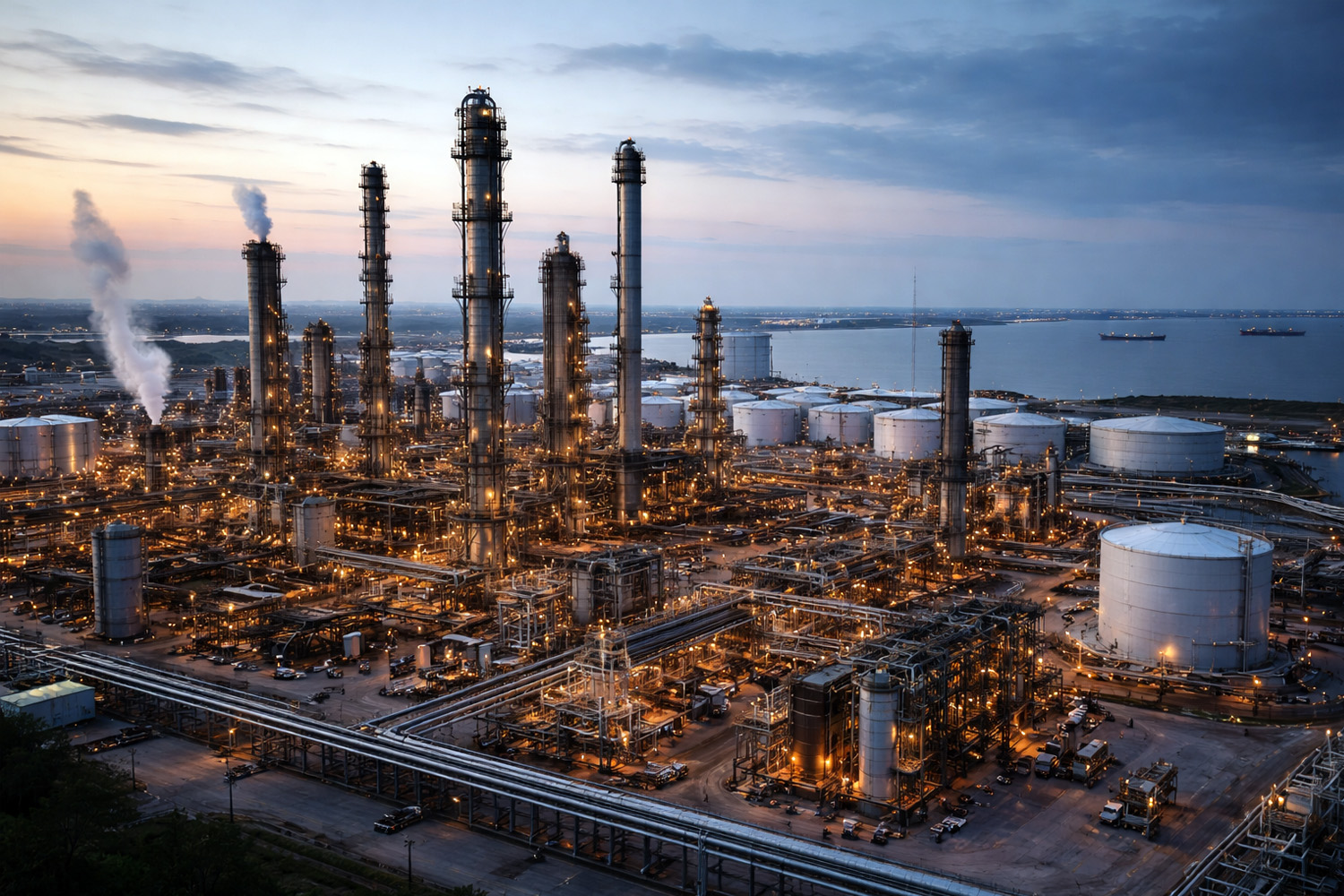
The announcement by Donald Trump that a new oil refinery will be built in the United States with backing from Reliance Industries has drawn global attention not only because of its scale but also because of its symbolic timing. The project, expected to be located at the Port of Brownsville in Texas and developed by the company America First Refining, would represent the first new major oil refinery built in the United States in roughly half a century.
Although Trump described the initiative as a “historic $300 billion deal,” industry reports indicate that the figure reflects the long-term economic value and output associated with the project rather than the direct construction cost, which has previously been estimated at several billion dollars.
Beyond the headline numbers, the project reveals several deeper trends shaping the global energy system: the restructuring of refinery capacity, the growing strategic alignment between the United States and India, and the continued relevance of oil infrastructure even as energy transitions accelerate.
A Structural Gap in the U.S. Refining System
One of the most significant aspects of the project is its technological orientation. The refinery is designed to process primarily American light shale oil – a type of crude that has become abundant in the United States due to the shale revolution.
Historically, much of the U.S. refining system was configured to handle heavier imported crude oils from regions such as the Middle East and Latin America. As domestic shale production surged over the past decade, this mismatch created logistical and economic inefficiencies.
A refinery specifically optimized for shale oil addresses that structural gap. Instead of exporting large volumes of crude and re-importing refined products, the United States could increasingly process its own resources domestically. From an energy policy perspective, this strengthens the long-standing American objective of energy security and export competitiveness.
The location of the facility at the Gulf Coast further reinforces this logic. The region already serves as one of the world’s largest refining and petrochemical hubs, with extensive shipping infrastructure linking North American production to global fuel markets.
Why Foreign Capital Is Entering U.S. Energy Infrastructure
Another notable dimension of the project is the role of Reliance Industries, India’s largest private-sector conglomerate and operator of the world’s largest refining complex in Jamnagar.
The involvement of an Indian energy giant in a U.S. refinery reflects a broader trend in global energy investment: cross-border infrastructure partnerships.
For Reliance, the logic is strategic. The company has long sought to expand its downstream and trading presence globally. Participation in a refinery linked to U.S. shale production would provide access to one of the most stable and scalable crude supplies in the world.
For the United States, foreign capital helps accelerate infrastructure projects that have historically faced high regulatory, financial, and environmental barriers. Building new refineries in the U.S. has been rare for decades partly because of high costs, permitting complexity, and uncertain long-term demand.
The partnership therefore reflects mutual economic incentives rather than purely political symbolism.
Energy Geopolitics and the Timing of the Project
The refinery announcement also comes during a period of heightened volatility in global oil markets. Tensions in the Middle East and fluctuations in supply chains have periodically pushed fuel prices upward, reinforcing concerns about the resilience of global energy infrastructure.
In this context, expanding refining capacity is not merely an industrial decision – it is a geopolitical one. Countries with large refining capabilities have greater flexibility to manage supply disruptions, influence regional fuel markets, and expand exports.
For the United States, strengthening refining capacity supports its role as one of the world’s largest exporters of petroleum products. Over the past decade, the country has shifted from being a major importer of energy to a dominant producer and exporter.
A new refinery aligned with shale production would reinforce that trajectory.
The U.S.–India Energy Axis
Equally important is the geopolitical signal embedded in the partnership between American energy infrastructure and an Indian conglomerate.
The energy relationship between the United States and India has deepened significantly in recent years, particularly after Washington became a major supplier of crude oil and liquefied natural gas to India. Investments flowing in the opposite direction – from India into U.S. infrastructure – represent the next stage of this alignment.
Such cooperation reflects broader economic ties between the two countries, which increasingly view energy trade and technology exchange as part of their strategic partnership.
In this sense, the refinery is not only an industrial project but also a symbol of a strengthening transnational energy corridor linking North American production with Asian demand.
What It Means for Global Energy Trends
Despite rapid investment in renewable energy, projects like this illustrate an enduring reality: global oil demand remains structurally embedded in transportation, petrochemicals, and industrial supply chains.
New refining capacity signals that energy companies still expect long-term demand for refined fuels, even as the energy transition progresses. Rather than disappearing, the oil sector is evolving toward higher efficiency, specialized processing, and integration with global trade networks.
If completed, the Brownsville refinery would therefore represent more than a single industrial facility. It would illustrate how the next phase of the oil industry is likely to unfold – through strategic infrastructure investments, cross-border partnerships, and technological adaptation to new crude supply patterns.
In that sense, the significance of the Trump-Reliance announcement lies less in the immediate project details and more in what it reveals about the future structure of the global energy system.
Related Analysis:
Energy Markets After 2025: Oil Prices, Supply And OPEC+ in 2026
Global Gasoline Prices in 2025: From Cheapest to Most Expensive