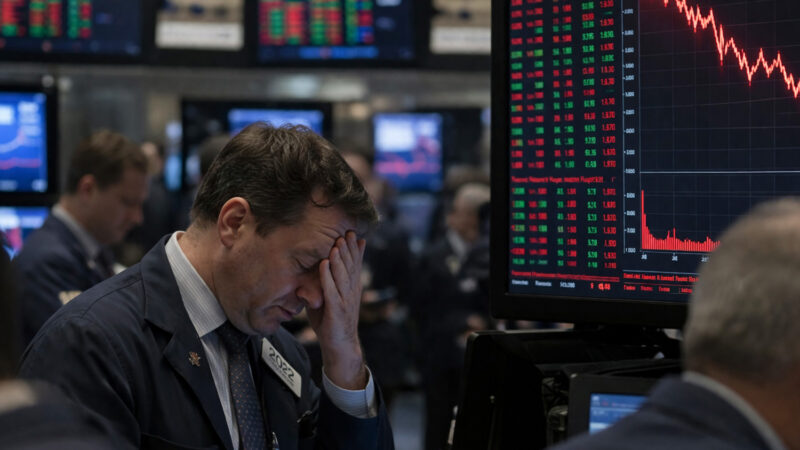
The start of the trading week on U.S. financial markets is marked by a sharp deterioration in investor sentiment. In pre-market trading, futures tied to the Nasdaq index declined by roughly 1.5%, while contracts linked to the S&P 500 and Dow Jones Industrial Average were down about 1.3%. The movement reflects a broad shift toward risk aversion among global investors rather than a single isolated market event.
The decline comes after several weeks of rising volatility across global financial markets, driven primarily by geopolitical tensions and the resulting shock in energy markets. At the center of the current sell-off is the rapid increase in crude oil prices following escalating conflict in the Middle East, which has heightened concerns about supply disruptions and inflationary pressures worldwide.
However, the significance of the current market decline extends beyond the daily fluctuations of major U.S. indices. The movement reflects a broader structural shift in investor expectations regarding inflation, economic growth, and monetary policy.
Oil Shock and the Return of Inflation Risk
The immediate catalyst behind the decline in U.S. equity futures is the surge in crude oil prices, which briefly approached levels near $120 per barrel-its highest level since the energy shocks of the early 2020s.
The rise in energy prices has been driven by fears of disruption in the Strait of Hormuz, one of the most critical shipping routes in global energy supply chains, through which roughly one-fifth of the world’s oil consumption passes.
For financial markets, energy shocks carry implications far beyond the commodities sector. Rising oil prices act as a systemic cost increase across the global economy: transportation, manufacturing, logistics, and consumer goods production all become more expensive. This dynamic can push inflation higher while simultaneously slowing economic growth-a combination that economists describe as stagflation.
The possibility of stagflation is particularly sensitive for financial markets because it limits the flexibility of central banks. If inflation rises again due to energy prices, monetary authorities may find it difficult to lower interest rates to support economic growth.
Federal Reserve Expectations and Market Repricing
Another factor influencing the current market decline is the reassessment of expectations surrounding U.S. monetary policy. Over the past year, markets had increasingly priced in the possibility of interest rate cuts as inflation gradually moderated.
However, the recent surge in oil prices and the reappearance of inflation risks have forced investors to reconsider that outlook. Market participants are now adjusting expectations regarding the timing and scale of potential interest-rate reductions by the Federal Reserve.
This shift in expectations tends to affect technology stocks particularly strongly. Growth-oriented companies-many of which dominate the Nasdaq index-are more sensitive to changes in interest rates because their valuations depend heavily on future earnings projections. As a result, when borrowing costs are expected to remain higher for longer, these companies often experience larger market corrections.
This dynamic helps explain why Nasdaq futures are currently leading the decline among major U.S. indices.
Market Volatility and Sector Rotation
Periods of heightened geopolitical uncertainty often trigger a rotation of capital across sectors rather than a uniform market collapse. Current trading patterns suggest that investors are moving funds away from sectors sensitive to economic growth-such as airlines, travel companies, and financial institutions-and toward industries that may benefit from geopolitical tensions.
Energy companies, for example, tend to outperform during oil price spikes, while defense-related stocks often gain attention when geopolitical risks intensify. At the same time, traditional safe-haven assets such as the U.S. dollar and government bonds typically see increased demand.
Financial volatility indicators have also begun to rise, reflecting a growing demand for hedging against further market declines. Elevated volatility levels generally indicate that institutional investors expect continued uncertainty rather than a short-lived market reaction.
Global Market Implications
The significance of the current decline on Wall Street extends far beyond the United States. U.S. financial markets serve as the central hub of global capital flows, meaning that shifts in investor sentiment there tend to reverberate across international markets.
Several global implications are already becoming visible.
First, rising oil prices place additional pressure on energy-importing economies, particularly in Europe and Asia. Higher energy costs can worsen trade balances, increase production costs, and slow economic activity.
Second, emerging markets may face renewed financial stress. Historically, periods of rising energy prices and strong U.S. dollar demand often lead to capital outflows from developing economies, as investors seek safer assets.
Third, global supply chains could experience renewed disruptions if geopolitical tensions affect shipping routes or energy transportation infrastructure.
Structural Trends Behind Market Fragility
While geopolitical developments triggered the immediate sell-off, the market reaction also reflects deeper structural vulnerabilities within the global financial system.
Equity markets entered 2026 after a prolonged period of strong gains, particularly in technology and artificial intelligence-related sectors. High valuations left markets more sensitive to external shocks, as even moderate changes in macroeconomic expectations can trigger rapid repricing.
At the same time, global debt levels remain historically elevated, making the global economy more vulnerable to interest-rate volatility and inflation shocks.
These structural conditions mean that geopolitical events-such as disruptions in global energy supply-can now produce stronger market reactions than in periods of more balanced economic conditions.
A Market at a Strategic Inflection Point
The current decline in U.S. stock futures should therefore be interpreted less as a single negative trading session and more as a signal of shifting macroeconomic dynamics.
Financial markets are entering a period in which geopolitical risks, energy prices, and monetary policy expectations are becoming increasingly interconnected. Investors are being forced to reassess assumptions that dominated markets during the previous cycle of low inflation and stable global supply chains.
Whether the present decline evolves into a deeper correction will largely depend on two factors: the trajectory of oil prices and the response of central banks to renewed inflation pressures.
What is already clear, however, is that the global financial system has entered a new phase of heightened sensitivity to geopolitical and energy-driven shocks-an environment that may define market behavior for the foreseeable future.