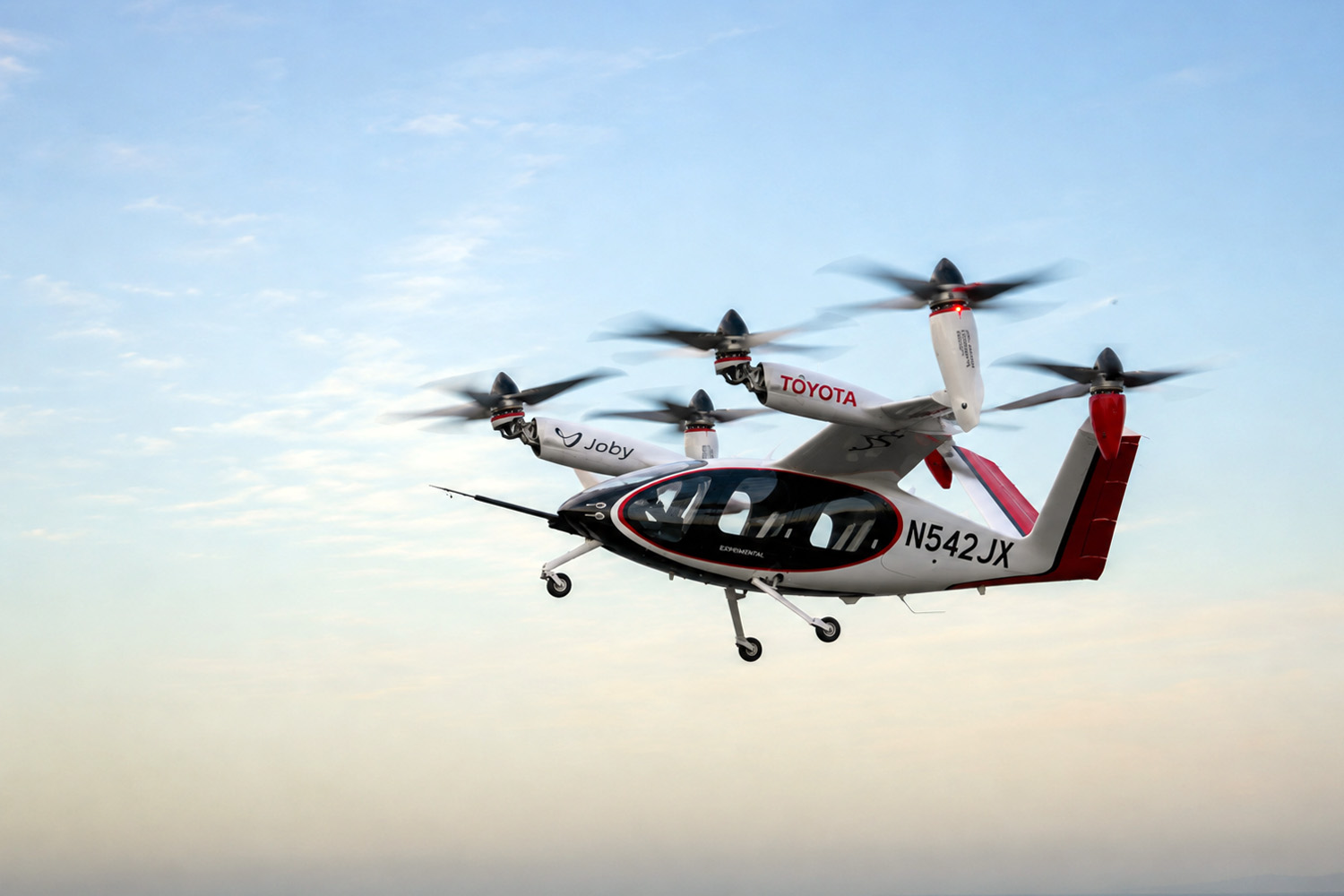
The Next Stage of Mobility Is Moving Beyond Roads
For more than a century, the automotive industry has competed primarily on roads. Vehicle performance, manufacturing efficiency, electrification, and software have defined competitive advantage. Today, however, another transition is quietly taking shape-one that extends transportation into low-altitude airspace.
Toyota’s decision to establish a manufacturing joint venture with Joby Aviation represents far more than another investment in an emerging technology. It illustrates how major industrial companies are beginning to reposition themselves for a future in which mobility is increasingly viewed as an integrated ecosystem rather than a collection of separate transportation industries.
By taking a 51% ownership stake in the new California-based manufacturing venture, Toyota is assuming operational leadership over production while Joby continues focusing on aircraft development, certification, and commercialization. The arrangement highlights an important shift in corporate strategy: manufacturing capability itself is becoming a competitive asset in the race to commercialize electric vertical takeoff and landing (eVTOL) aircraft.
The broader significance lies not in the aircraft alone but in how traditional automotive expertise is being repurposed to build an entirely new transportation sector.
Manufacturing Has Become the Competitive Bottleneck
The global eVTOL industry has attracted billions of dollars in investment over the past decade. Numerous startups have demonstrated prototype aircraft capable of vertical takeoff, quiet electric propulsion, and regional urban transportation.
Yet technical demonstrations are no longer the industry’s primary challenge.
Commercial success increasingly depends on the ability to manufacture aircraft consistently, safely, and at economically viable costs.
This is where Toyota’s involvement becomes strategically significant.
Unlike aviation startups, Toyota possesses decades of experience in high-volume manufacturing, supplier coordination, quality control, lean production, and industrial process optimization. These capabilities cannot be replicated quickly by companies whose expertise lies primarily in aircraft engineering.
The new joint venture effectively separates two different forms of specialization:
- Joby develops aircraft technology and certification.
- Toyota industrializes production.
This division mirrors a broader trend across advanced manufacturing industries, where innovation alone is insufficient without scalable production systems.
In sectors ranging from semiconductors to electric vehicles, manufacturing excellence increasingly determines which companies ultimately capture market share.
Toyota Is Expanding Its Definition of Mobility
Toyota has repeatedly emphasized that it views itself as a “mobility company” rather than simply an automobile manufacturer.
This distinction has become increasingly important as demographic trends, urban congestion, electrification, automation, and digital connectivity reshape transportation demand.
Rather than relying exclusively on passenger cars, Toyota has steadily expanded into:
- autonomous driving systems,
- connected mobility services,
- robotics,
- hydrogen technologies,
- smart city development,
- advanced logistics,
- and now commercial air mobility.
The Joby partnership aligns with this broader corporate strategy.
Instead of treating aviation as a separate industry, Toyota is positioning itself to participate wherever future transportation demand emerges.
This diversification also reduces dependence on the increasingly competitive global automobile market, where pricing pressure, slower growth in mature economies, and rapid Chinese competition continue compressing margins.
Electric air mobility offers exposure to a potentially high-value segment without abandoning Toyota’s core industrial strengths.
Why Joby Needs an Industrial Partner
For Joby Aviation, technological leadership alone does not guarantee commercial success.
The company has already advanced its S4 aircraft through extensive flight testing while pursuing regulatory certification.
The next challenge is fundamentally industrial.
Scaling production requires:
- global supplier networks,
- manufacturing automation,
- production engineering,
- quality assurance systems,
- workforce training,
- cost optimization,
- inventory management,
- and capital-intensive factory operations.
These capabilities traditionally belong to established manufacturing companies rather than venture-backed aerospace startups.
Toyota’s financial commitment-which has grown through investments made since 2020-demonstrates increasing confidence that the industry’s biggest hurdle is no longer proving the technology but producing it efficiently.
This reflects a recurring pattern seen across emerging industries.
Early innovators often establish technical feasibility, while large industrial partners ultimately enable mass commercialization.
The Economics of Air Mobility Depend on Scale
Electric air taxis remain significantly more expensive than conventional urban transportation.
Commercial viability therefore depends less on technological breakthroughs than on manufacturing economics.
Higher production volumes can reduce costs through several mechanisms:
- supplier purchasing power,
- standardized components,
- production learning curves,
- automation,
- lower assembly times,
- improved maintenance efficiency,
- and better asset utilization.
Toyota’s production philosophy has historically focused on eliminating waste while maximizing operational efficiency.
Applying similar principles to aircraft manufacturing could materially influence operating economics across the eVTOL sector.
If aircraft costs decline sufficiently, operators may expand routes beyond premium airport transfers toward broader regional transportation markets.
In other words, manufacturing scale directly affects future market size.
Certification Is Becoming a Barrier to Entry
Another structural trend shaping the industry is regulation.
Unlike consumer electronics or software, commercial aircraft face rigorous certification requirements before entering passenger service.
This creates exceptionally high barriers to entry.
Companies capable of completing certification while simultaneously preparing industrial production gain significant competitive advantages over rivals still focused primarily on prototype development.
Joby’s partnership with Toyota therefore strengthens both sides of the commercialization equation:
- regulatory readiness,
- and production readiness.
This integrated approach may prove increasingly important as governments establish operational frameworks for advanced air mobility.
Rather than competing solely on aircraft performance, future competition is likely to revolve around certification timelines, manufacturing capacity, operational reliability, and ecosystem partnerships.
Global Competition Is Becoming Industrial Rather Than Technological
The emerging eVTOL industry is no longer defined solely by startup innovation.
Competition increasingly includes established aerospace manufacturers, automotive companies, industrial suppliers, and sovereign investment funds.
This reflects a broader transformation occurring across advanced technology industries.
Governments increasingly view next-generation transportation infrastructure as strategically important for industrial competitiveness.
Countries that develop domestic manufacturing capability may capture high-value aerospace employment, advanced engineering expertise, battery production, and export opportunities.
Toyota’s deeper manufacturing commitment therefore carries implications beyond corporate strategy.
It also reinforces Japan’s long-standing industrial position within advanced manufacturing while expanding into future transportation technologies.
Meanwhile, regions such as the United States and the Middle East-where early commercial deployment is expected-could become initial testing grounds for scalable urban air mobility business models.
Winners Will Be Ecosystems Rather Than Individual Companies
One notable feature of advanced air mobility is its dependence on interconnected industries.
Commercial success requires coordination among:
- aircraft manufacturers,
- battery suppliers,
- charging infrastructure providers,
- aviation regulators,
- municipalities,
- air traffic management systems,
- software developers,
- maintenance providers,
- and mobility operators.
This ecosystem complexity favors companies capable of coordinating large industrial networks.
Toyota has extensive experience managing thousands of suppliers across global production systems.
That expertise may become as valuable as aircraft engineering itself.
Rather than competing as isolated manufacturers, future market leaders are likely to build integrated mobility ecosystems that combine vehicles, infrastructure, digital services, and operational support.
The joint venture reflects this ecosystem-oriented strategy.
Short-Term and Long-Term Market Impact
In the short term, the creation of the joint venture primarily strengthens Joby’s commercial execution capabilities.
Investors often differentiate between companies that possess promising technology and those capable of manufacturing at scale.
Toyota’s majority ownership signals confidence that industrial readiness deserves equal strategic emphasis alongside product development.
The partnership may also encourage additional collaborations between established manufacturers and advanced aviation startups seeking similar production expertise.
Over the longer term, the implications extend well beyond one aircraft program.
If commercial deployment expands successfully, automotive manufacturing techniques could become increasingly integrated into aerospace production.
This convergence would blur traditional industry boundaries, creating a new category that combines automotive efficiency with aviation safety standards.
Such structural integration could reshape supplier networks, workforce skills, capital investment priorities, and manufacturing strategies across both sectors.
The Real Opportunity Lies in Industrial Transformation
The most important takeaway from Toyota’s expanded partnership with Joby Aviation is not simply the arrival of electric air taxis.
It is the emergence of a broader industrial transformation.
Transportation industries are becoming increasingly interconnected, with manufacturing capabilities, software integration, electrification, and ecosystem coordination determining competitive advantage.
Toyota is leveraging decades of production expertise to participate in a transportation market that extends beyond automobiles, while Joby gains access to industrial capabilities that few startups could build independently.
Whether electric air taxis ultimately become a mainstream transportation option will depend on regulation, operating economics, infrastructure development, and consumer adoption. Those uncertainties remain.
What is already becoming clear, however, is that the companies most likely to shape the future of advanced mobility will not necessarily be those with the most innovative prototypes. They will be those capable of transforming innovation into reliable, scalable industrial production.
In that sense, the Toyota–Joby joint venture represents less a bet on a single aircraft than a strategic investment in the manufacturing foundations of an entirely new mobility industry.