The Car as a Health Platform
The automotive industry is undergoing a transformation that extends far beyond electrification and autonomous driving. While much of the public conversation focuses on batteries, charging infrastructure, and artificial intelligence-assisted driving, another trend is quietly reshaping vehicle engineering: the rise of in-car health monitoring systems.
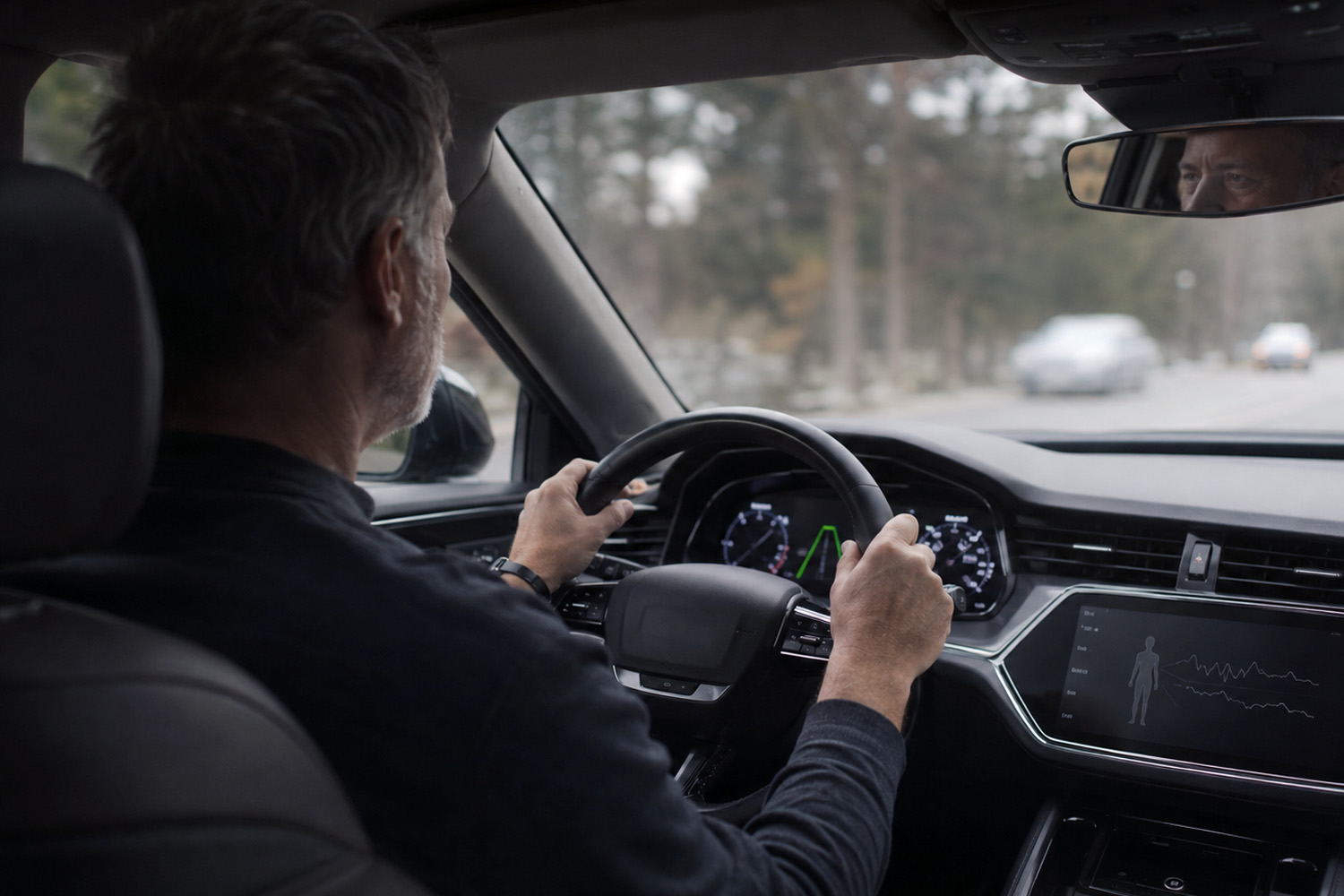
Modern vehicles are increasingly being designed not only to transport passengers but also to observe, interpret, and potentially respond to their physical condition. Sensors embedded in seats, steering wheels, cameras, wearable integrations, and biometric systems are turning cars into environments capable of detecting fatigue, stress, distraction, abnormal heart rates, and even early warning signs of medical emergencies.
This shift reflects a broader structural change in mobility. Cars are becoming digital ecosystems where safety, software, wellness, and personalized services converge. In-car health monitoring is no longer a futuristic concept reserved for luxury vehicles or experimental prototypes. It is becoming part of a larger automotive strategy shaped by aging populations, regulatory pressure, insurance economics, and the rise of software-defined vehicles.
The central question is no longer whether vehicles can monitor occupants’ health, but why automakers increasingly see this capability as strategically important.
Why Health Monitoring Is Emerging Now
Several industry forces are converging to accelerate adoption.
First, demographics matter. Many developed economies face aging populations, increasing the likelihood of medical incidents occurring behind the wheel. Conditions such as fatigue, cardiovascular disease, diabetes, and sleep disorders raise safety risks for drivers. In response, automakers and suppliers increasingly view preventive monitoring as a way to reduce accidents caused by health-related impairment.
Second, road safety priorities have changed. Historically, vehicle safety revolved around crash protection-seatbelts, airbags, structural integrity, and braking systems. Today, the emphasis is shifting toward prevention. Advanced Driver Assistance Systems (ADAS) already attempt to prevent collisions through lane keeping, collision warnings, and driver attention monitoring. Health sensing represents the next logical extension of predictive safety.
Third, vehicles now possess the technical architecture to support such systems. The growth of software-defined vehicles means cars are increasingly equipped with powerful processors, cloud connectivity, and centralized computing platforms capable of analyzing biometric data in real time. Without these advances, health monitoring would remain technically impractical or prohibitively expensive.
Finally, consumer expectations around health technology have evolved. The widespread adoption of smartwatches and fitness trackers normalized biometric monitoring. Drivers who already use wearable devices to monitor sleep quality, heart rate variability, or oxygen levels may be more receptive to similar capabilities inside vehicles.
The Technologies Behind In-Car Health Monitoring
The technology stack supporting in-car health monitoring combines sensors, machine learning, computer vision, and connectivity.
One major component is camera-based driver monitoring. Interior-facing cameras already detect distraction and drowsiness by tracking eye movement, blinking frequency, head position, and gaze direction. What began as a safety feature is expanding into biometric interpretation.
For example, subtle facial indicators can suggest fatigue, elevated stress, or declining alertness. Some systems analyze micro-expressions and pupil behavior to determine whether a driver may be cognitively overloaded.
Another rapidly developing area involves contact-based biometric sensing. Steering wheels and seats increasingly serve as platforms for embedded sensors that can detect heart rate, breathing patterns, and stress responses. Conductive materials integrated into steering wheel surfaces may eventually allow passive cardiovascular monitoring without requiring any additional user action.
Radar-based sensing technologies are also gaining importance. Ultra-wideband radar sensors can measure tiny chest movements caused by breathing or heartbeat without direct physical contact. Originally developed for occupant detection and child-presence monitoring, these systems are evolving toward more sophisticated health analysis.
Artificial intelligence is the enabling layer that transforms raw sensor inputs into meaningful interpretations. A vehicle does not merely collect data-it must distinguish between ordinary behavior and potentially dangerous conditions. For example, AI systems may learn a driver’s baseline behavior and recognize deviations indicating illness, fatigue, or impairment.
This matters because simple alerts are insufficient. If a system frequently produces false alarms, drivers may ignore it altogether. The effectiveness of in-car health monitoring depends on balancing accuracy with usability.
From Driver Assistance to Preventive Intervention
The practical function of these systems extends beyond passive observation.
Current driver monitoring technologies primarily issue warnings: encouraging breaks, increasing cabin alerts, or activating steering wheel vibrations if fatigue is detected. However, the next stage of development may involve intervention.
In vehicles equipped with advanced driver assistance capabilities, health events could trigger automated responses. If a driver experiences a suspected medical emergency, the car could slow down, activate hazard lights, contact emergency services, or safely maneuver to the roadside.
This possibility becomes increasingly realistic as automated driving technology matures. While fully autonomous vehicles remain limited, Level 2 and Level 3 systems already enable partial automation under certain conditions. Health monitoring may become an important complement to automation by addressing scenarios where human capability suddenly deteriorates.
Such developments also reshape how manufacturers frame vehicle safety. Rather than protecting occupants only after an accident occurs, future cars may seek to anticipate physiological risks before an incident happens.
Competitive Pressure and Industry Strategy
Automakers are approaching in-car health monitoring differently depending on brand positioning and market strategy.
Premium manufacturers have largely treated health features as part of luxury and wellness experiences. Vehicles increasingly include air purification, stress reduction environments, adaptive cabin settings, fatigue detection, and biometric personalization. Health technology reinforces premium branding by emphasizing comfort and personalization.
Mass-market manufacturers, by contrast, tend to frame health monitoring primarily through safety and insurance value. The challenge is cost efficiency. Technologies must become affordable enough to scale beyond flagship models.
Technology suppliers play a crucial role in this ecosystem. Semiconductor companies, sensor manufacturers, AI developers, and automotive software providers increasingly shape innovation pathways. In many cases, suppliers-not automakers themselves-develop the underlying sensing hardware and analytics platforms.
Competition from technology companies also matters. Consumer electronics firms have built strong expertise in biometric monitoring through wearable devices. As vehicles become connected ecosystems, the boundary between automotive and digital health industries may blur.
This convergence could create new partnerships between automakers, healthcare providers, insurers, and software companies. Vehicle-generated health data might eventually integrate with broader digital health systems, though such integration raises significant ethical and regulatory questions.
Privacy, Regulation, and Ethical Challenges
Despite its potential benefits, in-car health monitoring introduces difficult concerns around privacy and data governance.
Biometric information is highly sensitive. A vehicle capable of measuring stress, fatigue, heart rhythms, or behavioral changes generates deeply personal information that consumers may not want shared.
The key issue is control over data ownership. Questions remain unresolved: Who owns health-related vehicle data-the driver, automaker, insurer, or software provider? Can insurance companies request access to behavioral risk patterns? Could employers monitor professional drivers?
Regulators are increasingly attentive to these concerns. In regions such as Europe, strict privacy frameworks limit how personal data can be collected and processed. Automakers must ensure transparency, consent, and cybersecurity protections.
False positives also present challenges. Incorrect medical interpretations could undermine trust or even create liability risks. If a vehicle mistakenly concludes a driver is impaired-or fails to recognize an actual emergency-the consequences could be serious.
As a result, regulators are likely to favor gradual implementation focused on safety-critical monitoring rather than broad health diagnostics.
Consumer Adoption: Enthusiasm Meets Skepticism
Consumer attitudes toward health monitoring remain mixed.
Many drivers appreciate features that improve safety, especially systems addressing fatigue or distraction. Parents, older adults, and fleet operators may see clear value in technology that reduces accident risk.
However, enthusiasm often declines when surveillance concerns emerge. Drivers may welcome alerts for drowsiness but resist systems perceived as constantly “watching” them.
Generational differences could influence adoption. Younger consumers accustomed to health apps and wearable technology may be more accepting of biometric integration, whereas others may prioritize privacy over convenience.
Trust will depend heavily on implementation. Systems perceived as transparent, optional, and genuinely useful are more likely to gain acceptance than features seen as intrusive or commercially exploitative.
The Future of Mobility: Vehicles That Understand Occupants
The long-term significance of in-car health monitoring lies not only in safety but also in how it changes the definition of mobility.
Historically, vehicle innovation focused on performance, efficiency, and crash protection. Increasingly, automotive engineering is moving toward contextual awareness-vehicles capable of understanding both road conditions and human behavior.
In-car health monitoring aligns with larger industry transitions including electrification, automation, and software-defined mobility. The vehicle of the future may function less as a mechanical machine and more as an intelligent environment responsive to passenger needs.
This does not mean cars will replace healthcare systems or become medical devices in the traditional sense. Instead, they may act as preventive platforms capable of identifying risks, reducing driver impairment, and supporting safer mobility outcomes.
As sensors become cheaper, computing power grows, and AI models improve, health monitoring is likely to expand beyond premium vehicles into broader market segments. The automotive industry’s next competitive battleground may not only concern horsepower, battery range, or autonomous capability-but how effectively a vehicle understands the person behind the wheel.
In that sense, the growing popularity of in-car health monitoring reflects something larger than a technological upgrade. It signals a transformation in how mobility itself is conceived: from transportation centered on machines to transportation increasingly centered on people.
In-Car Health Monitoring Systems in Modern Vehicles
| Automaker | System / Feature Name | Health Monitoring Capability | Sensor Type | How It Works | Vehicle Models Equipped | Introduction Year | Production / Prototype | Region Availability | Supplier / Technology Partner | Current Status |
|---|---|---|---|---|---|---|---|---|---|---|
| Mercedes-Benz | Attention Assist | Drowsiness / fatigue detection | Steering behavior analysis, speed, driver inputs | Monitors steering corrections, braking, driving behavior, trip duration and vehicle dynamics to detect fatigue patterns. | S-Class, E-Class, C-Class, EQS, EQE and broader lineup | 2009 | Production | Global | Internal development | Active |
| Mercedes-Benz | Driver Monitoring Camera | Fatigue, distraction, alertness monitoring | Infrared interior camera | Tracks eye movement, blinking, head pose and driver attention. | S-Class, EQS, newer premium models | 2021 | Production | Europe, North America, Asia | Bosch / Continental ecosystem | Active |
| BMW | Driver Attention Camera | Drowsiness and distraction monitoring | Infrared camera | Detects eye closure, distraction and inattentiveness. | i7, 7 Series, iX, i5 and premium range | 2022 | Production | Global | Magna / Seeing Machines technologies | Active |
| BMW | Vitality / Wellness Integration | Stress reduction and wellness support | Wearable integration | Syncs vehicle environment with wellness profiles, relaxation modes and wearable data. | Luxury segment models | 2020 | Production (limited features) | Global | Connected wearable ecosystem | Limited rollout |
| Tesla | Cabin Camera Driver Monitoring | Driver attention monitoring | Interior camera | Tracks driver attentiveness while Autopilot or Full Self Driving features are active. | Model S, 3, X, Y | 2021 | Production | Global | Internal development | Active |
| Volvo | Driver Understanding System | Drowsiness, intoxication, distraction detection | Interior cameras + steering input monitoring | Detects abnormal driving behavior and attention loss, potentially slowing the vehicle or intervening. | EX90, EX30 successors | 2023 | Production | Global | Internal / Luminar ecosystem | Active |
| General Motors | Super Cruise Driver Attention System | Attention and alertness monitoring | Infrared eye-tracking camera | Confirms driver focus while hands-free driving is enabled. | Cadillac, Chevrolet, GMC premium vehicles | 2017 | Production | North America | Seeing Machines | Active |
| Ford | Driver Alert System | Fatigue detection | Lane tracking + steering behavior | Detects erratic steering and lane drift associated with fatigue. | Explorer, Mustang Mach-E, F-150, Focus | 2012 | Production | Global | Internal development | Active |
| Hyundai / Kia | Driver Attention Warning | Fatigue and inattentive driving | Driving behavior analysis + camera | Evaluates steering patterns, reaction times and lane behavior. | IONIQ lineup, EV6, Genesis range | 2019 | Production | Global | Mobis ecosystem | Active |
| Hyundai Mobis | Smart Cabin Care | Vital sign monitoring | 3D camera + biosensors | Tracks heart rate, breathing and posture for occupant health. | Prototype / future programs | 2022 | Prototype | South Korea | Hyundai Mobis | Pilot stage |
| Toyota | Driver Monitor System | Driver fatigue and distraction | Infrared cabin camera | Monitors face orientation and eyelid movement. | Lexus LS, Toyota Mirai, Crown | 2018 | Production | Global | Denso | Active |
| Lexus | Driver Emergency Response | Medical emergency mitigation | Driver monitoring + ADAS | If driver becomes unresponsive, vehicle may slow and stop safely. | LS, RX, advanced safety models | 2023 | Production | Japan, Europe | Toyota Safety Sense ecosystem | Limited rollout |
| Nissan | Driver Attention Alert | Drowsiness detection | Driving pattern analytics | Establishes baseline behavior and identifies fatigue indicators. | Rogue, Qashqai, Pathfinder | 2014 | Production | Global | Internal | Active |
| Subaru | DriverFocus | Fatigue and distraction monitoring | Infrared facial recognition camera | Detects signs of drowsiness and distraction. | Forester, Outback, Legacy | 2019 | Production | North America, Japan | Denso | Active |
| Volkswagen | Emergency Assist | Medical emergency intervention | Steering input + ADAS sensors | Detects lack of driver input and can safely stop the vehicle. | ID.4, Passat, Arteon, Touareg | 2018 | Production | Europe | VW Group safety systems | Active |
| Audi | Driver Monitoring | Fatigue detection | Camera + steering analysis | Detects drowsiness and recommends breaks. | A6, A8, Q8 e-tron | 2015 | Production | Global | Continental | Active |
| BYD | Driver Monitoring System | Attention monitoring | Cabin camera | Detects distraction and driver fatigue. | Yangwang, Denza, premium EVs | 2023 | Production | China | Chinese supplier ecosystem | Active |
| NIO | NOMI Driver Monitoring | Fatigue and alertness monitoring | Camera + AI analysis | Uses cabin AI and monitoring systems to track attentiveness. | ET7, EL7, ET5 | 2022 | Production | China, Europe | NIO internal AI | Active |
| SAIC / MG | Driver Fatigue Monitoring | Drowsiness detection | Interior camera | Detects signs of fatigue and distraction. | MG4, premium Chinese EVs | 2023 | Production | China, Europe | Local ADAS suppliers | Active |
| Faurecia / FORVIA | Vital Signs Monitoring Seat | Heart rate and respiration monitoring | Seat biosensors | Embedded seat sensors measure breathing and pulse. | Supplier technology | 2021 | Prototype / Supplier-ready | Global | FORVIA | Pilot stage |
| ZF | Occupant Health Monitoring | Heart rate and breathing detection | Seat sensors + radar | Measures biometrics to support emergency intervention. | Future OEM integrations | 2022 | Prototype | Global | ZF | Testing phase |
| Gentex | Cabin Sensing Platform | Biometric wellness monitoring | Infrared + optical sensing | Tracks stress, fatigue and cabin wellness metrics. | Supplier platform | 2024 | Prototype | Global | Gentex | Development stage |
| Continental | Contactless Vital Sign Monitoring | Heart rate and respiration | Radar / infrared sensors | Detects breathing and pulse without physical contact. | Supplier demonstration programs | 2021 | Prototype | Global | Continental | Development stage |
Reference table of health monitoring technologies implemented in production vehicles and advanced automotive programs lobally.
Related Analysis:
Biometric Car Access: Security Innovation and Industry Trends