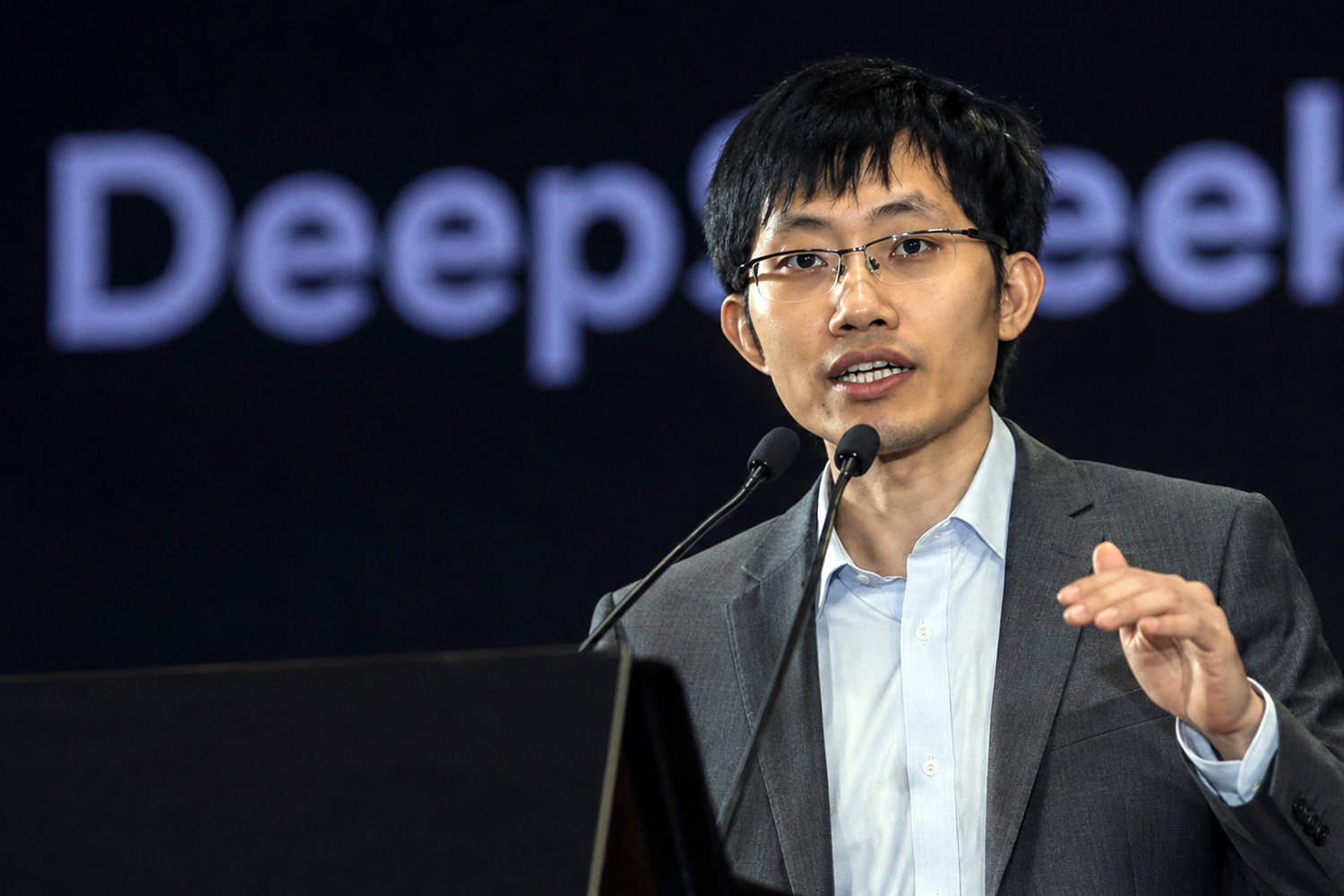
Artificial intelligence has produced a new generation of technology billionaires, but unlike previous waves of wealth creation in Silicon Valley, today’s fortunes are being shaped less by software alone than by ownership structures, capital allocation and corporate governance.
The latest example is Liang Wenfeng, founder of Chinese AI company DeepSeek, whose estimated net worth has risen to approximately $36 billion following the company’s latest funding round. According to the Bloomberg Billionaires Index, this makes him the wealthiest entrepreneur whose fortune is derived primarily from developing foundation AI models, surpassing OpenAI President Greg Brockman and Anthropic co-founder Dario Amodei.
The ranking deliberately excludes technology leaders whose wealth comes primarily from broader ecosystems-including Elon Musk, Mark Zuckerberg, Larry Page, Jeff Bezos and Jensen Huang-rather than from companies whose principal business is developing large language models.
Liang’s ascent is therefore more than a story about individual wealth. It illustrates how the economics of artificial intelligence are beginning to diverge between the United States and China, raising important questions about founder control, financing strategies, competitive dynamics and the future distribution of value across the AI industry.
Wealth in AI Is Determined by Ownership, Not Valuation
One of the most surprising aspects of the current AI market is that the richest founder does not necessarily lead the highest-valued company.
OpenAI and Anthropic are each valued at hundreds of billions of dollars and rank among the most valuable private technology companies in the world. Yet neither organization’s founders have accumulated fortunes comparable to Liang Wenfeng’s.
The explanation lies in equity ownership rather than corporate valuation.
Liang reportedly retains approximately 78% ownership of DeepSeek, an unusually large stake for the founder of a company valued at roughly $50 billion.
By contrast, American AI startups typically experience multiple rounds of equity dilution.
As companies raise billions of dollars from venture capital firms, sovereign wealth funds and strategic investors-including Microsoft, Amazon and Google-founders gradually surrender significant ownership in exchange for access to computing infrastructure, engineering talent and global expansion.
Consequently, even companies with substantially higher valuations may generate comparatively smaller personal fortunes for their founders.
This demonstrates an increasingly important principle in technology economics:
Founder wealth depends less on company size than on retained ownership.
Capital Efficiency Is Becoming a Competitive Advantage
The comparison between DeepSeek and many American AI companies also highlights a broader shift in startup financing.
Over the past decade, Silicon Valley rewarded companies that raised increasingly large investment rounds to accelerate growth.
The emergence of foundation models intensified this trend because developing frontier AI systems requires extraordinary computing resources, specialized hardware and access to vast quantities of data.
As a result, companies such as OpenAI and Anthropic attracted tens of billions of dollars in outside investment.
DeepSeek followed a different path.
Originating from the AI research division of Zhejiang High-Flyer Asset Management, the company benefited from substantial internal financial support while maintaining concentrated founder ownership.
Whether this approach proves superior remains uncertain, but it reflects an alternative financing philosophy that emphasizes capital efficiency over rapid equity dilution.
For investors, this raises an increasingly relevant question:
Can future AI leaders achieve global competitiveness without repeatedly surrendering ownership to external capital?
If so, founder-controlled AI companies could become more common, particularly in markets where domestic financing ecosystems differ from those in Silicon Valley.
AI Is Entering a New Phase of Corporate Competition
Only a few years ago, discussions about artificial intelligence focused primarily on technological breakthroughs.
Today, competition increasingly revolves around industrial organization.
Developing state-of-the-art AI models now requires far more than research talent.
Companies must coordinate enormous investments across:
- semiconductor supply;
- cloud infrastructure;
- electricity generation;
- data acquisition;
- software engineering;
- enterprise distribution.
This has transformed AI companies from software startups into integrated industrial businesses.
Consequently, ownership structures, financing strategies and operational efficiency have become as strategically important as model performance itself.
DeepSeek’s rise demonstrates that technological capability alone no longer determines competitive positioning.
Corporate structure increasingly matters.
Diverging AI Business Models
The global AI industry is gradually splitting into two distinct organizational models.
The American model relies heavily on strategic partnerships with hyperscale cloud providers.
Microsoft supports OpenAI.
Amazon has become Anthropic’s largest infrastructure partner.
Google simultaneously develops Gemini while investing in external AI companies and expanding its cloud ecosystem.
These relationships provide virtually unlimited computing resources but inevitably dilute founder control.
China appears to be pursuing a somewhat different path.
Domestic AI companies operate within a more nationally integrated technology ecosystem supported by local semiconductor development, domestic cloud providers and government-backed industrial policies.
This structure may enable founders to retain larger ownership stakes while relying less on foreign institutional capital.
Neither model guarantees long-term success.
However, each reflects different priorities regarding capital allocation, corporate governance and technological independence.
Why Founder Control Matters
Large ownership stakes influence far more than personal wealth.
They also shape corporate decision-making.
A founder with overwhelming voting power can often pursue long-term strategies without facing the short-term financial pressures commonly imposed by external investors.
This may encourage:
- longer research cycles;
- greater tolerance for experimentation;
- reduced pressure for immediate monetization;
- faster organizational decision-making.
Conversely, concentrated ownership also concentrates risk.
Should strategic decisions prove unsuccessful, fewer governance mechanisms exist to challenge leadership.
Publicly traded companies generally balance founder influence with broader shareholder oversight.
Privately controlled AI firms often do not.
As artificial intelligence becomes increasingly important to national economies, governance structures may become just as significant as technical capabilities.
The AI Economy Is Becoming Increasingly Concentrated
Another important implication concerns market concentration.
Foundation-model development requires extraordinary financial resources.
Training next-generation AI systems now costs billions of dollars.
Inference infrastructure continues consuming massive quantities of electricity and high-performance computing capacity.
These economics naturally favor companies with access to exceptional financial resources.
Consequently, the global frontier AI market is increasingly dominated by relatively few organizations.
Rather than thousands of competing startups, the industry may ultimately consist of a limited number of companies capable of sustaining multi-billion-dollar research programs.
This resembles historical patterns observed in semiconductor manufacturing and commercial aviation, where escalating capital requirements gradually reduced the number of viable competitors.
DeepSeek’s rapid rise therefore reflects not only entrepreneurial success but also increasing concentration within the AI industry itself.
Geopolitical Competition Extends Beyond Technology
Liang Wenfeng’s emergence also highlights the growing geopolitical dimension of artificial intelligence.
The competition between American and Chinese AI companies increasingly involves national innovation ecosystems rather than individual startups.
Governments now recognize foundation models as strategic assets with implications extending beyond commercial software.
Artificial intelligence influences:
- productivity;
- industrial automation;
- military logistics;
- scientific research;
- healthcare;
- education;
- financial services.
As a result, AI companies increasingly operate within broader national industrial strategies.
The success of DeepSeek demonstrates China’s determination to cultivate globally competitive AI companies despite export restrictions on advanced semiconductor technologies.
Likewise, continued investment in OpenAI, Anthropic and other American firms reflects Washington’s strategic interest in maintaining technological leadership.
The AI race is therefore evolving into a contest between innovation ecosystems rather than isolated corporations.
What This Means for Investors
The emergence of billionaire AI founders should not distract investors from the industry’s underlying economics.
Company valuations remain highly dependent on expectations regarding future commercialization.
Sustainable profitability will ultimately depend on converting advanced language models into recurring revenue through enterprise software, developer platforms, cloud services and specialized industry applications.
Ownership concentration may create extraordinary wealth for founders, but long-term corporate success still depends on building durable businesses rather than merely attracting capital.
Investors are therefore increasingly evaluating AI companies using criteria that extend beyond technical benchmarks.
Commercial scalability, infrastructure efficiency, customer acquisition costs and ecosystem integration have become equally important measures of competitiveness.
The Next Stage of AI Wealth Creation
The first generation of internet billionaires accumulated wealth primarily through network effects.
Social media founders benefited from rapidly expanding user bases.
E-commerce entrepreneurs created value through logistics and digital marketplaces.
Cloud computing leaders built scalable infrastructure businesses.
Artificial intelligence represents a different economic model.
Here, wealth increasingly derives from ownership of intellectual property, proprietary models and the infrastructure necessary to operate them efficiently.
Liang Wenfeng’s fortune illustrates how concentrated ownership can dramatically amplify personal wealth when combined with rapidly appreciating enterprise value.
However, it also suggests that future AI fortunes may become increasingly difficult to replicate.
The enormous capital requirements associated with frontier model development create substantial barriers to entry for new competitors.
Future founders may need to choose between retaining ownership and raising the capital required to compete globally.
That trade-off is likely to define the next decade of AI entrepreneurship.
Conclusion
Liang Wenfeng’s emergence as the wealthiest founder in the foundation-model industry is not merely a milestone in personal wealth.
It reflects a deeper transformation in how value is being created within artificial intelligence.
The next phase of AI competition will not be determined solely by which company builds the most capable language model. It will increasingly depend on who controls the infrastructure, who owns the intellectual property, how companies finance expansion and how much ownership founders retain as their businesses scale.
In that sense, the AI industry’s newest billionaire represents more than individual success. He embodies the emergence of a new economic model in which ownership structure has become just as strategically important as technological innovation itself.
Related Analysis:
AI Infrastructure War: Why Compute Power Now Decides the Market