Amazon’s latest strategic moves reveal a transformation that extends far beyond e-commerce. By opening its logistics infrastructure to outside businesses and simultaneously expanding aggressively across Europe, the company is evolving into something structurally different: a global infrastructure operator.
The launch of Amazon Supply Chain Services – allowing third-party companies to use Amazon’s freight, warehousing, and delivery systems – signals that the company is no longer simply competing with retailers. It is increasingly competing with the logistical backbone of the global economy itself.
This distinction matters because logistics infrastructure has historically been one of the most difficult industries to disrupt. Companies such as UPS and FedEx built their dominance over decades through expensive physical networks:
- aircraft fleets,
- trucking operations,
- warehouses,
- routing systems,
- customs operations,
- and global distribution hubs.
Amazon spent years building similar infrastructure internally to support its retail ecosystem. Now, the company is beginning to monetize that infrastructure externally.
That changes the competitive structure of the logistics market.
Amazon Is Converting Internal Infrastructure Into a Commercial Platform
The most important strategic aspect of Amazon Supply Chain Services is not transportation itself. It is the conversion of internal operational infrastructure into a revenue-generating external platform.
This follows a pattern Amazon has used before.
The company originally built cloud computing infrastructure to support its own operations. That infrastructure later became Amazon Web Services, which ultimately transformed into one of the world’s most profitable technology businesses.
Amazon is now applying a similar logic to logistics.
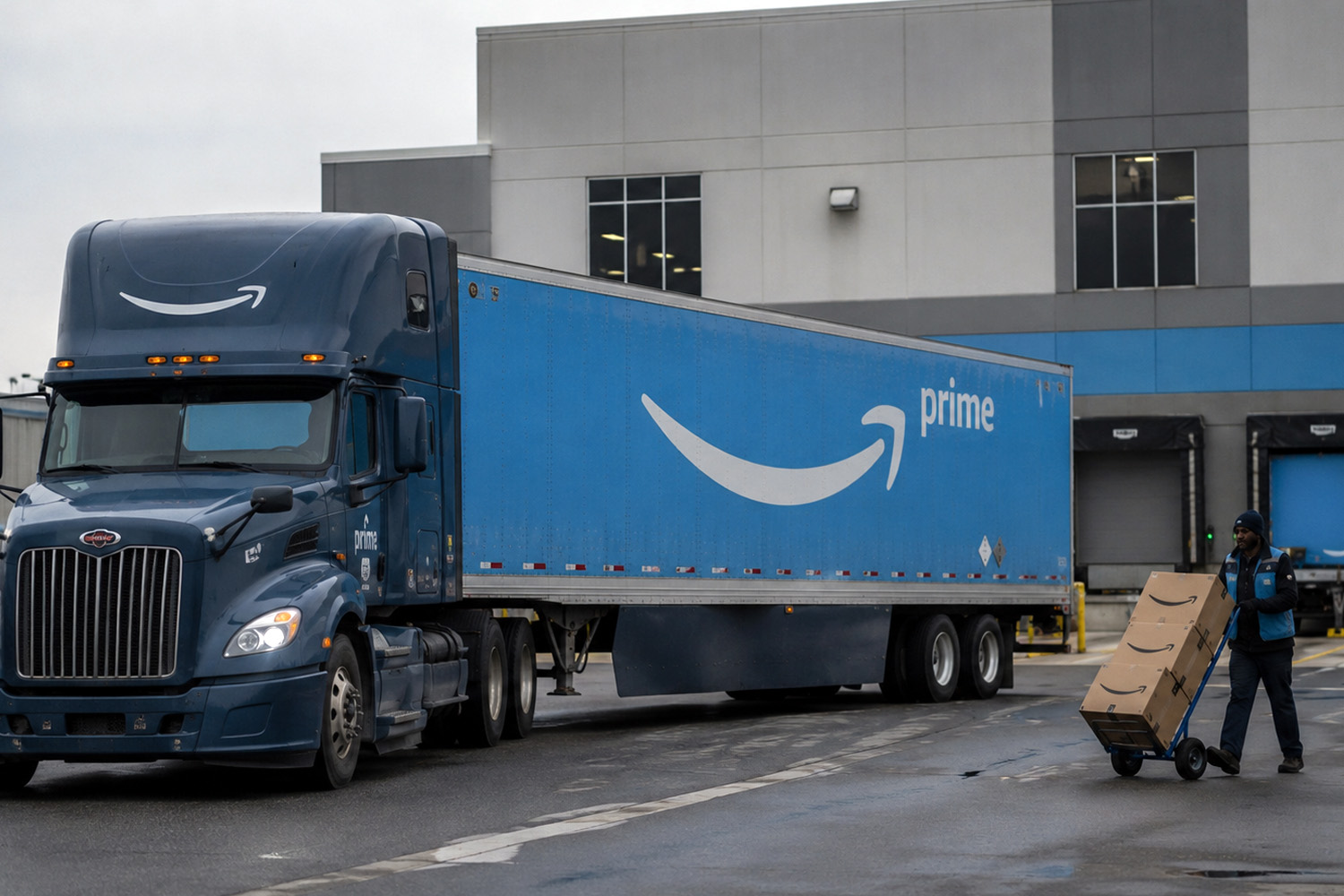
The company already operates one of the largest logistics systems in the world:
- hundreds of fulfillment centers,
- thousands of delivery stations,
- cargo aircraft,
- freight trucking networks,
- ocean shipping partnerships,
- robotics systems,
- and advanced inventory management platforms.
According to industry estimates, Amazon now handles a larger volume of U.S. parcel deliveries than FedEx and rivals UPS in several major categories. Over recent years, Amazon’s logistics network expanded at a pace rarely seen in modern infrastructure industries.
The strategic significance is enormous:
Amazon is transforming logistics from a cost center into a platform business.
That transition could fundamentally alter pricing dynamics across the shipping industry.
Why Amazon Wants Control Beyond E-Commerce
At first glance, opening logistics services to third parties may appear like a natural expansion. In reality, the move reflects deeper structural pressures inside e-commerce and retail markets.
The core issue is market saturation.
Amazon’s traditional retail growth has gradually matured in several developed markets. As e-commerce penetration stabilizes, infrastructure monetization becomes increasingly important.
This creates a powerful incentive:
maximize utilization of existing logistics assets.
Large infrastructure systems become more profitable when utilization rates increase. Aircraft, warehouses, trucking fleets, and fulfillment centers generate stronger returns when operating closer to full capacity.
By allowing outside companies to use its network, Amazon can:
- improve operational efficiency,
- spread fixed infrastructure costs,
- increase network density,
- and create new high-margin revenue streams.
This is economically similar to how cloud providers monetize excess server capacity.
In both cases, Amazon converts scale advantages into infrastructure services competitors struggle to replicate.
The Logistics Industry Is Entering a New Competitive Phase
Traditional logistics firms built their business models around transportation efficiency and network reliability.
Amazon introduces a different model:
integrated commerce-driven logistics.
This distinction matters strategically.
Unlike UPS or FedEx, Amazon controls:
- consumer purchasing behavior,
- inventory systems,
- seller ecosystems,
- cloud infrastructure,
- AI optimization tools,
- and last-mile delivery operations.
That integration allows Amazon to optimize logistics using real-time commercial data at enormous scale.
For example:
- inventory positioning can be adjusted dynamically based on purchasing trends,
- warehouse allocation can be optimized algorithmically,
- delivery routes can be modified using predictive demand forecasting,
- and freight flows can be coordinated directly with marketplace activity.
This level of ecosystem integration creates operational efficiencies that traditional logistics companies may struggle to match.
The competitive pressure therefore extends beyond shipping prices alone.
Amazon is competing on:
- delivery speed,
- network density,
- automation,
- predictive logistics,
- and infrastructure integration.
Why AI and Cloud Infrastructure Matter in Logistics
Amazon’s €15 billion investment plan in France reveals another important structural trend: logistics, cloud computing, and AI are increasingly converging into a single infrastructure ecosystem.
Historically, logistics was largely a physical industry.
Today, competitive advantage increasingly depends on software systems capable of optimizing:
- inventory movement,
- warehouse robotics,
- route planning,
- labor allocation,
- and predictive demand forecasting.
This is where Amazon holds a major structural advantage.
Through AWS, the company already operates one of the world’s largest cloud computing platforms. That allows Amazon to integrate AI directly into supply chain operations at scale.
Modern logistics networks increasingly depend on:
- machine learning,
- real-time analytics,
- computer vision,
- and automation systems.
As a result, logistics companies are gradually becoming technology infrastructure companies.
Amazon’s investment strategy in France demonstrates this convergence clearly. The company is not simply building warehouses. It is expanding:
- logistics infrastructure,
- cloud capacity,
- AI systems,
- and data infrastructure simultaneously.
That integrated expansion reflects a long-term strategy centered on ecosystem control.
Europe Has Become Strategically Important
Amazon’s decision to invest more than €15 billion in France also reflects broader geopolitical and economic shifts.
Europe is becoming increasingly important for infrastructure localization.
Several factors are driving this:
- supply chain regionalization,
- geopolitical uncertainty,
- digital sovereignty concerns,
- and rising demand for localized cloud infrastructure.
By opening new facilities in Illière-Combrey, Beauvais, Colombier-Saunier, and Ensisheim, Amazon strengthens its position inside one of Europe’s largest consumer economies while improving regional distribution efficiency.
The projected creation of more than 7,000 permanent jobs also highlights another strategic reality:
large-scale logistics infrastructure has become politically significant.
Governments increasingly view:
- warehouses,
- cloud facilities,
- AI infrastructure,
- and logistics hubs
as economically strategic assets tied to employment, investment, and industrial competitiveness.
This gives major infrastructure operators like Amazon growing influence within regional economic development strategies.
Traditional Logistics Companies Face Structural Pressure
The greatest long-term threat to UPS and FedEx is not necessarily immediate market share loss. It is margin compression and infrastructure duplication.
Amazon’s network creates several competitive pressures simultaneously:
- Lower delivery costs through scale
- Faster delivery speeds through dense fulfillment infrastructure
- Integrated commerce and logistics optimization
- AI-driven operational efficiency
- Direct access to merchants and inventory systems
Traditional carriers remain highly powerful companies with global networks that cannot easily be replicated. However, their historical advantage depended partly on infrastructure scarcity.
Amazon is reducing that scarcity.
The company’s strategy effectively increases supply in logistics infrastructure markets while simultaneously reshaping customer expectations around delivery speed and flexibility.
This forces competitors into expensive infrastructure investment cycles.
As a result, the logistics industry may gradually resemble cloud computing markets:
- capital intensive,
- infrastructure dominated,
- and concentrated among a small number of hyperscale operators.
Infrastructure Is Becoming the Core Business Model
One of the most important business transformations underway globally is the rise of infrastructure-centric corporate strategy.
Technology companies increasingly compete through ownership of:
- logistics networks,
- cloud systems,
- AI infrastructure,
- semiconductor supply,
- and data ecosystems.
Amazon exemplifies this transition.
The company is no longer best understood simply as:
- an online retailer,
- or even an e-commerce platform.
It increasingly functions as a multi-layered infrastructure company operating across:
- commerce,
- logistics,
- cloud computing,
- AI,
- and industrial automation.
This diversification creates unusually strong competitive resilience because each infrastructure layer reinforces the others.
For example:
- AWS supports AI development,
- AI improves logistics efficiency,
- logistics strengthens e-commerce dominance,
- and e-commerce generates infrastructure utilization.
The result is a self-reinforcing ecosystem difficult for competitors to replicate fully.
The Long-Term Structural Outlook
The long-term implications extend beyond Amazon itself.
Global supply chains are entering a period of technological consolidation where scale, automation, and infrastructure integration become increasingly decisive.
Several structural trends are emerging simultaneously:
- AI-driven logistics optimization,
- warehouse automation,
- infrastructure regionalization,
- supply chain digitization,
- and convergence between physical and digital infrastructure.
The companies most likely to dominate future logistics markets are not necessarily those with the largest transportation fleets alone. They are increasingly the firms capable of integrating:
- data,
- AI,
- cloud computing,
- robotics,
- and physical distribution networks into unified operational systems.
This favors hyperscale infrastructure operators.
At the same time, barriers to entry continue rising because infrastructure expansion requires enormous capital expenditures.
That may gradually reduce the number of globally competitive logistics ecosystems.
Conclusion
Amazon’s expansion into third-party logistics services and its massive infrastructure investment in France reveal a broader transformation occurring across the global economy.
The company is moving beyond retail into infrastructure dominance.
By integrating logistics, cloud computing, AI, and automation into a unified ecosystem, Amazon is positioning itself not merely as a competitor to UPS or FedEx, but as a foundational operator within global supply chains themselves.
The most important shift is structural:
logistics is no longer just transportation.
It is becoming a data-driven infrastructure business where competitive advantage increasingly depends on scale, AI integration, and ecosystem control.
In that environment, the companies controlling infrastructure – physical and digital – are likely to shape the next phase of global commerce.