The artificial intelligence market is entering a new phase where the decisive competitive advantage is no longer the quality of the chatbot interface or the sophistication of the model itself. The new bottleneck is infrastructure.
Anthropic’s explosive growth illustrates this transformation clearly. According to widespread industry reporting, the company’s revenues increased roughly 80 times amid surging enterprise demand for Claude. But the most important signal is not the revenue growth itself – it is the fact that Anthropic reportedly no longer has enough computing power to support demand at scale.
That is why the company reportedly signed a strategic agreement tied to Elon Musk’s SpaceX ecosystem to secure access to the Colossus 1 infrastructure facility in Tennessee, which combines more than 220,000 Nvidia processors and approximately 300 megawatts of additional capacity.
The significance of this move extends far beyond one company.
It reveals a structural reality now reshaping the entire AI economy: even the fastest-growing AI firms may not possess sufficient infrastructure to sustain their own success.
The AI race is no longer primarily about software.
It is becoming a contest over who controls the physical systems powering computation itself.
Anthropic’s Compute Problem Reveals the Industry’s Biggest Weakness
The most important business insight behind Anthropic’s expansion is not simply that Claude demand is growing rapidly. It is that demand is growing faster than infrastructure capacity.
This distinction matters enormously.
Historically, successful software companies scaled efficiently because distribution costs were relatively low. AI changes that equation completely. Every AI interaction consumes expensive computational resources continuously.
Unlike traditional SaaS platforms, generative AI systems require:
- enormous GPU clusters,
- advanced networking systems,
- industrial cooling infrastructure,
- and massive electricity consumption.
As usage scales, operating costs scale alongside it.
Anthropic’s reported infrastructure agreement therefore highlights a critical structural weakness: despite extraordinary growth, the company still lacks sufficient proprietary compute infrastructure to independently meet demand for Claude.
That means Anthropic remains dependent on external infrastructure ecosystems rather than owning a fully vertically integrated stack.
This is one of the defining characteristics of the modern AI economy.
Even leading AI firms are increasingly dependent on hyperscale infrastructure providers, semiconductor suppliers, and strategic compute partnerships simply to maintain operational growth.
Why 220,000 Nvidia Processors Matter
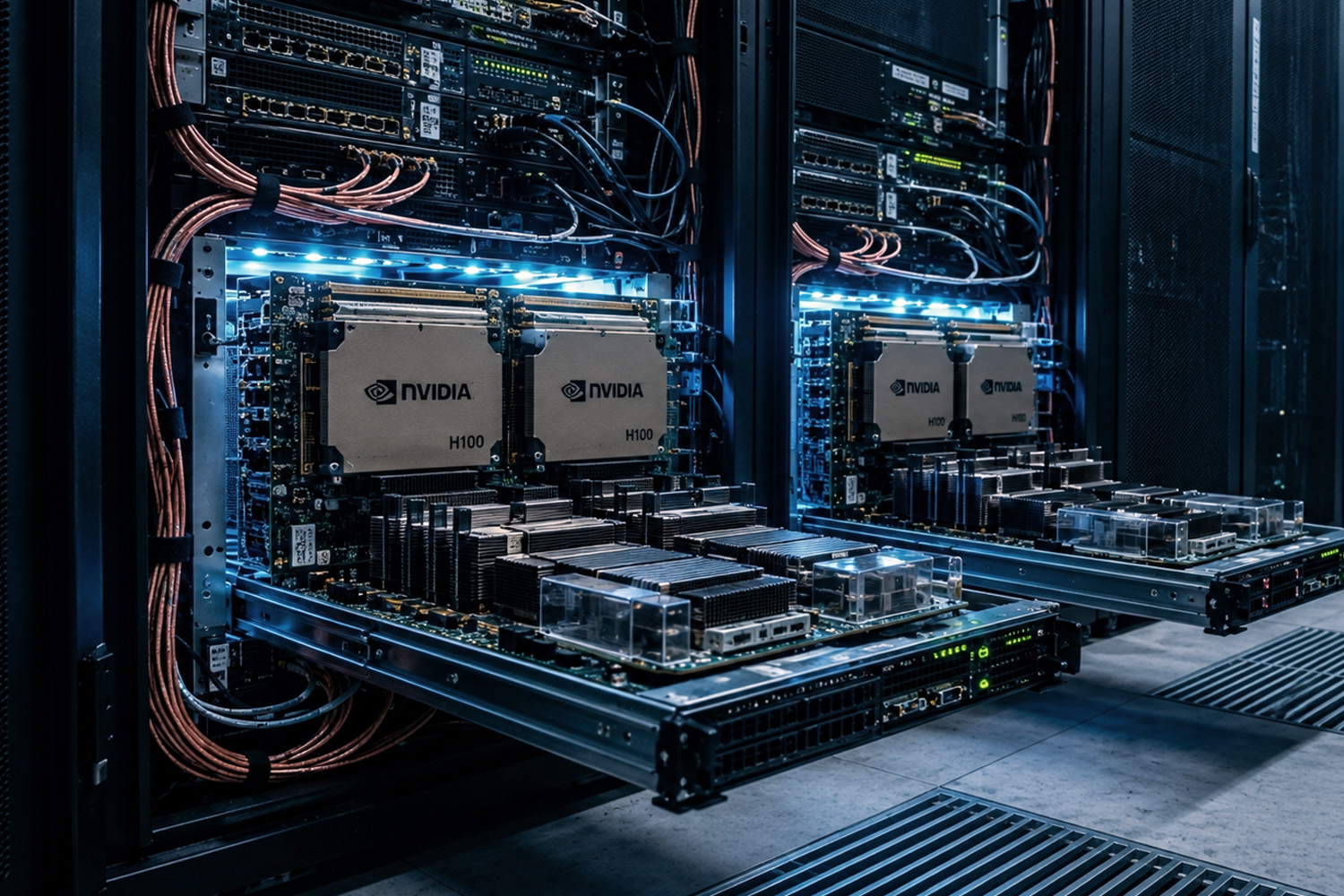
The reported Colossus 1 facility represents industrial-scale AI infrastructure.
A cluster containing more than 220,000 Nvidia processors is not merely a large server deployment – it is comparable to a national strategic asset.
To understand the scale:
- A single Nvidia H100 GPU can cost between $25,000 and $40,000 depending on market conditions.
- Large AI training clusters often require tens of thousands of GPUs operating simultaneously.
- The infrastructure costs of frontier AI systems can reach billions of dollars before electricity expenses are included.
At estimated market pricing, 220,000 high-end Nvidia processors could represent hardware investments worth several billion dollars alone.
The energy requirements are equally extraordinary.
The reported 300-megawatt expansion would place the facility among the largest AI compute operations globally. At near-full utilization, a 300-megawatt facility could consume more than 2.6 terawatt-hours of electricity annually – enough to power hundreds of thousands of homes.
This reveals why AI infrastructure is increasingly becoming an energy problem as much as a technology problem.
Compute Is Becoming the New Oil
The AI industry is increasingly behaving like a heavy industrial sector rather than a traditional software market.
In previous technology cycles, competitive advantage depended largely on software innovation and network effects.
Now, competitive advantage increasingly depends on:
- access to electricity,
- semiconductor allocation,
- data center construction,
- cooling systems,
- and supply chain control.
This is why compute access is beginning to resemble oil reserves during the industrial era.
The companies controlling large-scale computational infrastructure increasingly determine:
- who can train frontier models,
- who can scale globally,
- and who can economically survive rising AI demand.
The importance of infrastructure is also creating a new hierarchy inside the technology sector.
The market is gradually separating into two groups:
- Companies that own infrastructure
- Companies that depend on infrastructure access
That distinction may ultimately determine long-term winners and losers.
Google’s Strategy Is Structurally Stronger
Anthropic’s infrastructure limitations become even more significant when compared to Google.
Unlike most AI firms, Google already controls one of the world’s largest computational ecosystems.
Google owns:
- hyperscale global data centers,
- proprietary Tensor Processing Units (TPUs),
- advanced networking systems,
- Android distribution,
- Search,
- YouTube,
- Workspace,
- and one of the largest cloud platforms globally.
This vertical integration changes the economics entirely.
While Anthropic must secure external compute agreements to satisfy demand, Google can expand AI services using infrastructure it already controls internally.
This is why Google’s upcoming Gemini AI agent project matters strategically.
According to reports, the internally tested “Remy” project aims to create a persistent AI assistant capable of autonomously performing daily tasks rather than simply answering prompts.
That transition is economically important.
A chatbot is a product.
An AI agent becomes an operating layer embedded throughout digital life.
If integrated deeply into Gmail, Android, Search, Docs, and Workspace, Gemini could significantly increase ecosystem dependence while strengthening Google’s existing dominance.
Google’s reported 81% profit increase also provides another major structural advantage: the company can finance massive AI infrastructure expansion using profits generated from advertising and cloud operations.
This allows Google to tolerate the enormous capital intensity of AI far more easily than most independent AI startups.
Nvidia Has Become the Most Important Company in AI Infrastructure
Although OpenAI, Anthropic, and Google dominate headlines, the infrastructure war may ultimately benefit Nvidia more than any individual AI developer.
The reason is structural dependency.
Nearly every major AI company relies heavily on Nvidia accelerators for training and inference workloads.
Industry analysts estimate Nvidia controls roughly 80–90% of the high-performance AI accelerator market.
This creates a powerful economic dynamic:
- AI companies compete against one another,
- but many still purchase infrastructure from the same supplier.
As a result, Nvidia captures value regardless of which AI platform wins the application layer.
The company’s data center business has grown at unprecedented speed:
- Nvidia’s data center revenues surged into annualized territory exceeding $100 billion during the AI boom,
- hyperscalers collectively spend tens of billions annually on AI hardware,
- and demand for advanced accelerators continues exceeding available supply.
In practical terms, Nvidia has become the foundational infrastructure supplier for the modern AI economy.
AI Is Becoming an Energy Industry
One of the least discussed aspects of the AI boom is electricity consumption.
Large AI facilities require extraordinary amounts of energy for:
- GPU operation,
- cooling systems,
- networking infrastructure,
- and uninterrupted uptime.
According to projections from the International Energy Agency, electricity consumption from data centers and AI systems could more than double globally within a few years.
This is transforming the strategic geography of technology infrastructure.
Regions with:
- lower electricity costs,
- stable power grids,
- favorable regulation,
- and available land
are becoming increasingly attractive for AI expansion.
This explains why companies are rapidly expanding infrastructure in states such as Tennessee and Texas.
AI infrastructure deployment now resembles industrial manufacturing planning more than traditional software scaling.
The implications extend beyond technology.
AI demand is beginning to influence:
- utility investment,
- energy pricing,
- renewable infrastructure,
- and even nuclear energy discussions.
Hyperscalers Are Quietly Consolidating Power
The companies best positioned for long-term AI dominance are increasingly the hyperscalers:
- Google,
- Microsoft,
- Amazon,
- and Meta.
The reason is simple: they already own the infrastructure layer.
Collectively, hyperscalers are expected to spend hundreds of billions of dollars on AI-related capital expenditures over the coming years.
This includes:
- data center construction,
- proprietary chips,
- networking systems,
- energy procurement,
- and GPU acquisition.
The economics of AI favor scale heavily.
Larger companies benefit from:
- lower compute costs,
- better supply-chain access,
- stronger bargaining power,
- and the ability to subsidize infrastructure through existing businesses.
This creates rising barriers to entry for smaller firms.
As infrastructure requirements intensify, the AI industry may increasingly resemble:
- cloud computing,
- telecommunications,
- or semiconductor fabrication,
where only a limited number of firms possess the capital required to compete globally.
The Long-Term Transformation of the Technology Sector
The most important structural change underway is the industrialization of artificial intelligence.
Technology is becoming less asset-light and more infrastructure-heavy.
The critical competitive variables are increasingly physical:
- compute capacity,
- energy access,
- semiconductor supply,
- land,
- cooling systems,
- and capital expenditure.
This fundamentally changes how the technology sector operates.
In previous decades, small software firms could challenge incumbents with relatively modest infrastructure.
In the AI era, infrastructure itself is becoming the moat.
The companies dominating the next decade may not necessarily be those producing the most impressive demos today. Instead, they are likely to be the firms capable of financing, operating, and scaling the largest computational ecosystems efficiently over long periods.
Conclusion
Anthropic’s infrastructure expansion and reported reliance on external compute agreements reveal one of the defining realities of the modern AI economy: demand for advanced AI is now growing faster than available infrastructure capacity.
That is transforming the industry.
The AI race is evolving into a global competition over:
- compute,
- energy,
- semiconductor supply,
- and hyperscale infrastructure ownership.
Google’s vertically integrated ecosystem, Nvidia’s dominance in AI accelerators, and the growing industrial scale of data centers all point toward the same conclusion:
The future leaders of artificial intelligence will not simply be the companies with the best models.
They will be the companies controlling the physical infrastructure required to power AI at planetary scale.