Strategic Context
Vehicle access systems have evolved significantly over the past several decades. Traditional mechanical keys have gradually been replaced by electronic key fobs, smartphone-based digital keys, and increasingly sophisticated authentication technologies.
As vehicles become more connected and software-driven, automakers are investing in new forms of identity verification to improve both convenience and security. Biometric technologies-including facial recognition, fingerprint authentication, and driver monitoring systems-are emerging as a potential next step in automotive access control.
These technologies reflect a broader convergence between the automotive industry and the consumer electronics sector, where biometric authentication has already become widely used in smartphones, laptops, and financial services.
The adoption of biometric vehicle access systems illustrates how automakers are responding to growing cybersecurity concerns, consumer expectations for seamless digital experiences, and the broader transition toward connected and software-defined vehicles.
What Happened
Several automakers have begun integrating biometric technologies into their vehicles as part of broader digital access strategies.
Mercedes-Benz introduced fingerprint authentication in some models equipped with its MBUX infotainment system. The fingerprint sensor allows drivers to authenticate profiles and access personalized settings within the vehicle.
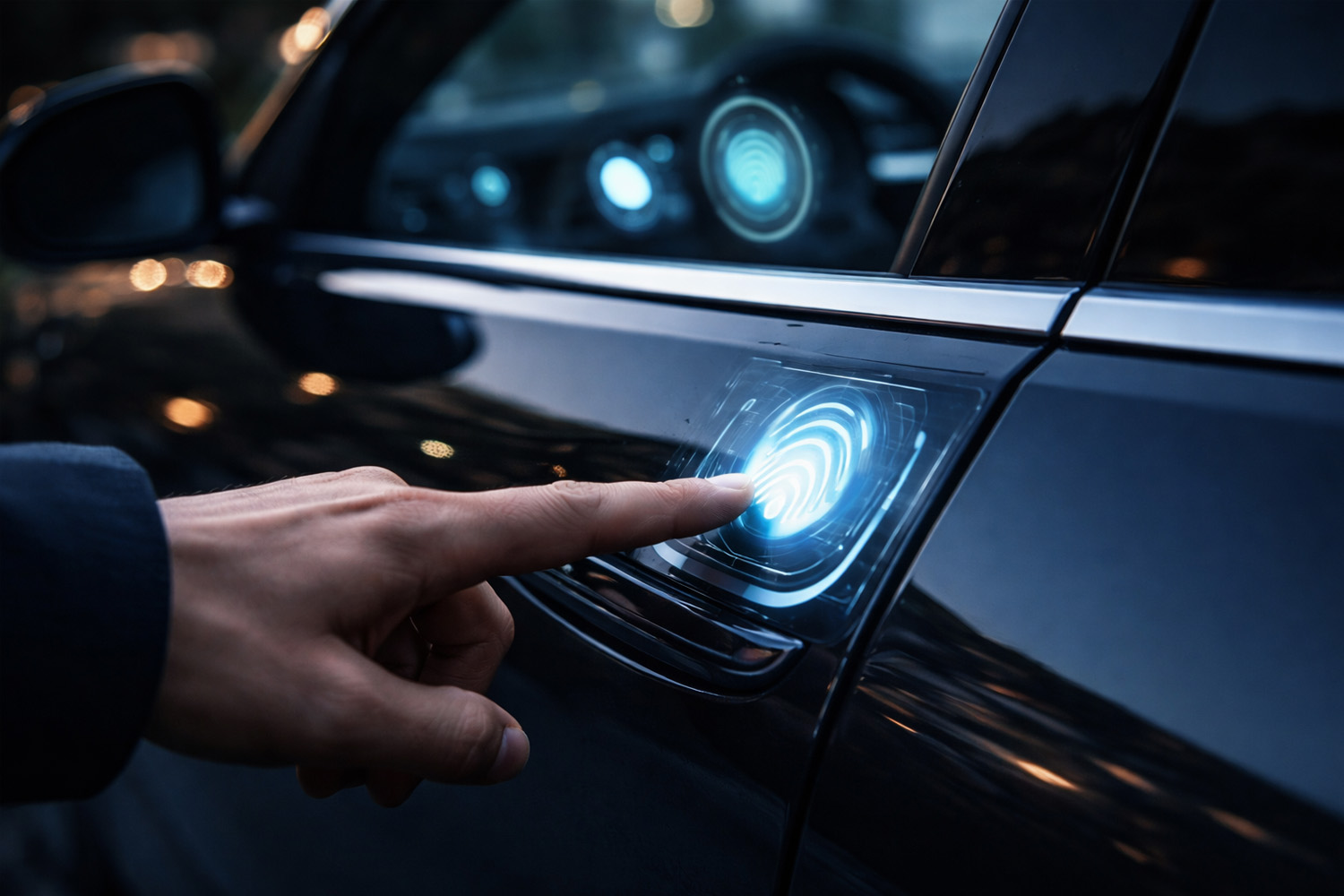
Hyundai has implemented fingerprint recognition technology in certain vehicles, enabling drivers to unlock doors and start the car without a physical key. The system scans a driver’s fingerprint and compares it with encrypted data stored in the vehicle.
Genesis, Hyundai’s luxury brand, has also deployed fingerprint-based access and driver identification features in select markets.
Facial recognition technology has also been explored by several manufacturers. Tesla has reportedly tested internal camera systems capable of recognizing drivers and enabling personalized settings, although these systems are primarily used for driver monitoring and safety features.
Chinese automakers have also moved aggressively into biometric technologies. For example, NIO has integrated advanced driver recognition systems in some models, linking biometric identification with driver profiles and personalized vehicle settings.
In addition to direct biometric authentication, automakers are increasingly adopting digital key technologies, which allow drivers to unlock and start vehicles using smartphones. These systems rely on secure wireless standards such as Near Field Communication (NFC) or Ultra Wideband (UWB).
Industry organizations such as the Car Connectivity Consortium have developed the Digital Key standard, which enables smartphone-based car access across multiple automakers and technology companies.
Why It Matters
The adoption of biometric car access systems is significant because it addresses several challenges facing modern vehicles.
First, vehicle theft and unauthorized access remain persistent issues worldwide. Traditional key fobs can be vulnerable to relay attacks, in which attackers intercept and extend the wireless signal between the key and the car.
Biometric authentication introduces an additional layer of identity verification, making unauthorized access more difficult. Unlike traditional keys, biometric identifiers are directly linked to the driver’s identity.
Second, biometric technologies support vehicle personalization. Modern vehicles increasingly function as digital platforms with customizable driver profiles, including seat positions, climate preferences, infotainment settings, and driving modes. Biometric identification allows vehicles to automatically recognize the driver and apply these settings.
Third, biometric systems align with broader trends in mobility. As autonomous driving technologies and shared mobility services evolve, verifying the identity of the person accessing the vehicle becomes more important.
In such environments, biometric authentication could serve as a secure access mechanism for shared vehicles, car subscription services, and fleet management platforms.
Market / Financial / Sector Impact
The growing use of biometric vehicle access systems is creating new opportunities within the automotive technology ecosystem.
Suppliers specializing in sensors, identity verification, and automotive cybersecurity are becoming increasingly important partners for automakers.
Companies involved in semiconductor manufacturing, biometric sensors, and embedded security software are likely to benefit as demand for these technologies increases.
In addition, the shift toward biometric authentication is closely tied to the broader development of software-defined vehicles, where software updates and digital services play a central role in the user experience.
Automakers are therefore investing not only in hardware but also in secure software architectures capable of protecting biometric data and managing digital identities.
Competitive Landscape
Biometric car access technologies are developing alongside several alternative vehicle access systems.
Digital keys are currently among the most widely adopted technologies. Automakers including BMW, Apple, and several others have collaborated on smartphone-based digital keys that allow vehicles to be unlocked and started using compatible devices.
Ultra Wideband (UWB) technology has been adopted by several manufacturers to improve the accuracy and security of smartphone-based car access. UWB can precisely determine the location of a device relative to the vehicle, reducing the risk of relay attacks.
Other emerging access technologies include:
- Smartphone-based digital keys – Developed by the Car Connectivity Consortium and supported by companies such as Apple and Samsung.
- Passive keyless entry systems – Used widely across modern vehicles and developed by automotive suppliers including Continental and Bosch.
- Bluetooth-based access systems – Integrated into mobile applications for vehicle entry and remote control.
- Driver monitoring systems – Developed by companies such as Seeing Machines and Smart Eye, primarily used for safety but potentially adaptable for driver identification.
These systems are increasingly being integrated into unified vehicle access platforms that combine multiple authentication methods.
Risks & Uncertainties
Despite their advantages, biometric vehicle access systems also present challenges.
One of the most significant concerns is data security and privacy. Biometric data is highly sensitive and must be securely stored and processed to prevent misuse.
Automakers must also ensure that biometric systems function reliably under real-world conditions, including varying lighting, weather, and driver behavior.
Another challenge is regulatory compliance. Data protection regulations in many jurisdictions impose strict requirements on how biometric data can be collected, stored, and processed.
In addition, consumer acceptance remains an important factor. While biometric authentication is widely used in smartphones, some drivers may still prefer traditional keys or smartphone-based systems.
Bigger Trend Implications
The development of biometric vehicle access systems reflects a broader transformation in the automotive industry.
Vehicles are increasingly becoming connected digital platforms that integrate identity verification, cybersecurity, and personalized services.
Biometric authentication represents one possible pathway toward secure and seamless vehicle access in an era of autonomous driving, shared mobility, and digitally integrated transportation networks.
Over time, automotive access systems are likely to combine multiple technologies-including biometrics, digital keys, and advanced encryption-to create layered security architectures.
As vehicles continue to evolve into software-driven devices, identity verification and cybersecurity will become central components of automotive innovation.
The adoption of biometric technologies therefore signals not only an improvement in vehicle security, but also a fundamental shift in how drivers interact with their cars in the digital age.