The rapid development of artificial intelligence has triggered one of the most significant shifts in how information is accessed on the internet. For decades, traditional search engines structured online discovery through lists of hyperlinks ranked by algorithms. Generative AI systems are now challenging that model by providing direct answers to complex questions. Among the startups leading this transition is Perplexity AI, a company that has positioned itself as a new type of “answer engine” built around large language models and real-time information retrieval.
Founded in 2022 in San Francisco, Perplexity AI was created by a team of engineers and researchers including Aravind Srinivas, Denis Yarats, Johnny Ho, and Andy Konwinski. The startup quickly attracted attention from venture capital investors as well as from the broader technology community because it proposed a different approach to search: instead of showing a page of links, the system synthesizes answers using artificial intelligence while citing the sources used to generate the response.
The company’s valuation has increased rapidly as investor interest in generative AI surged. By 2024–2025, funding rounds placed the company’s valuation in the multi-billion-dollar range, reflecting the belief among investors that AI-driven information discovery could become a major technology market in the coming decade.
What Perplexity Actually Does
At its core, Perplexity AI is a hybrid platform that combines a search engine with conversational AI. Users can type questions in natural language and receive synthesized explanations that draw from multiple sources across the internet.
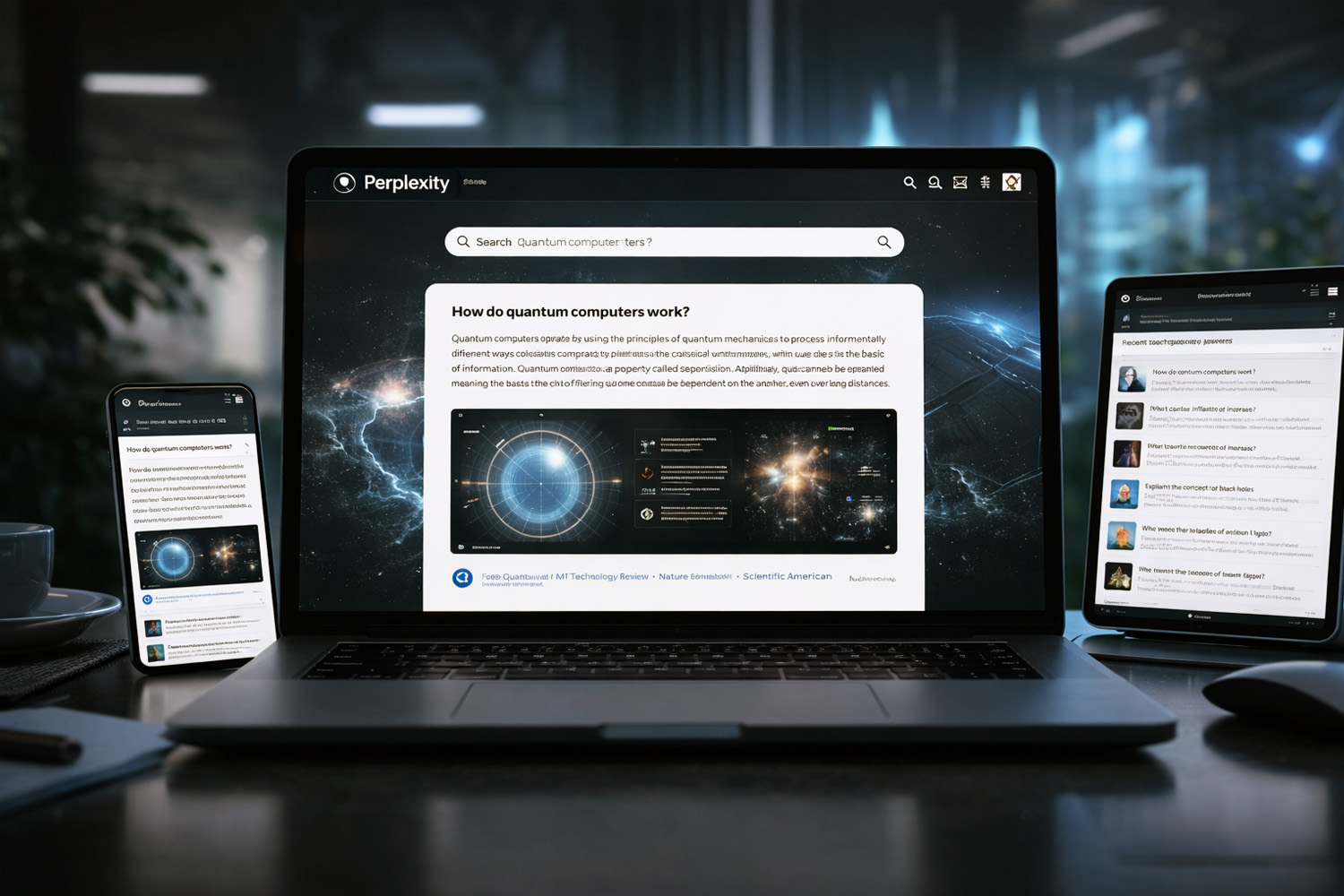
The system functions similarly to a research assistant rather than a conventional search tool. A user can ask a question such as “What are the main causes of global inflation?” or “How do quantum computers work?” and receive a structured answer accompanied by links to the sources used to generate the explanation.
This interaction model differs from traditional search in several ways:
First, the system interprets the intent behind the query rather than simply matching keywords.
Second, it synthesizes information from multiple sources to produce a single coherent answer.
Third, it allows follow-up questions in a conversational format, enabling users to refine or expand their research without starting a new search each time.
The interface therefore resembles a dialogue rather than a list of webpages.
Technology Behind the Platform
Perplexity AI relies on a technical architecture known as retrieval-augmented generation (RAG). In this framework, the system performs a real-time search of online sources and then uses large language models to summarize and synthesize the information retrieved.
Unlike a traditional generative AI chatbot that relies solely on training data, retrieval-augmented systems integrate fresh external data at the moment a query is made. This reduces the risk of outdated answers and improves factual grounding.
Importantly, Perplexity does not rely exclusively on its own proprietary language models. The platform integrates models from several providers, including systems developed by companies such as OpenAI and Anthropic, alongside its own internal infrastructure.
This modular approach allows the company to combine different models depending on the type of task being performed. For example, certain models may be optimized for reasoning, while others are designed for speed or cost efficiency.
Another key design principle is transparency. The system typically displays citations beneath its responses, allowing users to verify where the information originated. This feature addresses a major criticism of generative AI systems: their tendency to produce confident but inaccurate answers.
How Users Access the Platform
Perplexity is designed to be accessible to ordinary internet users without specialized technical knowledge. The service is available through a web interface and mobile applications, where users can interact with the system similarly to a chat platform.
A basic version of the service is free, while a premium subscription known as Perplexity Pro offers access to more advanced AI models, faster responses, and additional features.
Users employ the platform for a variety of purposes:
- conducting online research
- summarizing complex topics
- comparing information from multiple sources
- generating structured explanations
- exploring technical or academic questions
In many cases, the tool functions as a faster alternative to manually reading multiple articles or reports.
Competitors in the AI Search Market
Although Perplexity is often described as a pioneer of the answer-engine concept, it operates within an increasingly competitive landscape.
Major technology companies are rapidly integrating similar capabilities into their search products. For example, AI-generated answers have become a central component of search tools developed by companies such as Google and Microsoft.
These firms possess enormous advantages in infrastructure, distribution, and data access. However, startups like Perplexity can innovate more quickly because they are not constrained by legacy search architectures.
Competition is also emerging from other AI-native research tools and conversational assistants. The growing number of platforms experimenting with AI-driven search reflects the belief that the traditional search model is entering a period of transformation.
Why the Startup Matters
Perplexity’s importance lies not only in its product but also in what it represents for the future of information access. The company is part of a broader shift toward conversational interfaces that interpret user intent rather than simply matching keywords.
This change has implications for how people interact with digital knowledge. Instead of navigating through multiple websites, users increasingly expect systems to synthesize and explain information directly.
Such capabilities can dramatically reduce the time required to research complex topics. In professional environments – including journalism, finance, academia, and software development – AI research assistants may become standard productivity tools.
From an industry perspective, the rise of answer engines could alter the economic structure of the web. Traditional search engines rely heavily on advertising revenue generated by clicks on search results. If AI systems deliver answers directly without requiring users to visit external sites, that model may gradually evolve.
The Broader Trend: AI as the Interface to Knowledge
Perplexity’s emergence reflects a deeper transformation in the digital ecosystem. Artificial intelligence is increasingly becoming the primary interface between users and the internet’s vast information resources.
Rather than acting as passive indexes, search tools are evolving into active interpreters of knowledge. They analyze questions, extract relevant information, and generate explanations in human-readable language.
This transformation parallels earlier shifts in computing interfaces. Just as graphical interfaces replaced command-line systems, conversational AI may replace traditional search queries as the dominant way people interact with digital information.
In that context, Perplexity AI illustrates the experimental phase of a new category of technology: AI systems designed not only to find information, but to explain and contextualize it.
Whether the company ultimately becomes a dominant platform or remains one of several innovators in the field, its approach highlights the direction in which the internet’s information architecture may be evolving.
The search engine shaped how knowledge was organized online for more than two decades. Answer engines like Perplexity suggest that the next era of the internet may be defined by AI systems capable of transforming raw data into structured understanding.
Related Analysis:
Global AI Landscape: Leading Artificial Intelligences in 2026