For decades, the basic architecture of a digital hearing aid was relatively straightforward: microphones captured environmental sound, a processor analyzed it, and the device amplified selected frequencies according to the user’s hearing profile. Modern digital hearing aids added directional microphones, feedback suppression, environmental classification and increasingly sophisticated signal processing.
Artificial intelligence is changing the architecture rather than simply adding another feature.
The important transition is from amplifying an imperfect acoustic signal to computationally reconstructing a more useful version of that signal. Instead of treating speech, noise and competing sounds as components that should simply be amplified or attenuated, neural networks can learn statistical patterns that help separate them and produce a new audio representation optimized for intelligibility.
This places hearing technology within a much broader computing trend: specialized AI is moving from servers and smartphones into extremely constrained edge devices where computation must happen continuously, with minimal latency and very limited energy.
From Amplification to Signal Reconstruction
Traditional hearing aids operate largely within the framework of digital signal processing. Incoming sound is divided into frequency regions, analyzed and modified according to predefined rules. Directional microphones can emphasize sound arriving from particular directions, while noise-reduction algorithms can identify and suppress certain unwanted acoustic patterns.
These techniques remain important. AI does not replace signal processing; increasingly, it becomes another computational layer within the same system.
The distinction is that a neural network can learn relationships between desirable and undesirable acoustic components rather than relying exclusively on manually designed rules.
Research published in 2023 demonstrated this direction clearly. A deep-learning system was trained to selectively suppress noise while preserving speech and achieved speech-intelligibility results approaching those of people with normal hearing in the tested conditions. Importantly, the researchers designed the system to operate in real time and showed that it could work with a single microphone, highlighting the potential of neural processing beyond conventional multi-microphone beamforming.
The underlying architectural change is significant.
A conventional system effectively asks: Which parts of this signal should be amplified or attenuated?
A neural enhancement system can instead ask: What acoustic structure most likely represents the speech that the listener needs to understand, and what representation should be produced from the available input?
That is much closer to reconstruction than conventional amplification.
The Real Problem Is Not Noise – It Is Ambiguity
The hardest hearing environments are not simply loud ones. They are acoustically ambiguous.
A restaurant may contain several simultaneous speakers, dishes, ventilation systems, music and reflections from walls. A conversation on a street can combine traffic, wind and multiple moving sound sources. In these conditions, the hearing device must determine which information is relevant without having direct access to the listener’s intention.
This is why spatial information has become increasingly important.
Recent research on neural hearing systems has demonstrated architectures that exploit differences between microphone signals to infer the spatial characteristics of sound sources. A 2026 randomized study of an investigational Spatial AI hearing system found substantially greater preference for the AI system in tested multitalker conditions than for five control hearing aids, although the study was relatively small, involving 20 adults with mild to moderately severe bilateral sensorineural hearing loss.
The broader engineering lesson is more important than the individual result.
AI hearing systems are increasingly becoming spatial inference systems. They do not merely process a waveform; they attempt to infer the structure of the acoustic environment and then generate an output appropriate for the listener.
That resembles the evolution of computer vision. Early systems processed pixels using predefined transformations. Modern vision systems infer objects, boundaries and relationships. Neural hearing technology is moving toward a comparable interpretation layer for sound.
Why Processing Must Move to the Edge
There is an obvious alternative: send the audio to a cloud service, process it with a much larger model and return the reconstructed sound.
For hearing aids, that architecture is generally impractical.
Audio must be processed continuously. Delays can interfere with the synchronization between a person’s own voice, environmental sound and the processed signal. Wireless connectivity is not sufficiently predictable to make cloud processing the primary path for real-time hearing assistance. Continuous transmission would also impose substantial energy and privacy costs.
The result is a demanding edge-computing problem.
The AI model must operate:
- with extremely low latency;
- on limited processing hardware;
- within a small thermal envelope;
- at very low power consumption;
- continuously throughout the day;
- while maintaining stable and predictable audio behavior.
This is one reason hearing technology is becoming a useful test case for specialized AI acceleration.
A 2025 study on neuromorphic speech enhancement explicitly identified computational cost as a major obstacle to deploying deep-learning speech enhancement on resource-constrained devices such as hearing aids and headsets. Research published in 2026 has similarly explored lightweight streaming architectures designed specifically around real-time constraints.
The important point is that this is not simply a matter of making an AI model smaller.
The entire computational architecture has to be optimized around the acoustic workload.
Specialized Chips Become Part of the AI Model
The latest generation of commercial systems illustrates this hardware-software convergence.
Sonova’s Phonak EON platform, launched in August 2026, combines a newly developed HYPERSONIC chip with a deep-neural-network speech-processing system and a separate AI-based environmental analysis layer. Sonova says the new architecture is substantially more power efficient than its previous generation, enabling a smaller device while retaining real-time AI processing.
The significance is architectural.
As AI moves into wearables, general-purpose processors become increasingly inefficient for particular workloads. Specialized accelerators can execute neural-network operations more efficiently, while traditional digital signal-processing blocks continue to handle deterministic tasks.
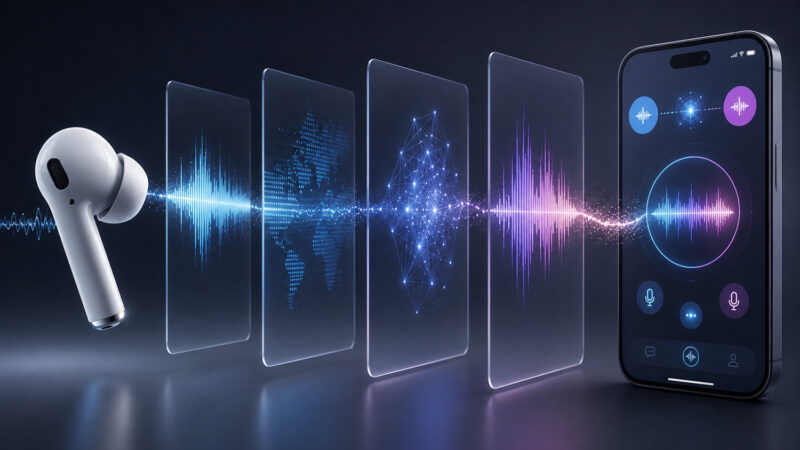
The likely architecture therefore looks less like a single AI processor and more like a heterogeneous audio-computing pipeline:
microphones → acoustic preprocessing → neural inference → environmental analysis → signal reconstruction → personalization → speaker output
Each stage has different requirements.
Some operations need deterministic latency. Others benefit from machine learning. Some can tolerate approximate computation, while others cannot. The engineering challenge is deciding where intelligence belongs and how the components interact.
That is a systems problem, not merely an AI-model problem.
The Training Data Problem Becomes a Hardware Problem
A neural network can only reconstruct sound reliably when its training conditions represent the environments in which it will eventually operate.
This creates an unusual constraint for hearing technology.
Real-world acoustic environments are enormously variable. Speech overlaps. People move. Rooms reverberate. Wind interacts with microphones. Background sounds can be intermittent or highly structured.
Recent work in commercial AI hearing systems has therefore emphasized training and evaluation using real-world environments rather than relying exclusively on artificially generated noise. Research presented in 2026 reported improvements after expanding training data to include environments such as restaurants, public transport, construction areas and reverberant indoor spaces.
This exposes an important scaling problem.
For a conventional algorithm, adding a new acoustic scenario might mean designing another rule or classifier.
For a neural system, improving robustness can require new data, retraining, validation and potentially changes to the model itself.
The competitive advantage therefore shifts toward organizations capable of building data, model-training, hardware and clinical-validation pipelines simultaneously.
That makes hearing AI increasingly resemble other specialized AI industries: the model is only one component of the technological moat.
AI Is Also Changing the Software Lifecycle
Traditional hearing-aid processing is comparatively static. Once an algorithm has been engineered, validated and embedded into a device, its behavior is largely determined by the installed software.
AI introduces a more iterative development model.
A better model can potentially improve performance without fundamentally redesigning the acoustic hardware. That creates the possibility of treating the hearing device more like a computing platform whose capabilities evolve through software.
However, medical-device regulation makes this fundamentally different from updating a smartphone application.
The U.S. Food and Drug Administration already maintains a dedicated framework for AI-enabled medical devices and has issued guidance addressing lifecycle management, documentation and predetermined change-control strategies for AI-enabled device software.
This creates a structural trade-off.
AI developers want models that can evolve quickly. Medical-device regulators require predictable performance, evidence and controlled changes.
The future architecture therefore cannot simply be “continuously learning AI.” It is more likely to involve controlled model releases, predefined update mechanisms and extensive validation before deployment.
That distinction matters because it separates medical AI from consumer AI.
The Hearing Device Is Becoming a Platform
Another important shift is occurring outside the ear itself.
Hearing assistance is increasingly becoming distributed across devices.
Apple’s hearing-health architecture, for example, combines AirPods hardware, iPhone or iPad processing and software-based personalization. The FDA authorized Apple’s Hearing Aid Feature in 2024 as software for compatible AirPods Pro hardware, while Apple’s current platform continues to integrate hearing testing, personalization and hearing assistance into its broader device ecosystem.
This creates two competing architectural models.
The first is the dedicated medical wearable: optimized hardware, specialized processors, professional fitting and highly controlled acoustic behavior.
The second is the general-purpose computing ecosystem: earbuds connected to smartphones, operating systems and health software.
Neither model eliminates the other.
Dedicated hearing aids retain advantages in specialized acoustics, power management, fitting and medical functionality. Consumer electronics companies, meanwhile, can leverage enormous installed hardware bases and mature mobile-computing ecosystems.
The result is likely to be greater competition at the boundary between medical devices and consumer electronics.
The Next Bottleneck Is Understanding Intent
Even highly effective speech separation has a fundamental limitation: the device still has to determine what the listener wants to hear.
Microphones provide acoustic information. They do not directly provide attention.
This is why research is beginning to explore interfaces between hearing systems and the human nervous system. A 2026 Nature Neuroscience study demonstrated a real-time brain-controlled system capable of decoding which speaker a person was attending to and dynamically enhancing that speaker in a multi-talker environment. The work was conducted using intracranial recordings in patients undergoing neurosurgical procedures, so it should not be confused with a deployable consumer hearing aid.
Nevertheless, it illustrates the direction of the technical problem.
Today’s systems infer intent indirectly from acoustic and spatial information.
A future generation of assistive hearing systems could potentially incorporate additional signals about attention, behavior or context.
That represents a transition from sound enhancement to intent-aware audio computing.
It is also where engineering complexity rises sharply, because every additional sensing modality introduces new requirements for safety, privacy, latency and validation.
Industry Implications: The Moat Moves Up the Stack
The hearing-aid industry has historically competed heavily on acoustic engineering, miniaturization, fitting and clinical expertise.
AI expands the competitive stack.
Companies now need expertise in:
- neural-network design;
- low-power inference;
- custom silicon;
- acoustic datasets;
- spatial audio processing;
- software updates;
- mobile connectivity;
- clinical validation;
- medical-device regulation.
This favors companies that can integrate hardware and software rather than those optimizing only one layer.
At the same time, AI could reduce differentiation at the level of basic signal processing. If speech enhancement becomes increasingly software-defined, the industry may shift competition toward model quality, computing efficiency, data, personalization and ecosystem integration.
The economic structure of the market could therefore begin to resemble other edge-AI sectors, where the hardware provides the sensing platform but software increasingly determines the perceived performance.
The Long-Term Trajectory: From Hearing Aids to Adaptive Audio Computers
The most important technological trend is not simply that hearing aids are acquiring AI.
It is that audio itself is becoming an inferential computing problem.
The first generation of digital hearing technology digitized sound.
The next generation increasingly analyzes sound.
AI-based systems go further by estimating which components matter and reconstructing an output optimized for a particular listener and environment.
That progression creates a general architecture that could extend beyond hearing aids into earbuds, communication devices, accessibility systems and other wearable audio platforms.
But the physical constraints will remain decisive. Battery capacity, latency, microphone quality, acoustic feedback, processing efficiency and thermal limitations cannot be solved by larger neural networks alone.
The winning architectures will therefore be those that combine better models with better hardware and carefully designed signal-processing pipelines.
Conclusion
AI-based hearing technology represents a deeper shift than simply adding machine learning to an existing medical device.
The fundamental architecture is moving from amplification toward inference and reconstruction. Neural networks can separate speech from complex acoustic environments, spatial processing can help identify relevant sound sources, and specialized edge hardware can execute these models within the severe power and latency constraints of a wearable device.
The next stage is likely to be defined less by increasingly large AI models and more by increasingly efficient ones: models designed around microphones, processors, batteries, acoustics and regulatory requirements from the beginning.
That is the central systems-level insight.
The future hearing device is not merely an amplifier with AI added to it. It is becoming a small, continuously operating edge-computing system whose primary task is to interpret the acoustic environment and construct a more useful version of reality for the listener.