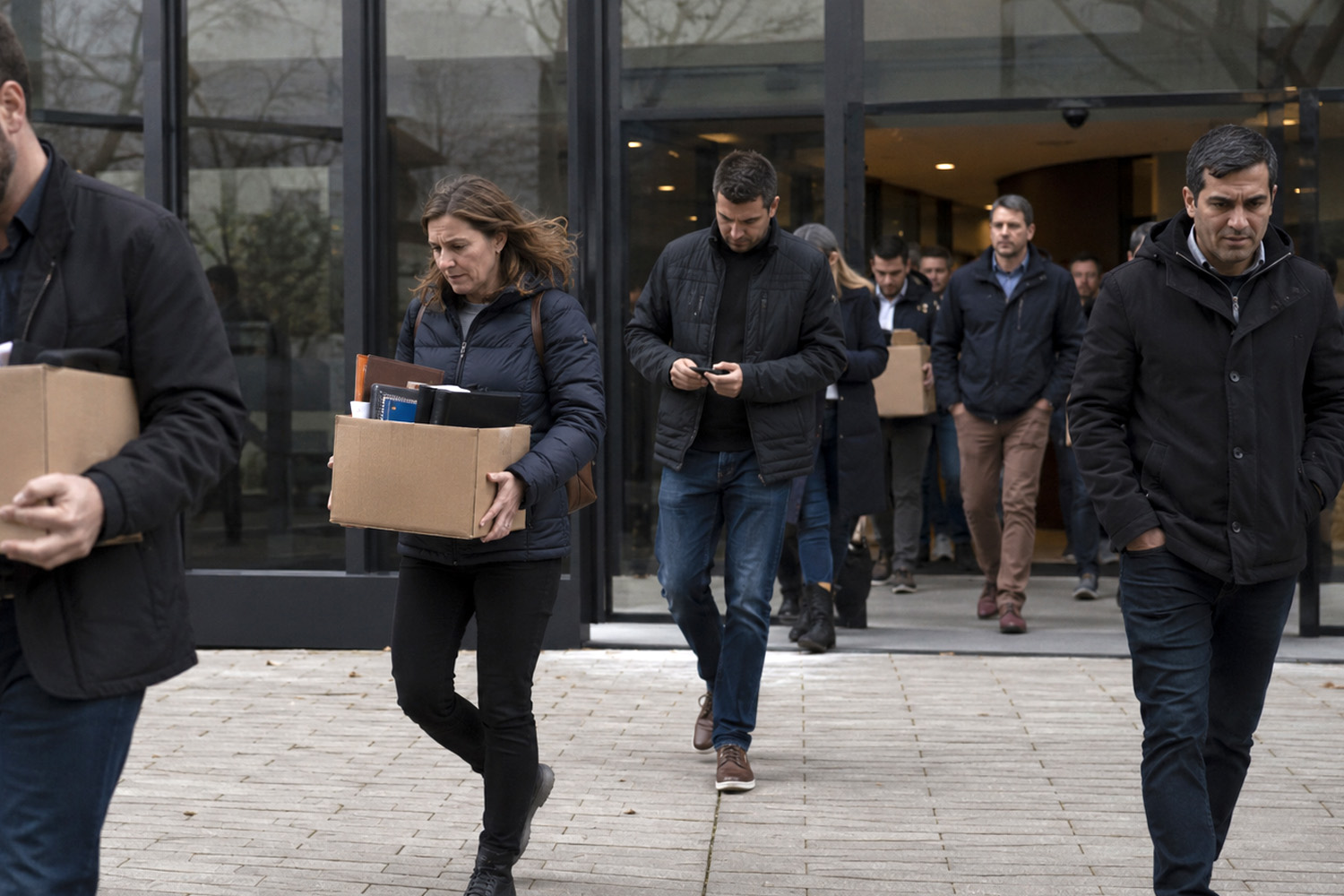
The decision by General Motors to reduce approximately 10% of its technical and IT contractor workforce marks more than a routine cost-cutting exercise. The company’s restructuring reflects a broader transformation taking place across global corporations in 2026: the replacement of traditional labor-intensive operational structures with AI-centered organizational models.
Across technology, finance, manufacturing, retail, logistics, and consulting, corporations are increasingly reallocating capital away from large workforces and toward artificial intelligence infrastructure, automation systems, and machine-learning integration. Layoffs are no longer primarily associated with recessionary panic or declining revenues. Instead, many firms reporting strong earnings and expanding market valuations are simultaneously reducing headcount while increasing investment in AI.
This shift signals a structural redefinition of corporate efficiency, managerial governance, and labor demand. The result is a labor market increasingly shaped not by cyclical economic weakness, but by technological substitution and institutional redesign.
The Numbers Behind the 2026 Layoff Wave
Data collected across public filings, industry trackers, and corporate announcements shows that workforce reductions accelerated significantly during the first months of 2026. According to multiple industry trackers, more than 92,000 technology-sector layoffs were recorded globally within the first five months of the year.
Several of the largest workforce reductions came from corporations simultaneously expanding AI spending programs.
| Month | Company | Estimated Jobs Cut |
|---|---|---|
| January 2026 | Amazon | 16,000 |
| January 2026 | Intel | 15,000 |
| January 2026 | Ericsson | 1,600 |
| January 2026 | General Motors | 1,140 |
| February 2026 | Salesforce | 4,000 |
| February 2026 | Block | 4,000 |
| February 2026 | ASML | 1,700 |
| March 2026 | Dell Technologies | 11,000 |
| March 2026 | Atlassian | 1,600 |
| March 2026 | Goldman Sachs | 1,500 |
| March 2026 | Epic Games | 1,000 |
| April 2026 | Meta Platforms | 8,000 |
| April 2026 | Microsoft | 8,750 |
| May 2026 | Accenture | 11,000 |
| May 2026 | Cloudflare | 1,100 |
| May 2026 | Coinbase | 700 |
The scale of these cuts demonstrates that workforce reduction is no longer confined to underperforming sectors. Many affected firms remain profitable and continue aggressive expansion in AI, cloud infrastructure, and automation.
Why Corporations Are Restructuring
The primary structural driver behind the 2026 layoff wave is the rapid commercialization of generative artificial intelligence.
Executives increasingly argue that AI systems can absorb functions previously requiring large numbers of software engineers, analysts, support staff, project managers, marketers, and administrative personnel. Tasks involving coding, customer support, documentation, data processing, scheduling, and internal communications are becoming increasingly automated.
Corporate management now views AI not merely as a productivity tool but as a mechanism for redesigning the organizational structure itself.
This explains why layoffs are occurring simultaneously with rising capital expenditures. Companies are redirecting labor budgets into AI infrastructure, semiconductor procurement, cloud computing expansion, and machine-learning integration.
For example, major technology firms dramatically increased AI spending targets in 2026 while implementing workforce reductions. Meta Platforms raised projected AI-related capital expenditures while cutting approximately 8,000 jobs. Amazon and Microsoft similarly combined restructuring initiatives with expanded AI investment programs.
The logic is increasingly financial rather than operational. AI systems require substantial upfront investment but potentially reduce long-term labor costs, pension liabilities, and management complexity.
From a governance perspective, corporations are attempting to create leaner structures with fewer middle-management layers and higher automation capacity. Amazon explicitly described its restructuring as an effort to “reduce bureaucracy” and flatten organizational layers.
The End of Pandemic-Era Hiring Expansion
Another important structural factor is the correction following the massive hiring expansion of 2020–2023.
During the pandemic and immediate post-pandemic years, many technology firms dramatically increased staffing in anticipation of permanent digital acceleration. Companies hired aggressively across software development, cloud services, logistics, digital commerce, and remote-work infrastructure.
However, the long-term demand projections underlying those hiring surges proved unsustainable.
The emergence of advanced generative AI systems accelerated the reassessment. Firms that once needed large engineering and support teams now believe automation can maintain or increase productivity with fewer employees.
This creates a dual correction process:
- Removal of excess hiring from the pandemic expansion period
- Replacement of some existing human functions with AI-assisted workflows
The result is not merely cyclical downsizing but a broader transition toward a permanently different employment model.
Institutional and Governance Implications
The restructuring wave also reveals changing relationships between corporations, labor markets, and institutional governance.
Historically, workforce expansion was associated with corporate strength and economic optimism. In 2026, investors increasingly reward companies for reducing headcount while increasing automation efficiency.
Financial markets now interpret layoffs as signals of operational discipline and AI readiness. This changes incentives for executives and boards.
Institutionally, companies face pressure from shareholders to demonstrate measurable AI integration. Corporate leadership teams increasingly frame labor reductions as evidence of modernization rather than retrenchment.
This shift has significant implications for labor relations and governance systems.
Traditional employment structures relied on long-term workforce stability, internal promotion pipelines, and gradual skill development. AI restructuring weakens those models by increasing demand for highly specialized technical expertise while reducing the need for broader mid-level staffing.
Consequently, labor markets may become increasingly polarized between:
- Small groups of highly compensated AI specialists
- Larger pools of contract-based, temporary, or displaced workers
This dynamic is already visible in sectors beyond technology, including finance, logistics, retail, consulting, and manufacturing.
Social Consequences of AI-Centered Workforce Reduction
The social consequences extend beyond unemployment statistics.
Large-scale layoffs contribute to declining perceptions of employment stability, particularly among white-collar professionals who previously viewed technology-sector careers as secure and upwardly mobile.
Public discussions surrounding AI increasingly reflect anxiety about long-term employability rather than enthusiasm for innovation alone. Online professional communities and labor forums show growing concern that automation is affecting not only repetitive work but also skilled knowledge-based professions.
This uncertainty may alter broader social behavior.
Workers may become more reluctant to specialize narrowly in fields vulnerable to automation. Universities and training systems could face pressure to redesign educational priorities toward adaptive and interdisciplinary skills rather than routine technical specialization.
At the same time, governments may encounter growing demands for labor protections, retraining initiatives, and updated social safety mechanisms.
The political implications are significant because technological displacement increasingly affects middle-income professional workers rather than only low-wage industrial labor.
A Global Shift Rather Than a Temporary Trend
Importantly, the 2026 layoffs are not confined to Silicon Valley.
The reductions span North America, Europe, and Asia across industries including automotive manufacturing, banking, consulting, semiconductors, logistics, telecommunications, and healthcare.
This indicates that AI-driven restructuring represents a systemic transformation of global corporate behavior rather than a temporary technology-sector correction.
The pattern also suggests that future competitiveness may depend less on workforce size and more on computational efficiency, proprietary AI systems, and access to advanced semiconductor infrastructure.
In this environment, labor itself becomes strategically redefined.
Rather than maximizing employee count to increase output, corporations increasingly seek to maximize automation capacity while minimizing organizational complexity.
Long-Term Outlook
The long-term consequences of the 2026 restructuring wave may reshape the relationship between productivity and employment.
Historically, technological revolutions eventually generated new categories of work even as older roles disappeared. However, the speed and scope of AI integration raise questions about whether labor-market adaptation can occur quickly enough to offset displacement.
Governments, educational institutions, and corporations may need to rethink how societies manage transitions during periods of rapid technological substitution.
Potential policy debates could increasingly focus on:
- Workforce retraining systems
- Corporate responsibility in AI deployment
- Regulation of algorithmic labor replacement
- Tax structures related to automation gains
- Social insurance modernization
The central challenge is not whether AI will improve productivity. Most evidence suggests it will. The deeper question is how the economic gains from automation will be distributed across society.
Conclusion
The layoffs carried out by General Motors and other global corporations in 2026 illustrate a structural transformation in modern capitalism rather than a temporary economic slowdown.
Artificial intelligence is reshaping how corporations define efficiency, productivity, and workforce value. Companies are increasingly reallocating resources away from traditional labor expansion and toward automation infrastructure, data systems, and AI-driven operational models.
This transition is redefining institutional governance, labor-market stability, and public perceptions of economic security.
The emerging corporate model prioritizes smaller, highly specialized teams supported by large-scale automation systems. While this may increase productivity and profitability, it also introduces significant social and political questions regarding employment stability, inequality, and the future role of human labor in advanced economies.
The 2026 layoff wave therefore represents more than a series of isolated corporate decisions. It marks an early stage in a broader restructuring of the relationship between technology, work, and society itself.