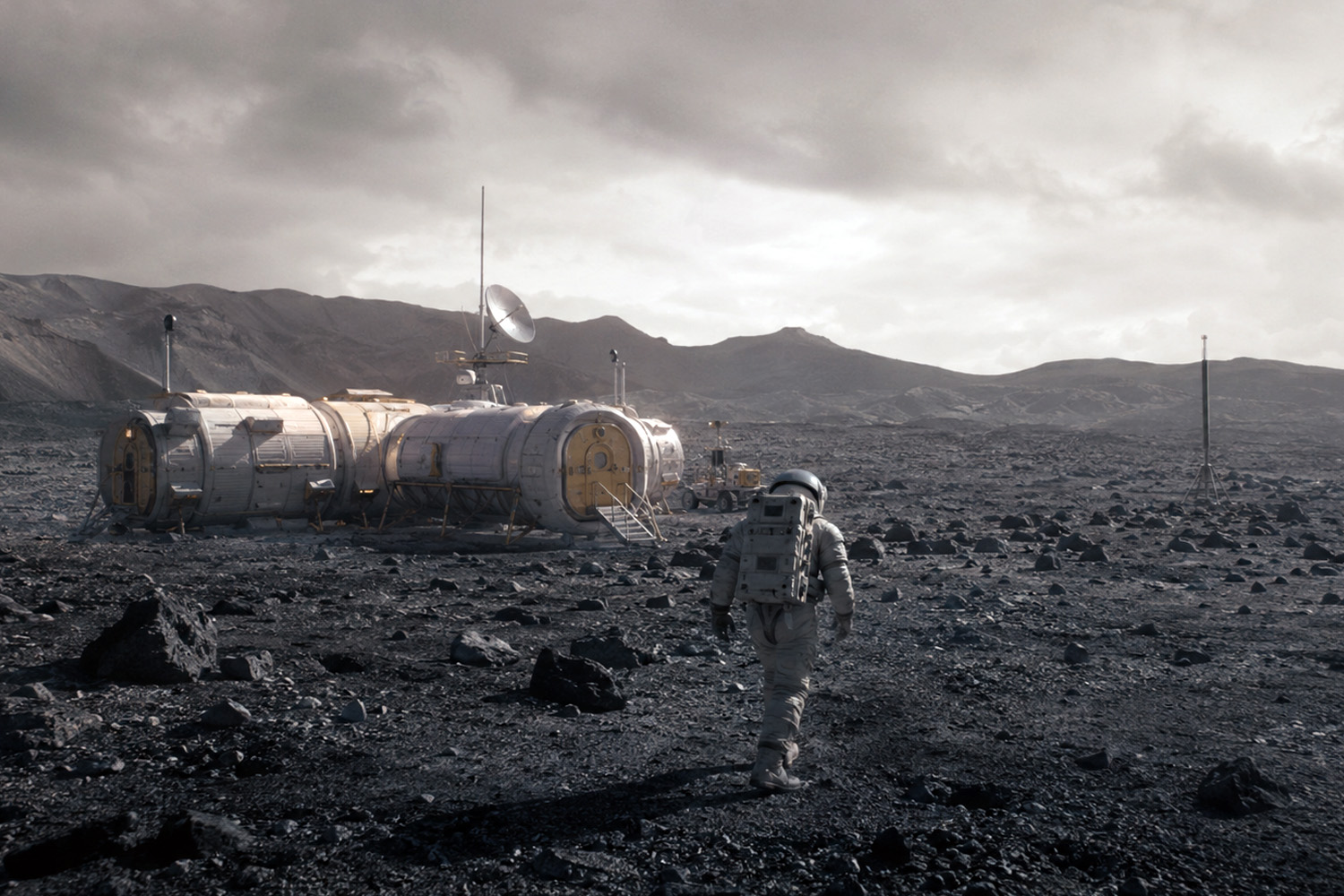
Human Space Colonization: Expansion or Escape?
For decades, human space exploration belonged largely to the realm of scientific prestige and Cold War competition. Today, however, the conversation has shifted. Governments and private companies are increasingly discussing permanent settlements on the Moon, eventual colonization of Mars, and even self-sustaining extraterrestrial cities. Yet behind the ambitious headlines lies a more complex question: is humanity genuinely preparing to become a multi-planetary species, or are we still struggling to solve the environmental and governance failures of our own world?
The answer depends less on rockets and billionaire ambition than on biology, ecology, resource management, and long-term institutional stability.
Why the Moon Matters More Than Ever
In recent years, the Moon has re-emerged as humanity’s most realistic near-term destination. Unlike the Apollo era, when lunar missions focused primarily on exploration and geopolitical symbolism, today’s programs increasingly emphasize permanence.
NASA’s Artemis program represents the clearest example of this transition. The agency has openly discussed long-term lunar infrastructure as part of a broader strategy to establish a sustained human presence near the Moon’s south pole. Contrary to some simplified claims, NASA has not formally announced a fully permanent Moon base with Jeff Bezos’s Blue Origin as the exclusive lead partner. Instead, NASA is working through a network of industrial partnerships involving multiple companies, with Blue Origin emerging as one of the major contributors to lunar transportation and infrastructure.
This distinction matters because space colonization is increasingly becoming an ecosystem of partnerships rather than a single national project.
The Moon’s strategic importance is grounded in science rather than symbolism. Researchers believe permanently shadowed regions near the lunar south pole contain water ice deposits. If accessible at industrial scale, this ice could be converted into drinking water, breathable oxygen, and hydrogen-based rocket fuel.
In practical terms, this would mean future missions would no longer need to transport every kilogram of fuel from Earth. The Moon could become a logistical fueling station for deeper space exploration, particularly missions to Mars.
Yet major uncertainty remains. Scientists still do not fully understand how concentrated or economically extractable lunar ice reserves are. Space agencies know the resources exist, but not whether they are sufficient to sustain large settlements over long periods.
This uncertainty reveals a broader truth often overlooked in public discussions: colonization depends not only on reaching another world, but on sustaining closed ecological systems once humans arrive.
Artemis II: More Than a Symbolic Mission
One of the most important milestones in this process is NASA’s Artemis II mission, the first crewed lunar expedition of the Artemis era.
The mission is historic because it moves beyond robotic testing and returns humans to deep space for the first time since Apollo. Artemis II is designed to validate spacecraft systems, radiation shielding, communications, navigation, and long-duration crew operations outside low Earth orbit.
Its significance goes far beyond a single journey around the Moon.
Space agencies increasingly view lunar exploration as preparation for far more difficult missions to Mars. A roundtrip to the Moon takes days; a Mars mission could take years. Every technical weakness discovered near the Moon may prevent catastrophic failure later.
This shift marks an important evolution in exploration philosophy. Space travel is no longer solely about proving technological capability-it is increasingly about testing the limits of human biological resilience.
Humans evolved under Earth’s gravity, atmosphere, magnetic protection, and ecosystems. Outside those systems, nearly every biological process becomes vulnerable.
Mars Colonization: Ambition Meets Reality
No discussion of human colonization can avoid Mars.
Elon Musk and SpaceX have arguably transformed public expectations around interplanetary settlement. Musk has repeatedly argued that humanity must become a “multi-planetary civilization” to reduce existential risk and improve long-term survival.
Yet despite growing excitement, colonizing Mars remains substantially harder than many public narratives suggest.
Mars offers advantages over the Moon: a day-night cycle closer to Earth’s, water ice reserves, and an atmosphere-although extremely thin. But the planet also presents immense challenges.
Surface temperatures regularly fall below minus 60 degrees Celsius. Radiation exposure is dangerous because Mars lacks Earth’s magnetic shielding. Dust storms can disrupt energy systems for weeks. Food production would require highly controlled agricultural environments.
Perhaps most critically, Mars cannot rely on constant resupply from Earth. Unlike lunar settlements, which could theoretically receive relatively frequent shipments, Martian colonies would need near-total self-sufficiency.
This explains why recent reporting suggesting Musk’s interest in a self-sustaining lunar city should not be interpreted as abandoning Mars. Rather, the Moon increasingly appears to function as a training ground for systems humanity will eventually require elsewhere.
In other words, if humans cannot sustain a functioning ecological settlement 384,000 kilometers away, it becomes difficult to imagine success 225 million kilometers from Earth.
The Economics Behind the Space Race
Economic motivations increasingly shape the future of colonization.
SpaceX remains privately owned, but recent reporting has generated debate over long-term valuation ambitions tied to Mars development. Some reports referenced a figure as high as $7.5 trillion, though this should not be confused with a confirmed public valuation target. Much of this discussion remains tied to long-term speculative growth assumptions rather than established financial reality.
Still, one truth is increasingly clear: investors now view space infrastructure as an emerging industrial sector rather than science fiction.
Lunar communications systems, cargo transport, satellite logistics, rare material extraction, energy technologies, and orbital manufacturing are all being discussed as future markets.
Yet economic growth in space introduces environmental questions rarely addressed in mainstream coverage.
Will humanity simply export extractive industrial behavior into extraterrestrial environments?
Or can future settlements become models for sustainability that Earth itself failed to implement?
Ironically, survival in space may require environmental discipline humans have historically resisted on Earth.
The Hardest Problem: Closed Ecosystems
The greatest obstacle to colonization may not be rockets-it may be ecology.
Earth functions because billions of interconnected biological relationships recycle waste, regulate atmosphere, sustain food systems, and stabilize ecosystems.
No such natural balance exists on the Moon or Mars.
A future settlement would require near-perfect recycling systems for water, oxygen, waste, food, and energy. Every ecological failure would immediately threaten human survival.
Experiments attempting artificial ecosystems have historically revealed how difficult this challenge is. Even carefully controlled environments on Earth have struggled to maintain stable atmospheric chemistry and food production over extended periods.
Space settlements therefore demand something humanity has rarely achieved at scale: resource systems with minimal waste and near-total efficiency.
Paradoxically, the technologies developed for extraterrestrial survival-closed water loops, advanced recycling, energy efficiency, sustainable agriculture-may eventually become more valuable on Earth than in space.
Can Space Exploration Help Earth?
Critics often ask whether humanity should invest in space while environmental crises worsen on Earth.
The debate is understandable but incomplete.
Historically, space programs have generated technologies later applied to daily life, including weather forecasting, climate observation, satellite communications, environmental monitoring, and advanced materials.
Modern Earth science increasingly depends on space infrastructure. Satellites track deforestation, methane leaks, ocean warming, drought, biodiversity shifts, and climate change.
In this sense, space exploration and environmental protection are increasingly interconnected rather than competing priorities.
Yet there is also a psychological dimension.
Some observers worry that colonization narratives encourage a dangerous assumption-that humanity can simply “escape” a damaged Earth.
Scientific reality offers little support for that idea.
Mars is not an easier Earth. The Moon is not a backup planet.
Even under optimistic projections, extraterrestrial settlements would remain fragile and technologically dependent for generations.
Protecting Earth remains dramatically easier than rebuilding planetary habitability elsewhere.
The Ethical Question Humanity Cannot Avoid
Beyond engineering challenges lies a deeper issue: governance.
Humanity still struggles to sustainably manage forests, oceans, fisheries, biodiversity, emissions, and resource extraction on Earth. International environmental agreements remain difficult to enforce, while ecological degradation continues.
Space law, governed largely through treaties written during the Cold War, remains incomplete regarding resource ownership, environmental preservation, and industrial activity beyond Earth.
This leaves humanity facing a profound test.
Will future settlements repeat familiar patterns of extraction, inequality, and environmental depletion?
Or will the extreme fragility of life beyond Earth force a fundamentally different relationship between humans and ecosystems?
Perhaps the greatest irony of colonization is this: surviving on another planet may require humanity to finally learn the ecological balance it has often failed to maintain on Earth.
The question is no longer whether humans can technically reach the Moon or Mars.
Increasingly, the real question is whether humans are environmentally and institutionally mature enough to deserve staying there.