Natural light displays have fascinated humans for centuries, and modern science has made it possible to explain many of these visually striking phenomena. From colorful rainbows to rare atmospheric effects, these events are the result of light interacting with water droplets, ice crystals, and air particles under specific conditions.
How Rainbows Form
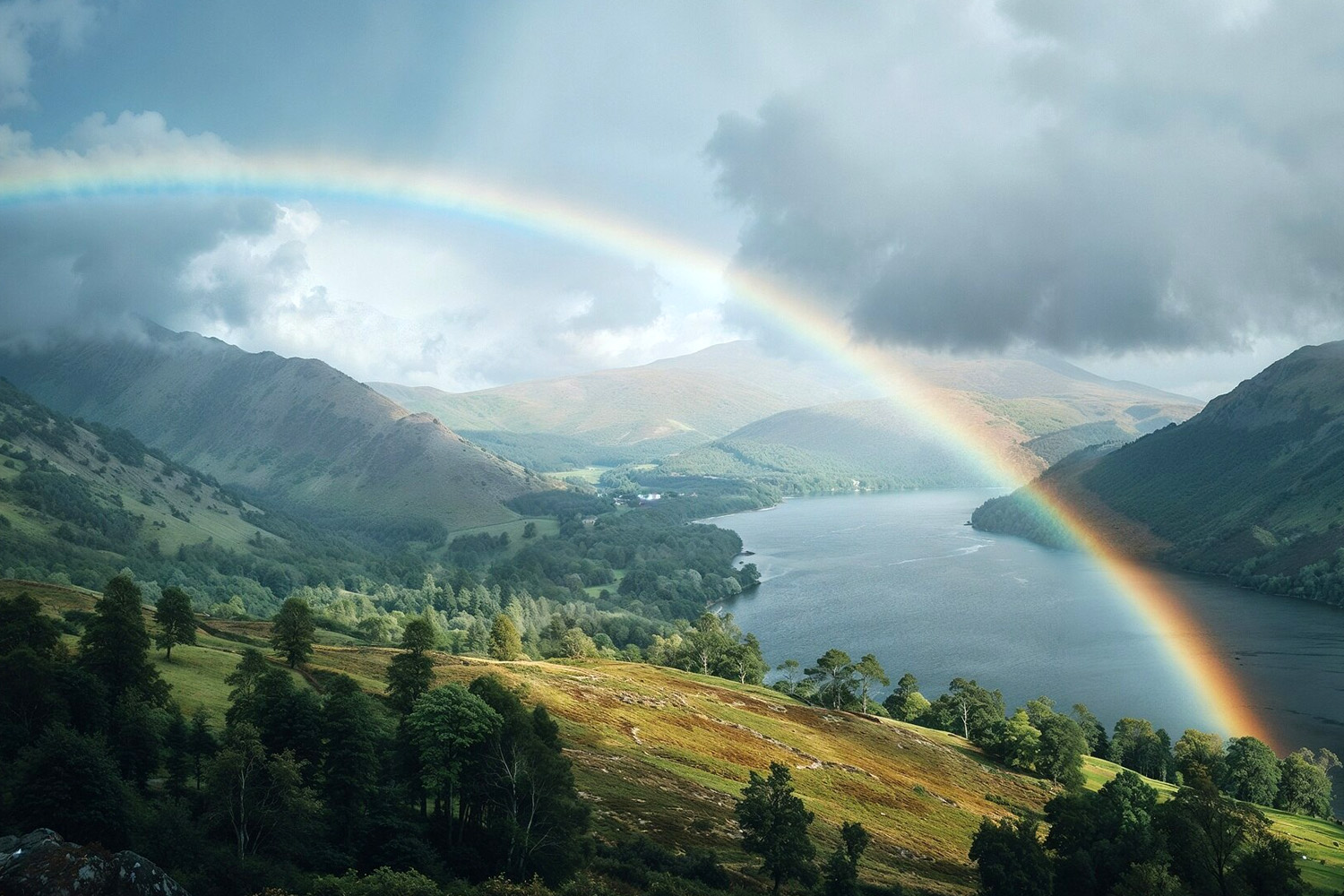
A rainbow is created when sunlight passes through tiny water droplets in the atmosphere, typically after rainfall. As light enters a droplet, it slows down and bends, a process known as refraction. The light then reflects off the inside of the droplet and refracts again as it exits.
During this process, white sunlight is separated into its component colors because different wavelengths bend by different amounts. This separation produces the familiar arc of red, orange, yellow, green, blue, indigo, and violet. The observer must have the sun behind them and rain in front of them to see a rainbow.
Double Rainbows and Color Reversal
Sometimes, a double rainbow appears. This occurs when light reflects twice inside water droplets before exiting. The second arc is fainter and shows reversed colors, with red on the inner edge and violet on the outer edge. The darker area between the two arcs is known as Alexander’s band, caused by differences in light scattering.
Supernumerary Rainbows
Supernumerary rainbows appear as faint, closely spaced pastel bands just inside the main rainbow. These are caused by interference between light waves and are most visible when water droplets are small and uniform in size. Their presence helped confirm the wave nature of light.
Halos and Sun Dogs
Not all optical phenomena involve rain. Halos form when sunlight or moonlight passes through ice crystals in high-altitude cirrus clouds. These crystals refract light at specific angles, producing rings around the sun or moon.
Sun dogs, also known as parhelia, appear as bright spots on either side of the sun. They occur when hexagonal ice crystals refract sunlight horizontally, creating colorful patches that resemble fragments of rainbows.
Glories and Fogbows
A glory is a circular rainbow-like pattern often seen from airplanes or mountain peaks, surrounding the observer’s shadow on clouds or fog. It results from backscattering of light within tiny droplets.
Fogbows are similar to rainbows but appear pale or nearly white. They form in fog, where droplets are much smaller than raindrops, reducing color separation.
Green Flashes and Atmospheric Refraction
A green flash is a rare phenomenon observed briefly at sunrise or sunset. It occurs when atmospheric refraction separates sunlight into colors, allowing green wavelengths to become visible for a moment as the sun dips below the horizon.
Why These Phenomena Matter
Optical phenomena are not only visually stunning but also scientifically important. They help researchers understand light behavior, atmospheric composition, and weather conditions. Many of these effects are predictable, but their rarity depends on precise environmental factors, making each observation unique.
Although the science behind them is well established, these natural displays continue to inspire curiosity and wonder, reminding us how complex and beautiful Earth’s atmosphere truly is.