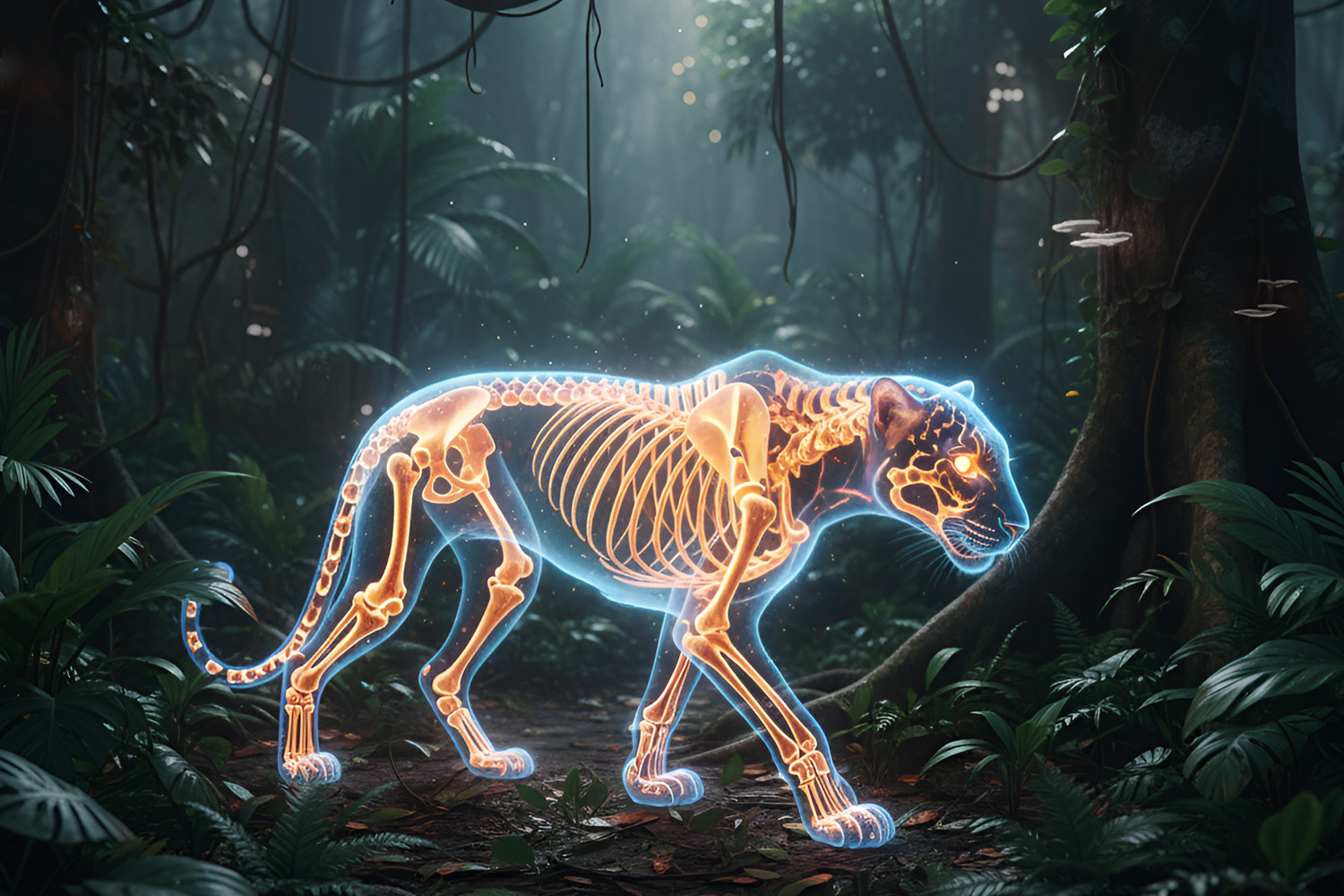
Among all terrestrial predators, the cat family (Felidae) stands out as one of the most biomechanically refined groups in the natural world. From the domestic house cat to the tiger and snow leopard, felines share a remarkably consistent body design that combines flexibility, precision, stealth, explosive power, and sensory mastery. This shared blueprint is what makes the cat family one of the most widespread and successful groups of hunters on Earth.
Despite differences in size, habitat, and lifestyle, nearly all cats operate on the same fundamental biomechanical principles. These traits are not specialized for a single environment-they work almost everywhere. That is what makes cats nature’s most universal predators.
What Makes Cat Biomechanics So Universal?
1. A Flexible Spine That Functions Like a Spring
A cat’s spine is one of its most important biomechanical features. Built from elongated vertebrae and elastic muscles, it can compress and extend dramatically during movement.
This enables:
• powerful acceleration
• long, controlled leaps
• mid-air rotation and balance
• energy-efficient running
This spring-like spine appears in both small and large cats, proving the universality of the design.
2. Retractable Claws Designed for Precision
Most felines have retractable claws-a biomechanical advantage rarely seen among mammals.
Retractable claws allow:
• nearly silent movement when stalking
• maximum traction during sprints
• secure grip when striking or climbing
• protection of claw sharpness
This mechanism helps both domestic cats sneaking through a living room and leopards stalking prey in the wild.
3. Digitigrade (Toe) Walking
Cats walk on their toes, not their entire feet.
This design provides:
• speed and agility
• excellent shock absorption
• smoother, quieter movement
• enhanced balance
Digitigrade locomotion is key to the feline hunting style: approach quietly, then strike explosively.
4. Exceptional Hearing – One of the Best Among Mammals
Hearing is one of the cat family’s greatest universal strengths. Each ear has more than 30 muscles, allowing it to rotate up to 180 degrees independently.
Cats can detect:
• frequencies from about 48 Hz to 85 kHz
• sound direction within 5 degrees of accuracy
• prey moving behind obstacles
• faint rustling from insects or rodents
This advanced auditory system allows cats to hunt efficiently even in total darkness.
5. Muscular Efficiency and High Power-to-Weight Ratio
Cats have dense, compact muscles with elastic fibers capable of releasing explosive power. Even small cats have musculature similar to their big-cat relatives.
Their build supports:
• high-speed bursts
• exceptional climbing ability
• strong vertical and horizontal jumps
• rapid acceleration
Across the cat family, strength is delivered precisely rather than wastefully.
6. Whiskers: One of Nature’s Finest Sensory Systems
Whiskers (vibrissae) are highly sensitive biological “antennae.” They are deeply rooted in the skin and connected to a dense network of nerves known as the follicle-sinus complex.
What Whiskers Enable Cats to Do
• sense air movements caused by obstacles or prey
• measure openings and distances
• navigate in total darkness
• detect texture, shape, and object edges
• determine whether they can fit through a space
Flexibility and Elasticity of Whiskers
Whiskers can:
• bend up to 30 degrees without breaking
• register tiny air vibrations
• send hundreds of nerve signals per second
This creates a natural 3D radar system-another universal feline trait.
How Universal Biomechanics Appear Across Cat Species
Cheetah – Speed Specialist
The cheetah is the fastest land animal, capable of reaching up to 112 km/h and accelerating from 0–96 km/h in about 3 seconds.
Its semi-retractable claws and long tail help with traction and steering.
While extraordinary, the cheetah is a specialist, not the most universal example.
Lion – Power and Social Coordination
The lion is unique among cats because of its social structure. Lions rely on teamwork and strength rather than stealth or climbing.
Biomechanical strengths include:
• extremely strong forelimbs and shoulders
• ability to pull down massive prey
• coordinated ambush strategies
Lions can leap about 2–3 meters vertically and 10–12 meters horizontally, but their biomechanics emphasize power over versatility.
Leopard – The Most Universal Hunter
Most zoologists consider the leopard the best overall expression of universal feline biomechanics.
Leopards can:
• run fast
• climb trees while carrying prey heavier than themselves
• swim when needed
• leap long distances
• thrive in deserts, jungles, mountains, or savannas
• hunt everything from rodents to large ungulates
Their combination of agility, strength, stealth, and adaptability makes them the most versatile of all felines.
Tiger – Power and Versatility in Large Scale
Tigers are the strongest big cats and exceptional swimmers.
They excel in:
• raw power
• short-distance bursts
• tackling large prey
• maneuvering through forests and wetlands
Their biomechanics emphasize strength without sacrificing agility.
Domestic Cat – A Miniature Masterpiece
The house cat retains all the universal traits of its wild relatives.
Domestic cats can:
• rotate ears 180°
• run up to ~48 km/h
• leap with extreme precision
• navigate in near-total darkness
They are small, but biomechanically almost identical to big cats.
How High and How Far Can Cats Jump?
Domestic Cat
• Vertical jump: 1.5–2 meters
• Horizontal leap: 3–4 meters
• Can survive high falls due to the “righting reflex”
Puma (Cougar)
• Vertical jump: up to 5.5 meters
• Horizontal leap: up to 12 meters
Snow Leopard
• Long leaps: 9–15 meters across rocky cliffs
These performances are possible due to long hind limbs, elastic muscles, and exceptional balance.
Which Cat Has the Most Universal Biomechanics?
The leopard is widely regarded as the most biomechanically universal member of the cat family.
It combines:
• speed
• climbing ability
• long-distance leaping
• stealth
• power
• adaptability
• environmental versatility
Its balanced skill set makes it nature’s most complete and versatile feline hunter.