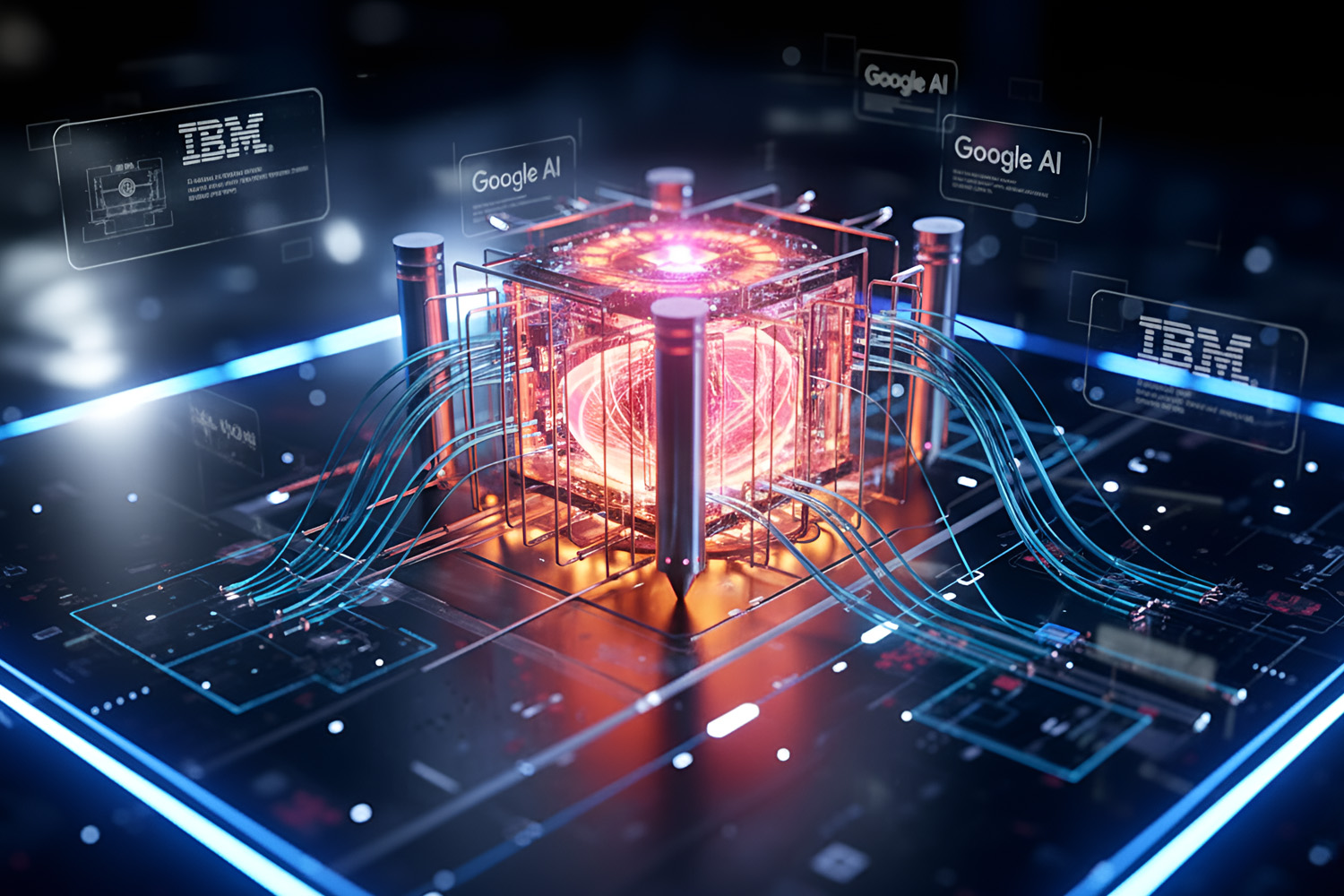
Quantum computing is moving from theoretical promise toward real-world impact in 2025. With companies like IBM, Google and IonQ accelerating their development curves, the industry is increasingly focused on achieving quantum advantage — where quantum machines outperform classical computers for useful tasks.
Key Innovations
Major advancements in 2025 include progress in scalability, error correction and hardware diversity:
- IonQ announced a strategic acquisition of Oxford Ionics for about US $1.08 billion, and reported that a collaborative chemical-reaction simulation with Nvidia and AstraZeneca ran 20× faster than previous classical methods.
- Amazon Web Services (AWS) unveiled its prototype quantum chip “Ocelot”, which uses cat-qubit technology to improve error correction efficiency by up to 90 % compared with conventional approaches.
- A February 2025 funding round saw QuEra Computing raise over US $230 million to push fault-tolerant neutral‐atom quantum computing.
- According to industry research, IBM, Google and others are progressing quantum hardware toward fault-tolerant systems and large-scale qubit counts — for example, IBM’s roadmap targets multi-thousand-qubit machines in the coming years.
Why It Matters
Quantum computers promise to transform multiple sectors by solving problems beyond the reach of classical machines:
- Cryptography & security: Quantum computing threatens conventional encryption but also offers new quantum-safe cryptographic solutions.
- Chemistry & drug discovery: Simulating molecular interactions at scale could accelerate development of new materials and medicines.
- Logistics & optimization: Industries like transportation, energy and manufacturing may use quantum algorithms to optimize complex systems, reduce costs and accelerate decision-making.
- Materials science: Discovering novel materials with tailored properties (e.g., batteries, catalysts) becomes far more feasible with quantum simulation capabilities.
Commercial & Research Landscape
- Enterprise access to quantum hardware and hybrid quantum-classical cloud services is growing: Companies are piloting quantum workloads, including using vendor toolchains and SDKs.
- Hardware diversity is expanding: superconducting qubits (IBM, Google), trapped-ion qubits (IonQ), neutral atoms (QuEra), and other emerging architectures are all active.
- Real-world collaborations are underway: For example, IonQ’s drug-discovery simulation demonstrates tangible commercial use-case progress.
- While full “quantum advantage” for generic applications is not yet achieved, the 2025 pace suggests that specific domain breakthroughs could arrive sooner than previously expected.
Challenges Ahead
- Error correction & fault tolerance: To scale quantum computers reliably, error-corrected logical qubits remain the key hurdle.
- Qubit count & connectivity: Many useful applications will require thousands to millions of logical qubits, far beyond current devices.
- Commercial viability: Demonstrating clear commercial benefit (e.g., cost savings, speed advantage) remains nascent.
- Software & algorithms: Quantum-native software stacks, hybrid frameworks and integrated toolchains need maturation for enterprise readiness.
- Ecosystem development: Talent, supply-chains, standards and risk frameworks must evolve alongside hardware.
Outlook
The quantum computing field in 2025 is poised for inflection: the transition from research proofs toward domain-specific, commercially relevant outcomes appears closer than ever. As hardware architectures diversify and software ecosystems mature, industries ranging from pharmaceuticals to aerospace may begin deploying quantum-enhanced solutions over the next few years. While general-purpose quantum computing remains a target for the late 2020s or early 2030s, 2025 marks the year of tangible momentum and enterprise readiness building.
Top 5 breakthrough quantum-computing applications in 2025
1. Verifiable quantum advantage in molecular simulation
Google announced in October 2025 that its “Quantum Echoes” algorithm, run on its “Willow” 105-qubit chip, achieved 13,000× faster performance than the best classical supercomputer for a molecular-structure simulation.
Why it matters: This is one of the first cases where quantum computing has shown a measurable advantage on a real scientific problem (molecular geometry) rather than a purely synthetic benchmark.
2. Medical-device simulation showing industry benefit
In March 2025, IonQ with Ansys executed a simulation of a medical-device design using a 36-qubit quantum computer and achieved a ~12 % improvement in runtime over classical HPC methods.
Why it matters: It demonstrates quantum computing moving beyond labs into practical industry workloads (here, medical device simulation) with measurable performance gains.
3. Quantum-enabled optimization and logistics gains
According to a report by McKinsey & Company (June 2025), quantum computing is increasingly employed in industries such as chemicals, life sciences, finance and mobility, thanks to improvements in error correction and qubit stability.
Why it matters: The shift from pure research toward industrial deployment suggests quantum is becoming ready for domain-specific optimization problems (e.g., chemical process modelling, supply-chain logistics).
4. Use-case compendium shows collaboration and pilot projects
The National Quantum Computing Centre (UK) published a “Quantum Computing Use Case Compendium” in June 2025, cataloguing 19 industry-led proof-of-concept and feasibility studies (2023-2025) across sectors such as healthcare, telecoms and materials science.
Why it matters: Structured, cross-industry pilot work shows that organisations are actively planning and testing quantum solutions now — not just in theory.
5. Infrastructure & talent ecosystem growth
Investments and infrastructure-initiatives surged: McKinsey’s monitor (June 2025) estimated the quantum technology market could reach up to US $97 billion by 2035, and noted governments and firms are stepping up funding and ecosystem development.
Why it matters: Foundational ecosystem growth (hardware, software, talent, standards) is critical to move quantum from niche to mainstream — the signs are now visible.