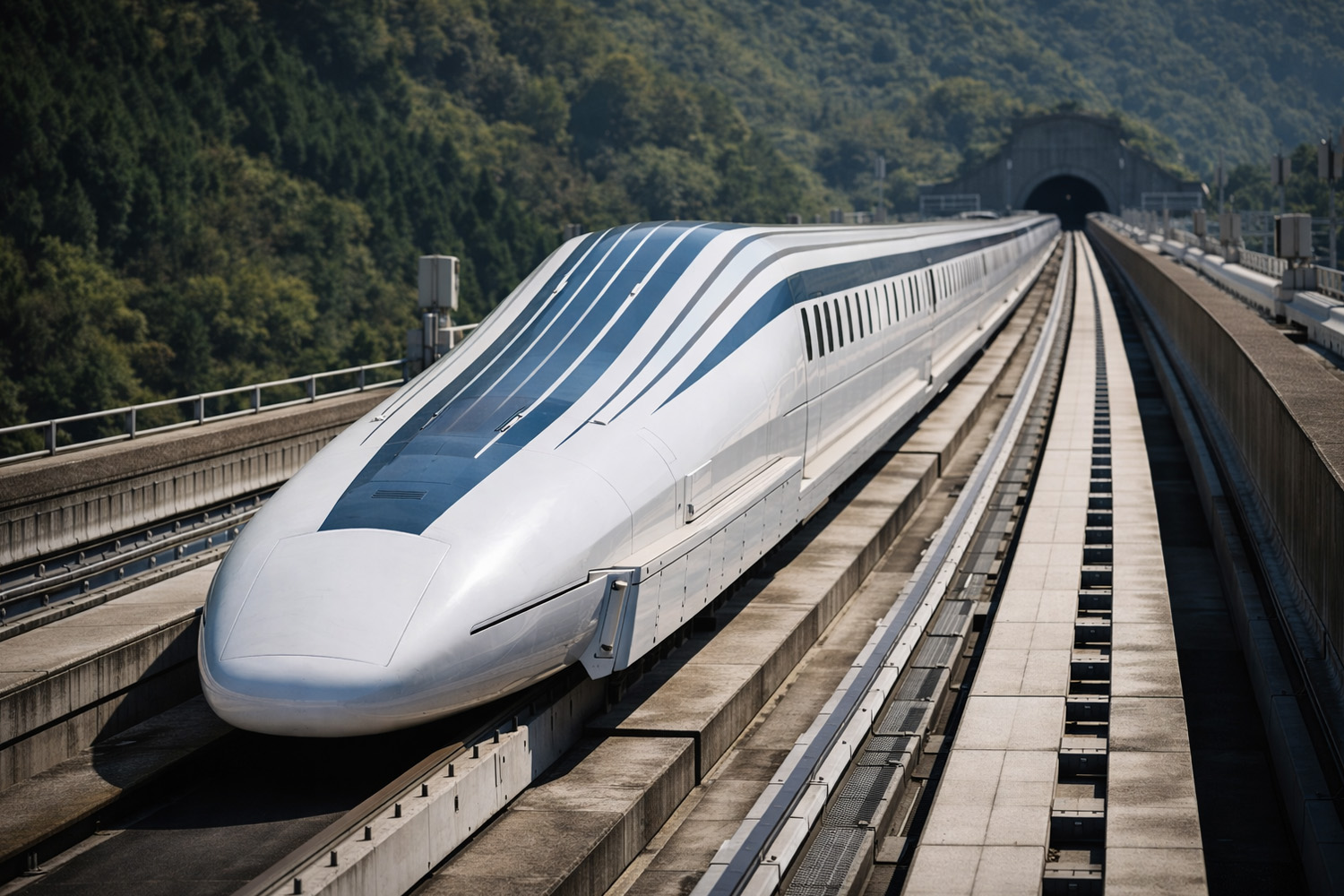
Japan is moving closer to redefining high-speed rail with the L0 Series maglev, a next-generation magnetic levitation train developed and tested by Central Japan Railway Company (JR Central). Designed to operate on the planned Chūō Shinkansen line, the L0 Series represents the most advanced application of superconducting maglev technology ever tested at scale.
During test runs on the Yamanashi Maglev Test Line, the L0 Series has achieved a record speed of 603.5 km/h, making it the fastest train system ever built. This places it well ahead of the world’s only commercial maglev service currently in operation — China’s Shanghai Maglev, which has a maximum operational speed of 460.2 km/h. By contrast, Europe’s fastest conventional high-speed trains, including France’s TGV and Italy’s AGV Italo, typically operate at top speeds ranging from 306 to 354 km/h.
Why It Matters
The L0 Series is more than a speed record. It is central to Japan’s long-term strategy to future-proof intercity transport, reduce congestion on existing rail lines, and provide a faster alternative to short-haul air travel. Using superconducting magnets, the train levitates several centimeters above the guideway, eliminating wheel-rail friction and allowing for unprecedented speeds with lower mechanical wear.
If deployed as planned, the Chūō Shinkansen would dramatically cut travel times between major economic hubs. For example, journeys between Tokyo and Nagoya — currently taking around 100 minutes by conventional Shinkansen — are expected to be reduced to roughly 40 minutes once maglev service begins. The technology is also designed with high seismic safety standards, a critical requirement for rail infrastructure in Japan.
Trend Impact
Globally, the L0 Series underscores a widening technological gap between maglev systems and traditional high-speed rail. While many countries continue to invest in steel-wheel trains due to lower costs and easier integration, Japan’s progress demonstrates what is possible when long-term infrastructure planning prioritizes speed, capacity and innovation over short-term economics.
The project is closely watched by governments and transport authorities worldwide, particularly in regions exploring next-generation rail to meet climate goals and growing urban populations. However, the high construction costs of maglev infrastructure remain a significant barrier to widespread adoption outside Japan.
As testing continues, the L0 Series stands as a clear signal that the future of ultra-high-speed ground transport is no longer theoretical — it is already moving, faster than ever.