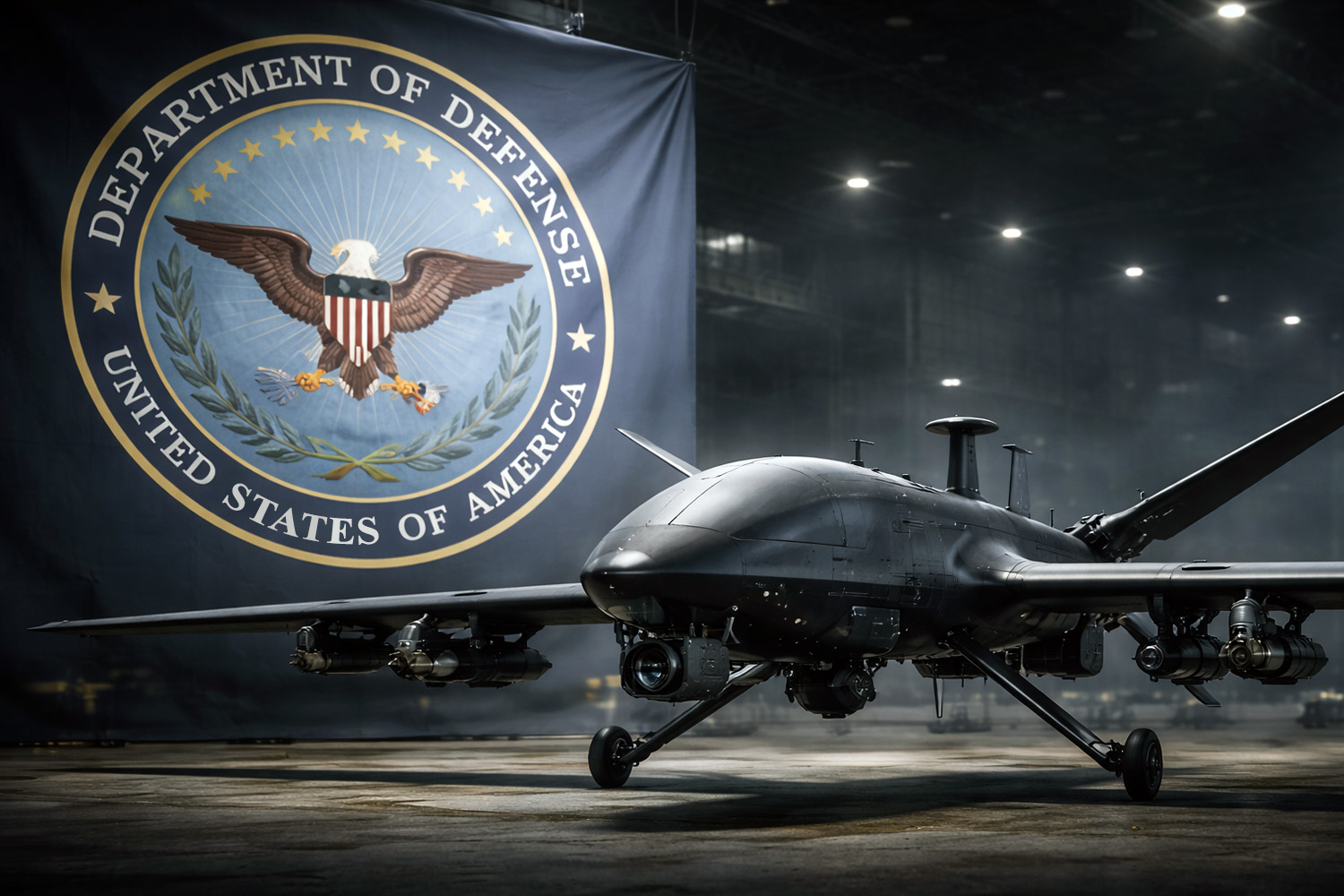
In early 2026, the U.S. Department of War launched a major shift in military drone procurement aimed not at cutting-edge technology but at producing large volumes of inexpensive, expendable drones to support future warfare needs. This push — known as the Drone Dominance Program — reflects lessons learned from recent conflicts, especially the Russia-Ukraine war, where low-cost unmanned aircraft systems played a decisive role on the battlefield.
Rather than rewarding contractors for the most advanced designs, the Pentagon is prioritizing companies capable of continuous, high-volume production of simple drones ready for battlefield use. Under the emerging structure, firms must demonstrate they can scale manufacturing — if supply chains falter or production stalls, contracts can be paused or reassigned to other competitors.
Competitive Procurement and Industry Participation
Earlier this month, the Defense Department selected 25 U.S. companies to participate in the initial phase of the Drone Dominance initiative. These firms — including both established defense contractors and newer drone makers — will compete in a series of evaluation events known as “Gauntlets” in locations like Fort Benning, Georgia, where their systems will be tested and assessed by military operators.
The first stage is expected to result in $150 million in orders for the top performers, with larger production contracts — potentially worth hundreds of millions more — coming later if companies meet scaling and reliability requirements.
Why the Shift Matters
1. Learning from Ukraine’s Drone Use
The intense use of inexpensive unmanned systems during the Russia-Ukraine war has reshaped military thinking. Analysts note that drones accounted for a substantial share of battlefield activity, demonstrating that sheer quantity and ubiquity can be as strategically valuable as high performance. This global trend influenced U.S. forces to adjust procurement priorities toward volume production instead of solely high-end capability.
2. Rapid Production as a Military Asset
The core philosophy behind the Pentagon’s approach is that “the factory is the weapon.” Instead of slow, bespoke projects, the military wants a domestic industrial base that can deliver hundreds of thousands of cheap drones in short order, treating these systems almost like expendable ammunition rather than long-lasting assets.
3. Supporting the U.S. Industrial Base
By incentivizing scalable production, the program also aims to boost American manufacturing and reduce reliance on foreign supply chains, a key objective shared with other U.S. defense initiatives.
Challenges and Future Outlook
Despite the ambitious goals, questions remain about how quickly such a production system can be built and sustained. Reducing unit costs while maintaining quality and reliability — especially in austere combat conditions — is a complex challenge. Moreover, the Pentagon’s experience with prior mass-production programs underscores the difficulty of balancing innovation with industrial scalability.
As the first “Gauntlet” tests run through March 2026, the defense industry — and global observers — will be watching to see whether this strategy can truly produce a new era of affordable drone dominance on future battlefields.