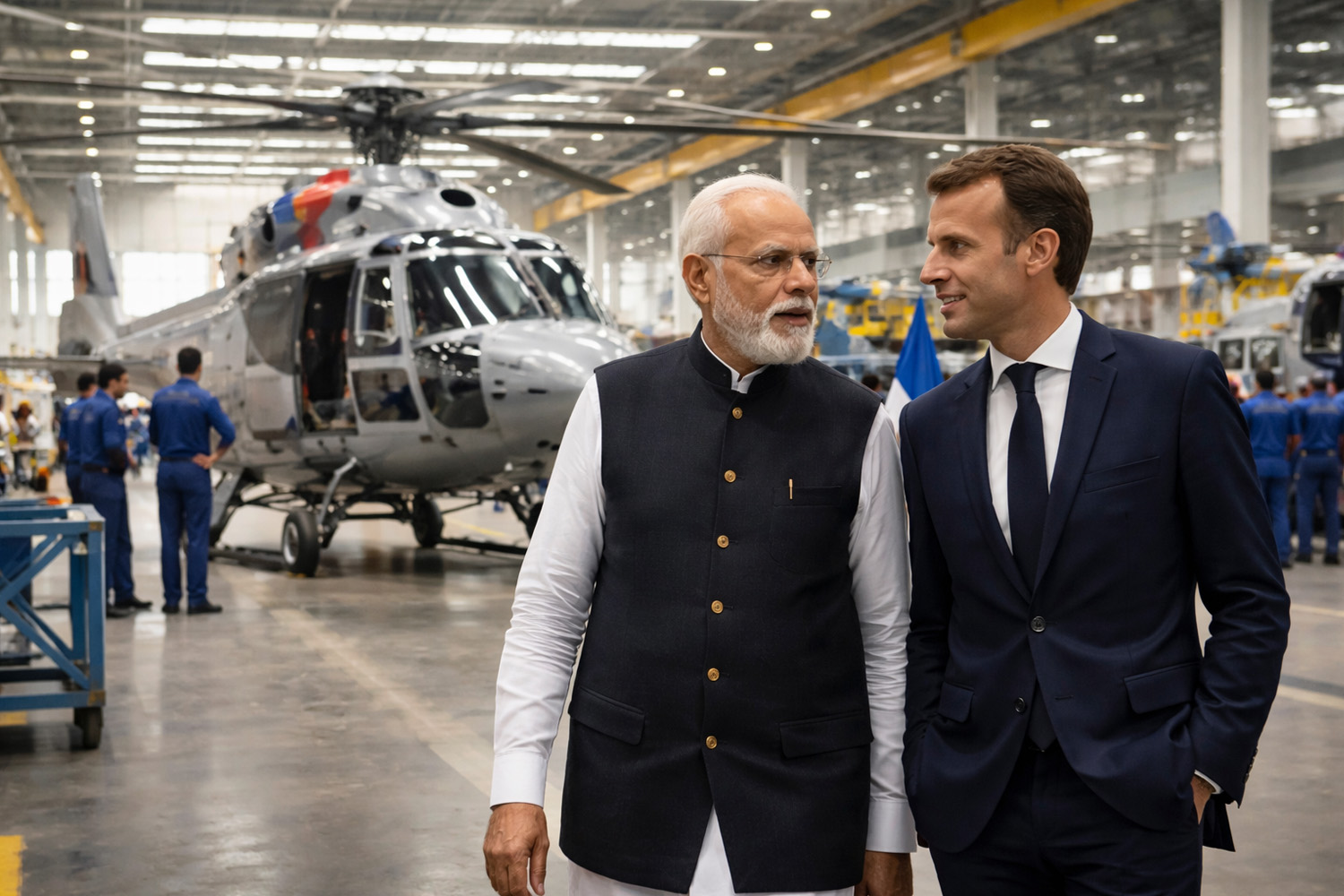
Indian Prime Minister Narendra Modi and French President Emmanuel Macron have officially inaugurated India’s first private-sector helicopter manufacturing facility, marking a milestone in the country’s defense industrial expansion.
The plant was established through a partnership between European aerospace giant Airbus and Tata Advanced Systems, a subsidiary of the Tata Group focused on aerospace and defense technologies. The project represents a significant step forward in India’s efforts to localize high-value defense production under its broader self-reliance strategy.
According to official statements, the facility is expected to manufacture helicopter components and potentially complete final assembly operations for both civilian and military platforms. The collaboration underscores growing defense ties between India and France, particularly in aerospace and advanced technologies.
Why It Matters
India has long been one of the world’s largest importers of defense equipment. Establishing a private helicopter manufacturing facility signals a shift toward domestic capability building and reduced reliance on foreign suppliers. The project aligns with New Delhi’s “Make in India” initiative, which seeks to strengthen local manufacturing across strategic sectors.
For Airbus, the partnership expands its industrial footprint in one of the fastest-growing aviation markets globally. For Tata Advanced Systems, the project reinforces its position as a key domestic defense manufacturing partner capable of handling advanced aerospace production.
The presence of both leaders at the inauguration highlights the geopolitical importance of the project. Defense cooperation has become a cornerstone of India–France relations, with previous agreements covering fighter jets, submarines, and other high-tech systems.
Trend Impact
The launch of India’s first private helicopter manufacturing plant reflects a broader global trend toward defense supply chain diversification and regional production hubs. As geopolitical tensions reshape procurement strategies worldwide, countries are increasingly prioritizing local assembly and co-development agreements.
For India, this facility could serve as a foundation for deeper technology transfer, skill development, and long-term industrial growth in aerospace manufacturing. If successful, it may accelerate additional joint ventures and reinforce India’s ambitions to become a major defense production and export hub in Asia.
The inauguration marks not only a new industrial chapter but also a strategic signal of India’s evolving defense posture and strengthening international partnerships.