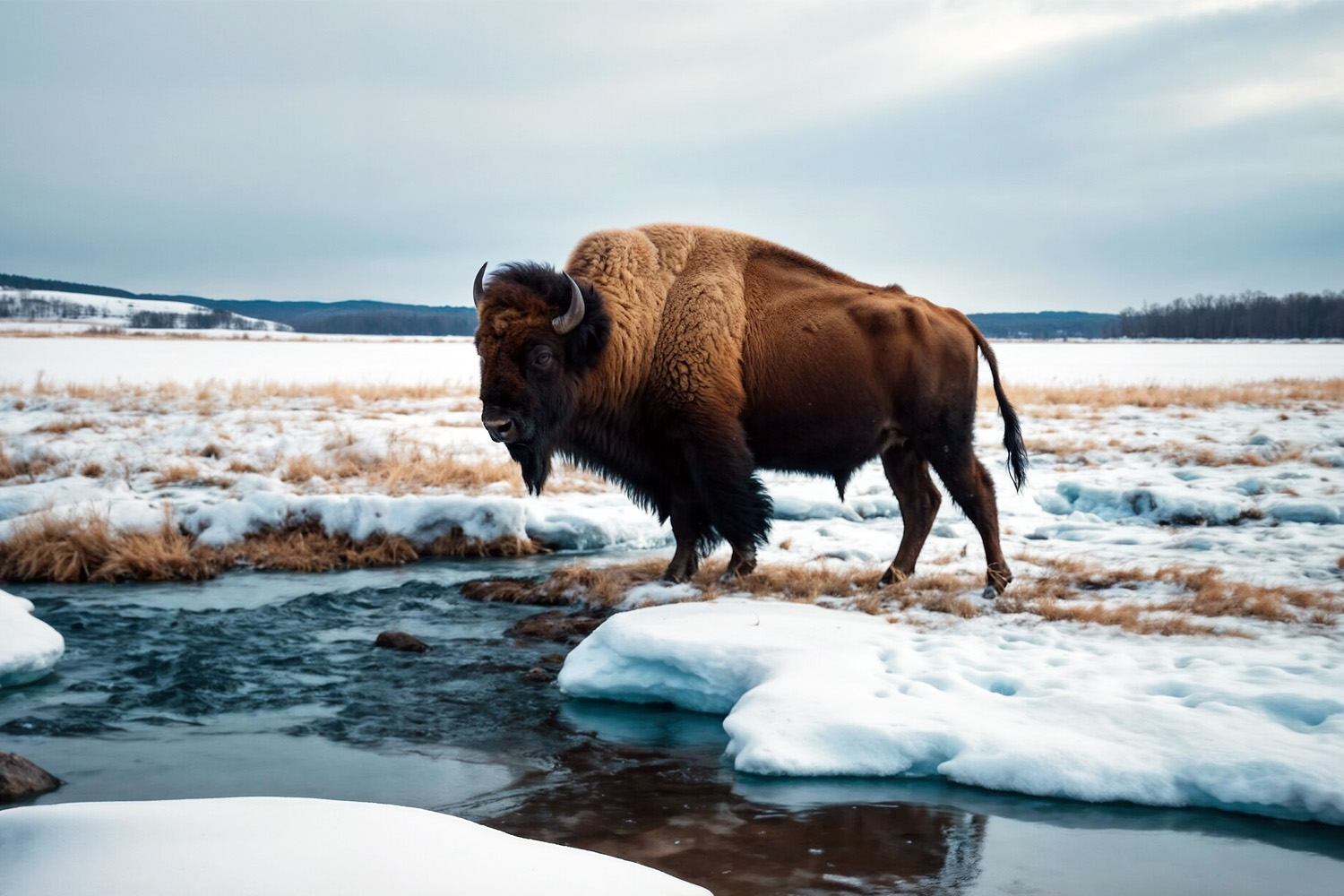
The majestic European bison (scientific name Bison bonasus) is no longer confined to memory and museum specimens. After being driven to the brink of extinction in the early twentieth century, concerted breeding, reintroduction and habitat‐restoration efforts have ushered in a remarkable comeback for Europe’s largest land mammal.
From near extinction to revival
By the 1920s, only 54 European bison remained—all in captivity—and the species was extinct in the wild.
Thanks to decades of conservation work, multiple European countries now host free‐roaming or semi‐wild herds. For example, according to the nature organisation WWF Romania, over 8,000 individuals now live across Europe and more than 200 bison roam freely in Romania’s Southern Carpathians.
In 2020 the species’ status on the IUCN Red List was changed from “Vulnerable” to “Near Threatened”, reflecting the improved population and recovery trajectory.
Key reintroduction milestones
- In May 2024, eight European bison arrived at Herdade do Vale Feitoso in Portugal—a first for that country.
- Research published in March 2025 modelling populations in Central Europe found that interventions such as connectivity restoration, additional reintroductions and reduced supplementary feeding could result in a doubling of female bison in 30 years and more than quadrupling in 100 years.
- In Romania’s Țarcu Mountains, the herd of over 200 bison is described as “one of the most ambitious and successful rewilding initiatives in Europe.”
Why their return matters
Beyond the measurable growth of the species, the European bison’s return is significant for ecosystem health and biodiversity. These large herbivores:
- Act as ecosystem engineers: their grazing, seed dispersal and soil trampling help create patchy vegetation structure, benefiting other species and influencing forest dynamics.
- Strengthen rewilding and wilderness initiatives: their presence indicates habitat scale, connectivity and restoration success.
- Offer community, educational and tourism opportunities in formerly remote or declining rural areas, linking conservation with sustainable livelihoods.
Challenges ahead
While the comeback is real, several challenges remain:
- Genetic diversity remains a concern due to the species’ bottleneck in the early 20th century. Long-term viability requires large, connected populations.
- Habitat fragmentation and human-wildlife conflict persist, especially where bison roam near farmland or villages. Coexistence strategies are essential.
- Ensuring long-term funding, monitoring and institutional support for reintroduction and monitoring programmes is vital for sustaining growth.
- Scaling populations to fully wild, self-sustaining meta-populations that span multiple habitat patches is the next frontier for bison conservation.
What’s next
Conservationists are now focusing on:
- Extending the species’ range further west and south in Europe, and replicating models in more countries.
- Enhancing habitat connectivity (wildlife corridors, overpasses) to allow natural dispersal and gene flow between bison herds.
- Integrating community-based tourism, education and local economic development into bison restoration projects so that nature comeback benefits people as well as wildlife.
- Continuing scientific monitoring of ecological impacts, such as the influence of bison on carbon sequestration, vegetation dynamics and biodiversity.
Conclusion
The return of the European bison stands as a beacon of what coordinated conservation can achieve. From being all but extinct in the wild just a little over a century ago, these great mammals are now reclaiming large tracts of Europe’s wilderness. Their recovery not only restores an iconic species—it signals the revival of ecosystems and the promise of a wilder, more resilient Europe. With careful planning, habitat management and community engagement, the European bison’s comeback will continue to gain momentum and inspire future conservation triumphs.