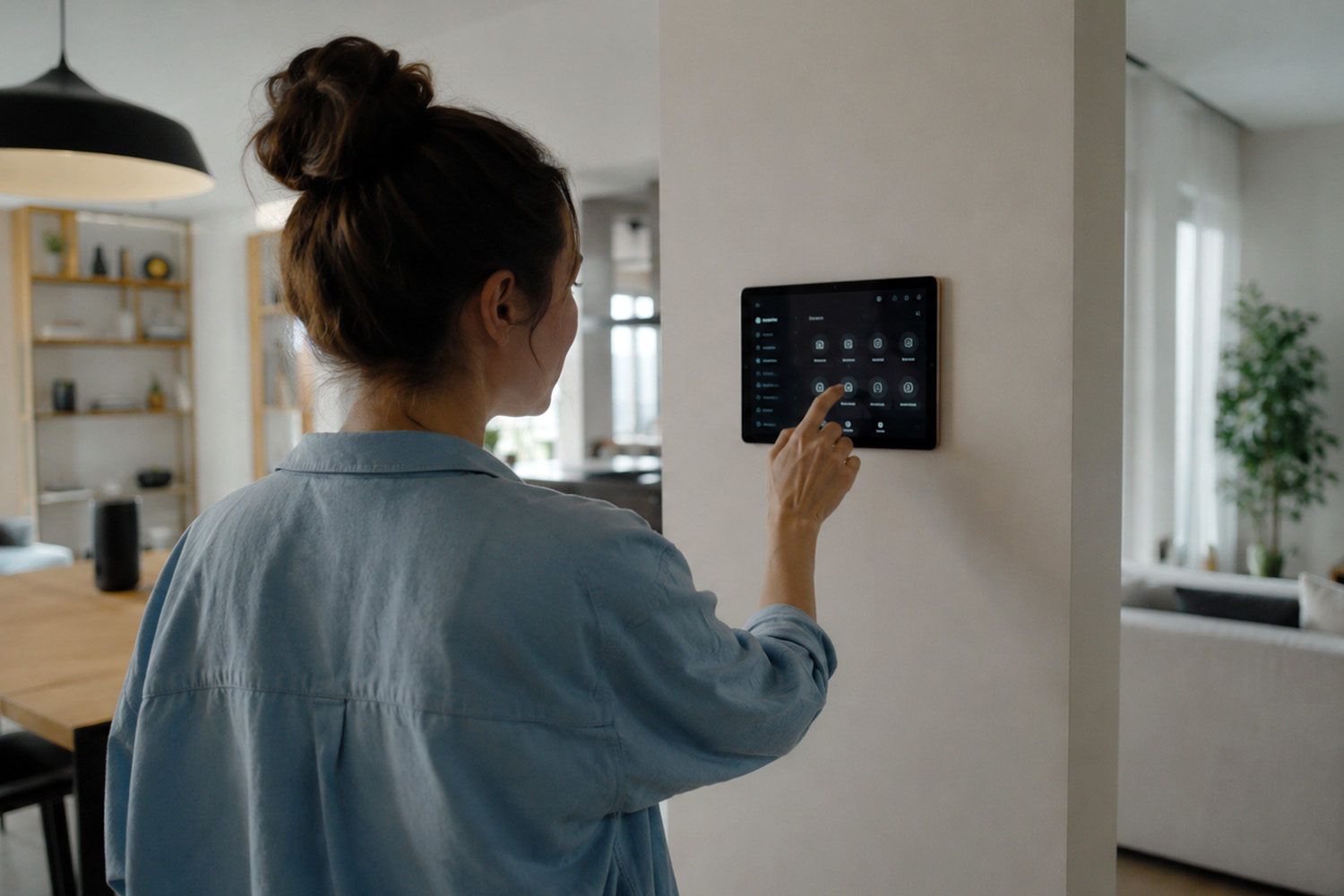
The rapid expansion of connected home technology has shifted smart homes from convenience-focused ecosystems into increasingly sophisticated energy management platforms. Early generations of connected devices primarily automated lighting or allowed remote control of thermostats. Today’s systems increasingly function as distributed computing networks that continuously analyze occupancy, environmental conditions, electricity pricing, and equipment performance to optimize household energy consumption in real time.
This evolution reflects broader trends occurring across digital infrastructure. Artificial intelligence is moving from cloud-only applications into edge computing, sensor prices continue to decline, wireless standards have matured, and residential electricity systems are becoming more data-driven. Instead of isolated smart appliances, modern homes are gradually transforming into integrated cyber-physical systems where software orchestrates multiple devices simultaneously.
The importance of this transition extends beyond lower electricity bills. Residential buildings account for a significant share of global energy consumption, while increasing electrification through electric vehicles, heat pumps, and distributed solar generation places greater demands on electricity networks. Smart home technologies increasingly serve as the coordination layer that helps balance these competing requirements without requiring major changes to homeowner behavior.
The most significant innovations are therefore not individual smart products, but the architectural systems that allow hundreds of connected components to operate as coordinated energy optimization platforms.
Smart Homes as Distributed Energy Control Systems
Traditional household electrical systems are largely passive. Appliances consume power whenever users activate them, with little awareness of external conditions such as electricity prices, weather forecasts, renewable energy availability, or overall household demand.
Modern smart homes fundamentally alter this architecture.
Instead of treating appliances as independent electrical loads, smart home platforms monitor thousands of data points collected from distributed sensors:
- Indoor temperature
- Outdoor weather
- Occupancy patterns
- Ambient light
- Window and door status
- Humidity
- Power consumption
- Electricity pricing
- Solar generation
- Battery charge state
These data streams are continuously processed by local controllers and cloud-based optimization systems. Rather than simply executing user commands, automation platforms increasingly make operational decisions based on predefined optimization goals.
For example, instead of maintaining a fixed indoor temperature throughout the day, a smart system may pre-cool a building before peak electricity pricing begins, temporarily reduce HVAC output while occupants are away, and restore comfort before residents return home. The objective is not simply automation but minimizing energy use while preserving occupant comfort.
This represents a shift from reactive control toward predictive optimization.
Intelligent HVAC Control Delivers the Largest Energy Savings
Heating and cooling remain the largest contributors to residential electricity consumption in many countries. Consequently, HVAC optimization has become the primary engineering focus for energy-saving smart home technologies.
Leading manufacturers including Google Nest, Honeywell Home, Ecobee, Schneider Electric, and Siemens increasingly combine multiple sensing technologies:
- Occupancy detection
- Weather forecasting
- Learning algorithms
- Multi-room temperature sensing
- Equipment performance monitoring
Rather than relying on programmable schedules, modern thermostats build behavioral models of household activity.
Machine learning algorithms identify recurring occupancy patterns, estimate building thermal inertia, and determine how quickly temperatures change under different weather conditions. These models allow systems to activate heating or cooling only when necessary instead of maintaining constant operation.
Engineering improvements have also expanded beyond thermostat intelligence.
Variable-speed compressors, inverter-driven heat pumps, zoned ventilation, and connected dampers allow software to control HVAC output with much finer precision than legacy on/off systems.
Instead of cycling between full power and complete shutdown, modern HVAC systems continuously modulate output to match current demand, improving both efficiency and equipment longevity.
Smart Lighting Demonstrates the Value of Sensor Fusion
Lighting represents a smaller share of household electricity consumption than HVAC, yet it illustrates an important architectural trend: sensor fusion.
Smart lighting systems integrate multiple information sources simultaneously:
- Motion sensors
- Daylight sensors
- Occupancy detection
- Time-of-day schedules
- Geographic sunrise and sunset data
- User behavior history
Companies such as Signify (Philips Hue), Lutron, Legrand, and Aqara increasingly deploy adaptive lighting algorithms rather than fixed automation rules.
Instead of simply turning lights on or off at scheduled times, lighting systems continuously evaluate whether natural daylight provides sufficient illumination, whether someone is actually present, and whether neighboring rooms suggest occupants are moving through the home.
The engineering challenge lies not in switching lights but in minimizing unnecessary activations while maintaining user satisfaction.
Poor automation often causes occupants to override systems permanently.
Successful implementations therefore prioritize prediction accuracy over aggressive energy savings.
Smart Plugs Turn Passive Appliances into Measurable Loads
Many household devices consume electricity even while inactive.
Televisions, gaming consoles, chargers, printers, and entertainment systems often draw standby power continuously.
Smart plugs manufactured by companies including TP-Link, Eve Systems, Shelly, and Meross provide two important capabilities:
First, they measure electricity consumption at the device level.
Second, they introduce software control over previously unmanaged electrical loads.
This granular monitoring generates detailed consumption profiles, allowing homeowners and automation systems to identify inefficient devices.
The broader technological significance is data visibility.
Traditional electrical systems expose only whole-home consumption through utility meters.
Smart plugs create appliance-level telemetry, enabling increasingly sophisticated optimization algorithms that determine when devices should remain powered and when they can safely disconnect.
This transition mirrors industrial digitalization, where machine-level monitoring dramatically improved operational efficiency.
Energy Management Platforms Integrate Distributed Resources
The most important evolution is occurring above the device layer.
Modern energy management systems increasingly coordinate multiple energy assets simultaneously:
- Rooftop solar
- Home batteries
- Electric vehicle chargers
- Heat pumps
- Water heaters
- HVAC systems
- Smart appliances
Companies including Tesla, Enphase Energy, Schneider Electric, Sonnen, Samsung SmartThings, and ABB are developing software platforms that optimize entire household energy flows rather than individual devices.
This architectural shift introduces optimization problems similar to those found in industrial control systems.
Software continuously decides:
- Should solar electricity charge the battery?
- Should the electric vehicle charge immediately?
- Should excess solar power heat water?
- Should battery power be reserved for evening demand?
- Should appliances operate during low electricity prices?
Instead of isolated automation, homes increasingly function as small-scale energy management systems.
This integration becomes particularly important as residential electrification expands.
Electric vehicles alone can double household electricity demand, making coordinated scheduling increasingly valuable.
Edge Computing Reduces Latency and Improves Reliability
Early smart home platforms depended heavily on cloud computing.
While cloud infrastructure remains important for software updates, analytics, and long-term learning, many energy management decisions increasingly execute locally.
Edge computing provides several engineering advantages.
Local processing reduces communication latency, allowing immediate responses to occupancy changes or sensor events.
It also improves reliability during internet outages.
Privacy benefits are equally significant.
Sensitive occupancy data, movement patterns, and household routines can increasingly remain within local gateways instead of being transmitted continuously to cloud servers.
Companies such as Apple, Samsung, Home Assistant, and Matter ecosystem participants increasingly support hybrid architectures where cloud services complement rather than replace local intelligence.
This reflects a broader trend across computing: distributing intelligence between cloud infrastructure and edge devices according to latency, bandwidth, and privacy requirements.
Interoperability Has Become an Infrastructure Challenge
One of the largest obstacles to energy optimization has historically been fragmentation.
Different manufacturers often developed proprietary communication protocols, preventing coordinated control between devices.
The emergence of the Matter interoperability standard represents an important infrastructure development rather than simply another wireless protocol.
Matter provides standardized communication across manufacturers while operating over existing networking technologies such as Wi-Fi, Ethernet, and Thread.
This architectural standardization reduces integration costs and enables software developers to build automation systems that operate across diverse hardware ecosystems.
The engineering significance resembles standardized internet protocols.
Innovation increasingly shifts from basic connectivity toward higher-level optimization software because device interoperability becomes less of a barrier.
As interoperability improves, competitive differentiation moves toward analytics, AI capabilities, cybersecurity, and user experience instead of proprietary communication systems.
AI Is Becoming an Optimization Layer Rather Than a Control Interface
Much public discussion emphasizes AI-powered voice assistants.
From an energy perspective, however, conversational interfaces are relatively minor innovations.
The more consequential development is AI functioning as an optimization engine operating largely without direct user interaction.
Machine learning models increasingly perform tasks such as:
- Predicting occupancy
- Estimating thermal performance
- Forecasting electricity demand
- Detecting abnormal equipment behavior
- Optimizing appliance scheduling
- Reducing simultaneous peak loads
These systems increasingly rely on reinforcement learning and predictive control rather than manually programmed automation rules.
Instead of executing predefined “if-this-then-that” instructions, optimization algorithms continuously adapt to changing household behavior.
Engineering constraints remain significant.
Accurate optimization requires high-quality sensor data, sufficient historical observations, reliable connectivity, and transparent control logic that homeowners understand and trust.
Poor explainability or excessive automation often reduces user acceptance despite technically optimal operation.
Consequently, successful AI implementations increasingly emphasize human oversight alongside automated optimization.
Cybersecurity Is Becoming a Core Energy Infrastructure Requirement
As smart homes gain direct control over HVAC systems, batteries, EV chargers, and electrical loads, cybersecurity becomes inseparable from energy management.
Unlike traditional consumer electronics, compromised smart home infrastructure can affect physical systems, household safety, and electricity network stability.
Manufacturers increasingly implement:
- Secure boot mechanisms
- Hardware security modules
- Encrypted communications
- Automatic firmware updates
- Device authentication
- Network segmentation
Regulatory attention has likewise intensified.
Governments increasingly require baseline cybersecurity standards for connected consumer devices because residential systems are becoming components of national digital infrastructure.
The growing importance of cybersecurity illustrates how smart homes are evolving beyond consumer gadgets into infrastructure assets connected to wider electricity systems.
Smart Homes and the Future of Distributed Energy Infrastructure
The long-term trajectory is not defined by individual smart devices but by increasingly coordinated residential energy ecosystems.
Homes are becoming active participants in electricity networks rather than passive consumers.
Several structural trends reinforce this evolution:
Electrification increases residential electricity demand through heat pumps, electric vehicles, and induction cooking.
Distributed renewable generation introduces intermittent local energy production.
Battery storage provides flexible load balancing.
Dynamic electricity pricing encourages demand shifting.
Grid operators increasingly require distributed flexibility to maintain system stability.
Smart home platforms serve as the software coordination layer connecting these technologies.
The underlying architecture increasingly resembles distributed computing systems in which thousands of autonomous devices cooperate through standardized communication protocols, predictive algorithms, and local intelligence.
The technological challenge is therefore shifting away from building individual smart products toward orchestrating complex ecosystems composed of interoperable hardware, software, cloud infrastructure, and edge computing resources.
Conclusion
Smart home technology is undergoing a structural transformation from isolated automation products to integrated energy management systems. The greatest advances no longer come from adding connectivity to individual appliances but from coordinating entire residential environments through sensors, predictive analytics, edge computing, and standardized communication protocols.
The most successful platforms reduce energy consumption by continuously optimizing interactions among HVAC systems, lighting, appliances, batteries, solar generation, and electric vehicles rather than managing each independently. As interoperability standards mature and AI becomes increasingly embedded in local energy optimization, the competitive focus shifts toward system intelligence, cybersecurity, and scalable software architectures.
Ultimately, smart homes are becoming an extension of modern digital infrastructure. Their importance lies not only in improving household efficiency but also in enabling more flexible, resilient, and data-driven electricity systems capable of supporting the broader transition toward electrified and distributed energy networks.
Related Analysis:
Best AR Smartglasses 2025: Asus AirVision M1 And Top Alternatives